

TL;DR:
- Tailoring in streetwear enhances fit, durability, and environmental sustainability.
- Techniques like soft-shoulder construction and modular design define modern streetwear tailoring.
- Brands focus on quality, ethical sourcing, and personal fit to build lasting loyalty.
For too long, tailoring and streetwear were treated as opposites: one belonged to hushed ateliers and precise measurements, the other to skate parks and bold graphics. That divide is dissolving. Today, tailoring in streetwear fuses precision craftsmanship with urban casual silhouettes, creating a language of dress that is both disciplined and free. For those drawn to Japanese aesthetics and European heritage, this shift is not a trend to follow but a movement to understand deeply, because it changes not just how garments look but how they are made, worn, and valued over time.
Table of Contents
- Why tailoring matters in streetwear today
- Precision meets street: Key tailoring elements in modern streetwear
- Spotlight: How European and Japanese tailoring inspire streetwear labels
- Tailoring as empowerment: Customisation, fit, and garment longevity
- A fresh perspective: Why tailoring is streetwear’s true disruptor
- Discover elevated streetwear tailoring at INCIDENT
- Frequently asked questions
Key Takeaways
| Point | Details |
|---|---|
| Tailoring redefines streetwear | Precision tailoring blends with relaxed urban style for fresh streetwear looks. |
| Cultural fusion drives creativity | European and Japanese tailoring inspire ethical, customisable streetwear. |
| Better fit and longevity | Tailoring improves garment fit and can extend the life of your favourite pieces. |
| Sustainability and empowerment | Custom and repair-focused approaches support personal style and reduce fashion waste. |
| Brands leading the change | Labels like Stacy Wear and SPSR.STUDIO set the pace for tailored streetwear innovation. |
Why tailoring matters in streetwear today
Having introduced the fusion of tailoring and streetwear, the next step is to explore what drives this evolution and why it matters so urgently right now. The answer lies in a growing dissatisfaction with clothes that simply do not fit well or last long enough to justify the purchase.
Fast fashion built its empire on speed and volume, but it consistently failed on one fundamental promise: fit. Garments cut to generic proportions leave most bodies poorly served, and the environmental cost of buying, wearing, and discarding in quick cycles is now impossible to ignore. Tailoring addresses both problems at once. A well-constructed garment that fits your actual body wears better, moves better, and lasts considerably longer.
The numbers support this shift. Tailoring demand has surged as consumers alter vintage and streetwear pieces, even amid a 30% decline in the number of professional tailors available, which speaks volumes about just how strong consumer appetite has become. People are actively seeking out skilled craftspeople to correct the failings of mass production. This is not nostalgia. It is a practical response.
Understanding the streetwear origins of this movement helps clarify how deeply tailoring has always been embedded in the culture, even when it was not labelled as such. Early streetwear pioneers were meticulous about how their garments fell on the body, whether through military surplus adjustments or custom graphic placements. That attention to form never disappeared. It evolved.
Key reasons tailoring has become central to modern streetwear:
- Fit as identity. In a world of identical drops and mass releases, a garment that fits your specific frame becomes a genuine statement.
- Durability as values. Consumers increasingly choose pieces built to last, rejecting the throwaway cycle.
- Heritage as inspiration. Both European atelier traditions and Japanese craft philosophies celebrate the art of construction, and streetwear is absorbing both.
- Versatility as function. A tailored streetwear piece moves between contexts, from a creative office to an evening event, without losing its character.
“Tailoring is not about formality. It is about respect for the garment and for the person wearing it.”
When you approach styling oversized looks through a tailoring lens, even deliberately relaxed silhouettes gain structure and intention. A wide-leg trouser with a softly constructed waistband reads entirely differently from a baggy pair thrown on without thought. Tailoring adds that distinction, and wearers are beginning to feel and recognise it.
Precision meets street: Key tailoring elements in modern streetwear
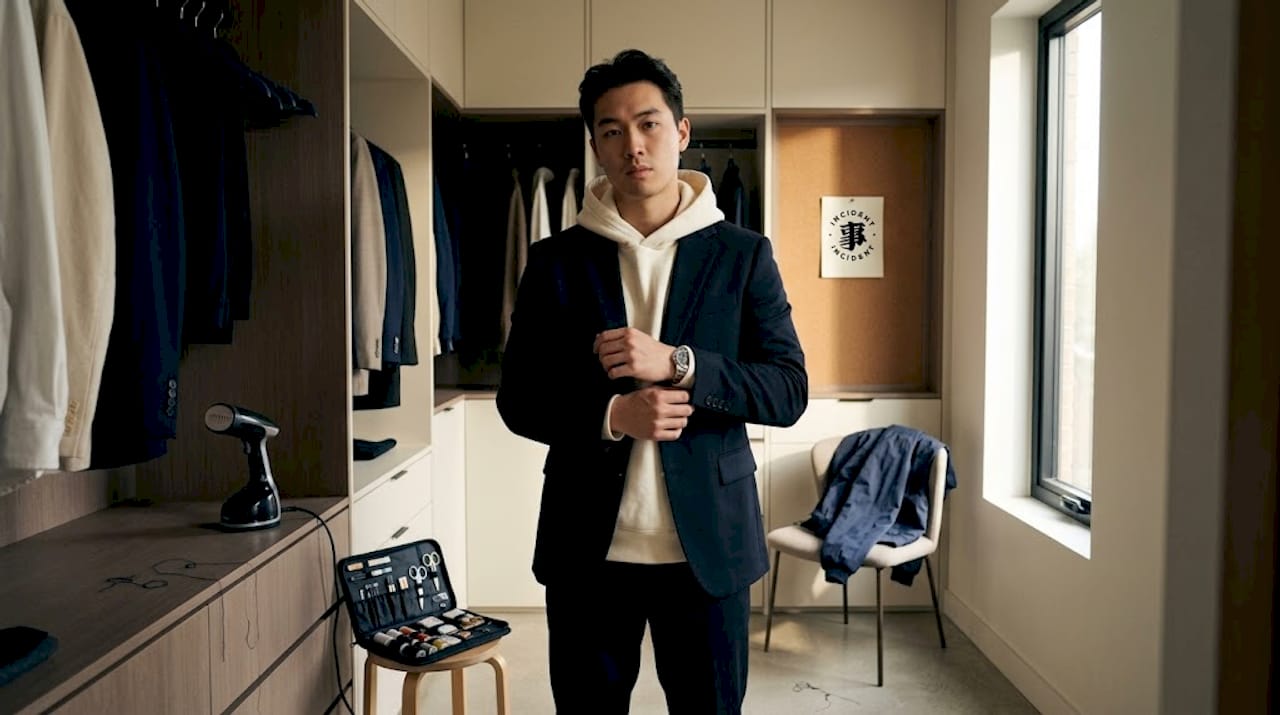
Now that we have established why tailoring is crucial, it is worth breaking down the actual methods and design choices that are making a genuine impact across streetwear collections. The techniques are specific, and understanding them gives you the vocabulary to assess garments with a sharper eye.
Japanese streetwear innovation has been particularly influential here. Japanese designers approach construction with a commitment to modularity and functional detail that sits perfectly alongside streetwear’s practical roots. A jacket with carefully mapped seam lines, a shirt collar engineered for both open and buttoned wear, or a trouser with a structured fall that maintains its shape across a full day of movement: these are tailoring decisions, even when the fabric is cotton canvas rather than worsted wool.
Key tailoring techniques now woven into streetwear design:
- Soft-shoulder construction. Rather than the padded, rigid shoulder of classic suiting, streetwear tailoring uses a natural, deconstructed shoulder that moves freely while still providing shape.
- Half-canvas or patch construction. Chest pieces and interfacing are applied selectively to give the front of a jacket body without stiffness.
- Darting and shaping. Subtle darts at the back of a shirt or jacket create a silhouette that flatters without constraining.
- Precision hem finishing. Blind hemming, overlock seams, and flat-felled construction all extend garment life and improve how a piece sits on the body.
- Waistband engineering. Elasticated waistbands with internal structure allow wide-leg and relaxed trousers to sit properly without slipping.
- Considered seam allowances. Wider seam allowances built into garment construction allow for future alterations, a detail borrowed directly from bespoke tailoring.
The choice of fabric is inseparable from these techniques. Garment durability depends significantly on how fabric and construction interact. A precisely tailored piece in a poor-quality cloth will still fail prematurely. The best streetwear tailoring matches technique with material: dense cotton twills, premium Pima blends, or structured linen all respond well to tailoring methods in ways that cheaper weaves cannot sustain.
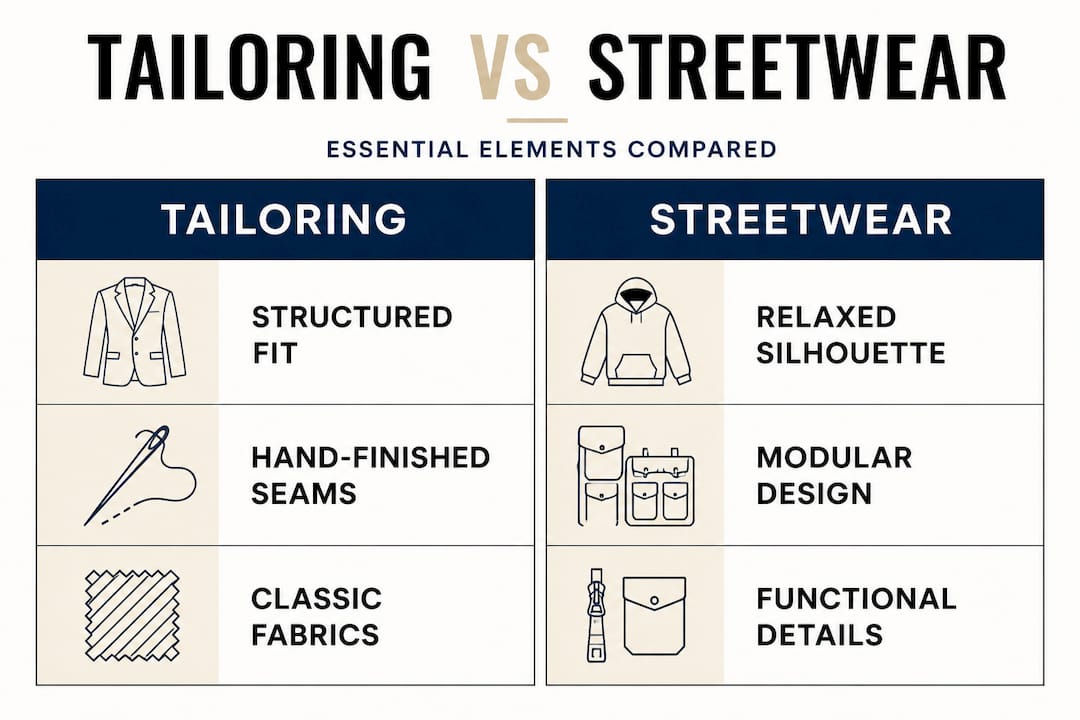
Comparing streetwear tailoring with traditional tailoring:
| Feature | Traditional tailoring | Streetwear tailoring |
|---|---|---|
| Shoulder construction | Padded, structured | Soft, deconstructed |
| Silhouette | Fitted, formal | Relaxed, wide, modular |
| Fabric | Wool, worsted, silk | Cotton, denim, technical weaves |
| Purpose | Occasion dressing | Daily versatility |
| Alteration allowance | Standard | Often built in by design |
| Cultural reference | European atelier | Japanese craft, urban heritage |
Japanese minimalism also brings a design philosophy centred on restraint: removing what is unnecessary rather than adding embellishment. In tailoring terms, this means clean seams, considered proportions, and details that serve a purpose rather than decorating a surface. When applied to streetwear, the result is garments that feel effortless because every element has earned its place.
Pro Tip: When shopping for tailored streetwear, turn the garment inside out before you buy. The quality of internal seam finishing tells you immediately how much care went into its construction. Clean, consistent stitching with ample seam allowance signals a piece worth investing in.
Spotlight: How European and Japanese tailoring inspire streetwear labels
With tailoring techniques defined, it is time to see how leading European and Japanese brands bring these concepts to life through specific design decisions, production philosophies, and cultural values.
Italian craftsmanship has a long tradition of treating the act of making clothes as an art form. Stacy Wear integrates streetwear rebellion with Tuscan tailoring for ethical, customisable pieces, while SPSR.STUDIO offers made-to-fit streetwear tailoring that refuses the binary between casual and formal. What makes these labels compelling is not just the quality of their construction but their values around production. Small runs, local manufacturing, and a commitment to customisation over mass output align perfectly with what a new generation of consumers actually wants.
The Japanese approach operates on different coordinates but arrives at a similar destination. Where Italian tailoring celebrates the hand of the maker, a slight imperfection that proves human touch, Japanese craft often pursues a kind of refined precision that borders on the meditative. Fabric finishes for sustainable apparel play a significant role in Japanese production, with surface treatments chosen to extend garment life and maintain aesthetic integrity over time.
Notable principles shaping these brands:
- Made-to-fit over made-to-measure. Rather than fully bespoke, many brands offer structured sizing with enough internal ease to allow for simple alterations.
- Ethical sourcing as standard. Fabric provenance and production conditions are disclosed, not as marketing copy but as genuine accountability.
- Modularity in design. Pieces are designed to layer, combine, and adapt, extending their usability across seasons and contexts.
- Community as production model. Small-batch releases and direct relationships between maker and wearer replace the anonymity of mass retail.
The contrast with luxury streetwear’s most theatrical expressions is instructive. Demna’s work at Balenciaga and Gucci prioritises cultural provocation and brand mythology over the quiet mechanics of construction. There is genuine artistry in that approach, but it operates through spectacle rather than craft. The brands discussed here take a different position: the garment itself is the statement.
“When the construction is honest, the design does not need to be loud. The piece speaks through how it fits and how long it lasts.”
Strong brand identity in streetwear increasingly draws from this craft-first position. As hype cycles accelerate and then exhaust themselves, labels that build identity around genuine quality and cultural depth find a more durable audience. This is where sustainable streetwear and tailoring naturally converge: both prioritise longevity over novelty.
How key design philosophies compare across regions:
| Philosophy | Italian approach | Japanese approach |
|---|---|---|
| Construction focus | Hand-finishing, visible craft | Precision seaming, clean lines |
| Cultural reference | Artisan heritage, Tuscan tradition | Functionality, wabi-sabi restraint |
| Customisation | Made-to-order batches | Modular, adaptable sizing |
| Sustainability model | Local production, ethical sourcing | Long-wear design, durable finishes |
| Aesthetic outcome | Warmth, tactile richness | Minimalism, considered proportion |
Understanding these distinct philosophies allows you to make more informed choices about what you wear and why, which is precisely the point of tailoring as a practice: to bring consciousness to the act of dressing.
Tailoring as empowerment: Customisation, fit, and garment longevity
After examining how brands use tailoring, the practical impact on wearers deserves equal attention. Tailoring is not just an aesthetic choice. It is a form of agency: the decision to shape your wardrobe around your actual body and values, rather than accepting what mass production offers.
Custom fit changes how you carry yourself. This is not a minor detail. When a jacket sits correctly on your shoulders, when a trouser breaks at precisely the right point above your shoe, the effect is immediate and physical. You stand differently. You move with more ease. The garment stops being something you adjust constantly and becomes something you simply wear. That shift in relationship between wearer and clothing is what tailoring offers at its most fundamental level.
For streetwear trends in 2026, the appetite for personalised, considered clothing continues to grow. Consumers are no longer satisfied by the uniform experience of buying the same garment as thousands of others. Tailoring answers this directly by making each piece specific to its owner.
How to approach getting your streetwear tailored or adjusted:
- Identify the specific fit issue. Is the shoulder too wide? Does the waist need taking in? Clarity about what needs changing helps a tailor work efficiently and accurately.
- Choose a tailor with experience in casual garments. Not all tailors work equally well with denim, heavy canvas, or technical fabrics. Ask about their experience before committing.
- Bring reference images. If you have a specific silhouette in mind, show it. This reduces guesswork and speeds up the fitting process.
- Request a toile or test alteration first. On a complex piece, a tailor may offer to mock up the change before making it permanent. Accept this option whenever possible.
- Ask about seam allowance. If a garment has enough fabric folded into its seams, more ambitious alterations become possible without compromising the structure.
- Consider repairs as maintenance. Reinforcing a stressed seam or replacing a worn lining is not a last resort. It is standard practice in extending a garment’s useful life.
The sustainability argument for tailoring is direct and compelling. Repair services across Europe are growing, with organisations like Sojo and URC in Paris leading a movement that treats alteration and repair as normal, desirable activities rather than signs of poverty or failure. Each repaired garment displaces a new purchase and the carbon and water that production would require.
Understanding streetwear hype through this lens reveals something interesting: the most enduring streetwear pieces are not the ones that generated the biggest release queues but the ones that were built well enough to still be worn years later. Tailoring is one of the forces that makes that possible.
Fabric stretch and structure also affect how well a garment responds to alterations. Woven fabrics with low stretch are generally easier to alter precisely, while technical stretch fabrics require a tailor experienced in their specific properties. This is worth researching before committing to a piece you intend to have altered.
Pro Tip: Before discarding a streetwear piece that no longer fits or has developed a small fault, get a quote from a local tailor. Repairs and alterations often cost a fraction of a replacement and result in a garment that fits better than the original ever did.
A fresh perspective: Why tailoring is streetwear’s true disruptor
Most conversations about disruption in streetwear focus on branding, limited drops, or the cultural currency of a particular logo. These are real forces, but they obscure something more quietly radical: the act of making a garment that fits, lasts, and earns the loyalty of its wearer over years rather than seasons.
Tailoring is that disruption. Not because it is new, but because it runs directly counter to the logic that has driven fashion’s growth for decades. Volume, speed, and disposability built an industry worth trillions. Tailoring proposes the opposite: less volume, slower production, and garments designed to stay. In the context of a fashion system under growing pressure for environmental and ethical accountability, that proposition is genuinely radical.
Most experts covering streetwear culture focus on the external signals: the colourways, the collaborations, the queue outside a flagship. We think this misses where the real shift is happening. The consumer who now waits six weeks for a made-to-order jacket, or who takes a beloved hoodie to a tailor for structural repairs, is expressing a values change that no hype cycle can replicate. That consumer is harder to win but, once won, far more loyal.
The principles of classic streetwear have always contained the seed of this attitude. Authenticity, self-expression, and respect for the communities that birthed the culture were never compatible with throwaway production. Tailoring makes that incompatibility explicit and actionable. It says: this garment is worth making well and keeping.
Personalisation is now core to what makes streetwear relevant. Not the personalisation of adding your name to a mass-produced item, but the deeper personalisation of a garment that has been shaped by and to your body, your preferences, and your history with it. Tailoring, in all its forms, is the mechanism for that.
We believe the next decade of streetwear will be defined not by which brands can generate the most noise, but by which can build garments compelling enough to be cared for, altered, repaired, and passed on. That is the legacy tailoring offers, and it is the foundation on which genuinely meaningful style is built.
Discover elevated streetwear tailoring at INCIDENT
Everything this article has explored, from the craft of construction to the values behind garment longevity, sits at the heart of what we create at INCIDENT. We design with the same precision that tailoring demands, using premium fabrics and clean, intentional lines drawn from both Japanese craft traditions and contemporary European sensibility.
Our Pima collection brings that philosophy into garments built for everyday wear: ultra-soft Pima cotton, considered silhouettes, and construction details that hold their form wash after wash. If you are ready to experience the difference that genuine craft makes to what you wear, explore our full range at incident.store and discover pieces designed not for a season but for the long term.
Frequently asked questions
How does tailoring differ in streetwear versus traditional fashion?
Streetwear tailoring prioritises relaxed fits, modularity, and functional design rather than the strict construction of classic suiting, creating elevated casual looks that move freely between contexts without sacrificing structure.
Is tailoring sustainable for streetwear?
Yes, tailoring meaningfully extends garment lifespan and reduces textile waste, a shift reflected in the growth of repair services like Sojo and URC across European cities.
Which brands excel in streetwear tailoring?
Italian Stacy Wear and SPSR.STUDIO lead the field by combining custom tailoring with urban streetwear sensibility, prioritising ethical production and made-to-fit construction over mass output.
Why is tailoring more popular in streetwear now?
A broad shift away from fast fashion’s poor fit has driven surging demand for tailoring, with wearers seeking crafted, specific garments that reflect genuine personal style rather than uniform mass production.


Share:
How influencer marketing shapes streetwear brands today
Create versatile Japandi outfits: a step-by-step guide