

TL;DR:
- Japandi fashion blends Japanese wabi-sabi with Scandinavian hygge, emphasizing simplicity, natural materials, and balanced silhouettes.
- Building a Japandi wardrobe requires intentional curation of versatile, high-quality basics in neutral tones with textured fabrics.
- Layering with focused attention to proportion, texture, and subtle visual cues creates a cohesive, authentic Japandi streetwear look.
There is a particular frustration in loving the quiet elegance of Japanese and Scandinavian design, yet standing in front of your wardrobe feeling like the look is always just out of reach. Japandi fashion blends Japanese wabi-sabi, the beauty found in imperfection, with Scandinavian hygge, a sense of cosy simplicity, creating a streetwear aesthetic built on natural materials, neutral palettes, and balanced silhouettes. This guide breaks the entire process into clear, actionable steps so you can move from inspiration to a complete, polished outfit with genuine confidence.
Table of Contents
- Essentials for building a Japandi-inspired wardrobe
- Step by step: layering for Japandi streetwear
- Balancing volume and texture for authenticity
- Finishing touches: accessories, footwear and common mistakes
- What most guides miss about Japandi streetwear
- Discover Japandi streetwear pieces at INCIDENT
- Frequently asked questions
Key Takeaways
| Point | Details |
|---|---|
| Curate versatile basics | Start your Japandi wardrobe with high-quality, minimalist essentials for easy layering. |
| Master intentional layering | Layer from base to outerwear using repeated cues for cohesive, balanced streetwear. |
| Balance volume and texture | Combine structured and relaxed pieces using tactile materials rather than bold patterns. |
| Finish with minimalist details | Select understated accessories and footwear to complete your Japandi outfit. |
| Mindful curation beats trends | Prioritise quality and authenticity over quantity to achieve lasting Japandi streetwear style. |
Essentials for building a Japandi-inspired wardrobe
With the Japandi philosophy defined, now explore what wardrobe basics set the foundation for your look. The single most important principle here is intentional curation. A timeless streetwear wardrobe built on Japandi values does not overflow with options. It contains fewer pieces that each earn their place through versatility, quality, and quiet beauty.
The core pieces you actually need
Think of your Japandi wardrobe as a considered collection rather than a revolving door of trends. Each item should be able to work with at least three other pieces already in your rotation. The starting list looks like this:
- Heavyweight cotton or Pima cotton tees in off-white, sand, slate, and charcoal
- Relaxed-fit knits in natural fibres such as merino or lambswool, in muted earth tones
- Wide-leg or tapered denim in raw indigo, washed grey, or deep black
- A structured overshirt in brushed cotton, linen, or lightweight wool
- A chore coat or unlined blazer in natural canvas or organic cotton
- Clean, minimal outerwear such as a quilted liner jacket or a long wool coat
Each category above serves a dual purpose: it functions as a standalone statement and contributes to a layered system. That dual function is what separates a curated capsule from a random collection of clothes. As the Japandi comfort philosophy teaches us, comfort and restraint are not opposites. They are partners in creating style that feels as good to wear as it looks to others.
Fabric and colour: the quiet foundation
Material choice is perhaps the most underrated decision in building a Japandi wardrobe. Linen breathes naturally, ages beautifully, and carries an inherently textural quality that adds depth without effort. Cotton is a reliable constant. Wool provides warmth and structure without synthetic stiffness. These are the fabrics that reward you over time.

The ‘less is more’ principle is central to Japandi: curate fewer high-quality pieces for a genuinely versatile minimalist wardrobe. That is not a limitation. It is a liberation. Colour palette should sit within a narrow band of neutrals, broken only by occasional earthy accents.
| Colour family | Example shades | Best used for |
|---|---|---|
| Warm neutrals | Sand, oat, terracotta | Base layers, knitwear |
| Cool neutrals | Slate, stone, chalk | Mid layers, outerwear |
| Deep anchors | Charcoal, raw indigo, ink | Denim, outer layers |
| Earthy accents | Moss, rust, clay | Accessories, detail pieces |
Minimal accessories with functional design
Accessories in a Japandi wardrobe are chosen for purpose as much as for appearance. A structured tote in waxed cotton, a simple canvas cap, a wooden-beaded bracelet, or a plain leather card holder all carry the same philosophy as your clothing. They should not compete for attention. They should contribute quietly to the whole.
Avoid anything with oversized branding, metallic hardware in excess, or novelty prints. The goal is for your entire silhouette to read as one considered thought, not a collection of individual statements fighting for dominance.
Step by step: layering for Japandi streetwear
With your core wardrobe assembled, it is time to craft and layer your outfit step by step for a distinct Japandi vibe. Layering is where the aesthetic truly comes to life. Done well, it communicates depth, seasonal awareness, and genuine personal style. Done carelessly, it produces bulk and visual noise. The following steps eliminate the guesswork.
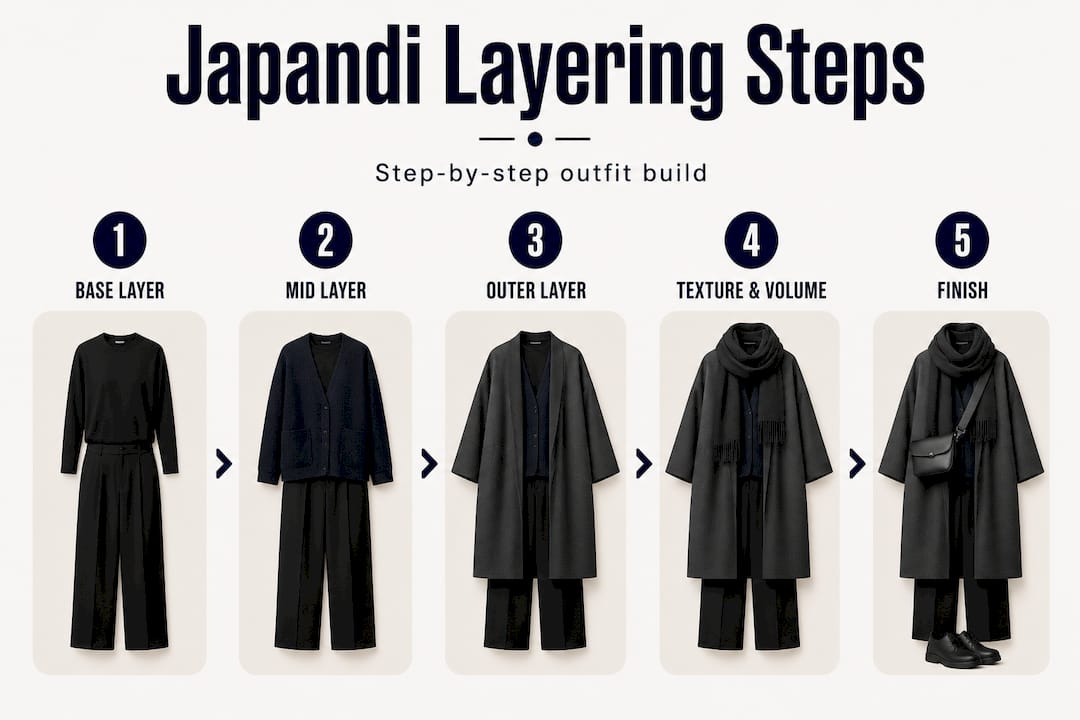
Step 1: choose your base layer
Your base layer sets the tone for everything built on top of it. Select a tee or fitted knit in a neutral tone from your palette. The fit should be relaxed but not oversize. Think of it as the quiet foundation of a building: invisible when complete, but essential to the structure. A heavyweight Pima cotton tee in oat or chalk works exceptionally well because its slight weight gives it a clean drape rather than a flimsy hang.
Consider the neckline carefully. A crew neck keeps things grounded and classic. A mock neck adds a subtle architectural element that reads as intentional and refined. Both are valid. The choice simply shifts the mood slightly toward either casual ease or quiet formality.
Step 2: add the mid layer
The mid layer is where personality enters the equation, though still in a restrained way. An overshirt in brushed cotton, a zipped hoodie in loopback fleece, or a lightweight knit cardigan each bring a different textural note without overwhelming the composition. For transitional layering tips across seasons, the overshirt is arguably the most versatile choice because it functions as a shirt alone in warm months and as a mid layer when temperatures drop.
The mid layer should share at least one visual cue with your base. If your base is in warm sand, your overshirt might be in a similarly warm stone or a deeper oat. The connection does not need to be a perfect match. A tonal relationship is enough to signal intention and coherence.
Step 3: complete with an outer layer
The outer layer anchors the entire outfit. A chore coat in natural canvas, an unlined blazer in a textured wool blend, or a longer structured jacket all carry the structured quality that keeps a Japandi outfit from dissolving into shapelessness. As
Here is a direct comparison to illustrate how intentional layering differs from careless layering:
| Element | Intentional Japandi layering | Careless layering |
|---|---|---|
| Colour relationship | Tonal, with shared undertones | Random, mismatched temperatures |
| Texture | Deliberate contrast or repetition | Accidental clashes |
| Silhouette | Balanced proportions throughout | One oversize item overwhelming others |
| Visual cues | 1 to 2 repeated across all layers | None or too many |
| Result | Cohesive, considered, calm | Busy, bulky, inconsistent |
Pro Tip: When building your three layers, hold each one against the previous before putting it on. Ask whether they share at least one quality: tone, texture, or weight. If none of the three qualities connect, one of the pieces is wrong for this outfit.
Footwear also plays a layering role, even if it sits outside the traditional three-tier system. Streetwear styling elements that ground a Japandi outfit often involve clean-lined sneakers in white, grey, or natural leather, or minimalist boots in suede or matte leather. The shoe should feel like a continuation of the outfit, not a departure from it.
Balancing volume and texture for authenticity
Now that you have layered with intent, refine your look with nuanced volume and tactile contrasts for true Japandi authenticity. This is the stage where many Japandi-adjacent outfits fall short. They get the colours right and the layers roughly correct, but they miss the subtle interplay between form and feel that gives the aesthetic its real power.
Volume: the art of proportion
Volume in Japandi streetwear is not about choosing oversize or fitted. It is about choosing deliberately and ensuring each piece relates to the others in a proportional conversation. A wide-leg trouser pairs naturally with a fitted base and a slightly boxy outer layer. A tapered trouser creates a different line, leaning into a cleaner, more architectural silhouette. Neither is more correct. Both require that you consider the full picture.
Versatile streetwear advice consistently points to the same truth: balance volume to avoid shapelessness by using texture over patterns and grounding the look with one strong Japanese-influenced focal piece alongside modern, clean basics. An outfit where everything is oversize reads as unfinished. An outfit where everything is fitted can feel too stiff for streetwear. The balance between the two creates something alive and considered.
Texture: the substitute for pattern
In a palette as restrained as Japandi, texture carries the entire decorative load. A sashiko-stitched fabric, a slubby linen surface, a brushed-fleece mid layer, a matte canvas outer: each of these adds visual and tactile complexity without breaking the colour discipline that defines the aesthetic. This is a critical insight. You do not need prints or patterns to make an outfit interesting. You need a thoughtful sequence of surfaces.
“Texture in Japandi streetwear is the quiet conversation between fabrics. When each layer speaks a slightly different material language, the outfit breathes, and the eye moves naturally from one surface to the next without being startled.”
The practical approach is to vary surface qualities across your layers. If your base is smooth cotton, let your mid layer be brushed or knit. If your mid is textural, your outer might return to a smoother canvas. Alternating between smooth and tactile surfaces maintains rhythm without chaos. Pairing Japanese style with denim is a perfect illustration: the structured, indigo surface of quality denim creates an anchor that plays well against the softer textures of cotton knits and linen overshirts.
The focal piece
Every strong Japandi outfit has one piece that speaks most clearly to the Japanese design influence. It might be a kimono-cut jacket in natural linen, a structured chore coat with traditional button detailing, or a loose haori-style overshirt. This piece does not need to be showy. In fact, the best examples are so well-designed that they read as modern while carrying clear cultural heritage. Place this piece as your outer or mid layer, then build the rest of the outfit in clean, quiet neutrals that allow it to breathe.
Pro Tip: Try tonal layering, where every piece sits within one to two shades of each other, for a look that feels effortlessly sophisticated. A full tonal outfit in charcoal, dark slate, and ink with varied textures reads as deeply intentional and remarkably modern.
Finishing touches: accessories, footwear and common mistakes
Complete your Japandi look with careful finishing choices and awareness of typical mistakes, so your outfit always feels intentional and polished. The final ten percent of an outfit often determines whether it reads as considered or accidental. These details matter far more than most guides acknowledge.
Accessories that serve the look
Japandi accessories are understated by design. They contribute without demanding. A small leather satchel in tan or dark brown, a wool beanie in charcoal or slate, a simple ceramic-beaded bracelet, a plain canvas tote: all of these reinforce the aesthetic without competing with it. The number of accessories also matters. One or two is usually enough. Three or more risks shifting the register from minimalist to cluttered.
Key principles for Japandi accessory selection:
- Choose natural materials: leather, canvas, wool, wood, ceramic
- Stick to the established colour palette: no sudden introduction of bright or contrasting tones
- Prioritise function: a bag should carry what you need, not simply exist for its logo
- Avoid visible branding where possible: the garment or accessory should speak through its form, not its label
- Scale matters: an oversize bag with a minimal outfit overwhelms; a compact bag preserves the proportional balance
For men’s streetwear essentials within a Japandi framework, a slim wallet, a clean-lined watch with a leather strap, and a structured cap or beanie cover virtually every scenario. For women’s Japandi inspiration, a minimal tote, simple stud earrings in wood or silver, and a wrap or scarf in a tonal neutral complete the picture with elegance.
Footwear: the grounding element
The wabi-sabi principle of finding beauty in natural simplicity translates directly to footwear. Clean-lined sneakers, unadorned leather derbies, minimal suede boots, or classic canvas shoes all work within the Japandi register. What to avoid: chunky platform soles in bold colours, heavily branded trainers with competing graphics, or novelty footwear that breaks the visual quiet of the outfit. Footwear with natural leather ageing, subtle sole detailing, or soft suede nap adds texture and authenticity without loud statement.
Common mistakes and how to avoid them
Even with the right pieces in place, certain patterns of error appear consistently:
- Over-layering: three layers is the structural limit for most Japandi outfits. A fourth layer almost always collapses the proportional balance.
- Clashing material temperatures: mixing cool synthetic fabrics with warm natural ones creates a jarring quality that undermines the aesthetic.
- Introducing one loud pattern: a single graphic tee or bold-print overshirt can undo the entire tonal composition of an otherwise strong outfit.
- Ignoring fit at the shoulders: in minimalist dressing, shoulder fit is everything. An outer layer that pulls or drops incorrectly reads as ill-considered, regardless of its quality.
- Forgetting the bottom half: many people assemble a strong upper half and default to whatever trousers are nearby. The trouser is part of the composition. It deserves the same consideration as the layers above it.
Pro Tip: Before you leave home, step back and look at your full outfit in a mirror. Ask one question: does every element feel like it was chosen, or does something feel like it happened by default? If anything feels like a default, replace it or remove it.
What most guides miss about Japandi streetwear
Most style guides approach Japandi as a visual exercise. They show you the colours, name the silhouettes, and hand you a shopping list. What they rarely address is the deeper reason why this aesthetic resonates so strongly with people who are drawn to it. The Japandi approach is not merely an aesthetic. It is a posture toward the act of dressing itself.
When you commit to the ‘less is more’ curation that defines Japandi streetwear, you are making a decision about how you want to engage with clothing. You are choosing depth over breadth. You are saying that you would rather know your wardrobe deeply than navigate it constantly. That shift is not just practical. It is genuinely clarifying.
Here is the uncomfortable truth that most style content avoids: the majority of people who struggle with minimalist dressing do not have a taste problem. They have a volume problem. They own too many pieces that are almost right. Each one was purchased with good intentions. Together, they create noise rather than coherence. The solution is not to buy more thoughtfully chosen pieces on top of an already crowded wardrobe. It is to reduce, to commit, and to sit with fewer options until those options become genuinely fluent.
The Japanese streetwear innovation that informs Japandi aesthetics has always prioritised craft, intention, and longevity over novelty. The garments that carry this tradition are not designed to be replaced every season. They are designed to grow with you, to age honestly, and to reward continued wear. That is a profoundly different relationship with clothing than the one promoted by fast-fashion culture.
We also want to challenge the idea that Japandi streetwear is inherently serious or austere. Done well, it carries a quiet warmth. The fabrics are soft. The fits are comfortable. The palette is calming. Wearing a well-chosen Japandi outfit should feel like arriving somewhere rather than performing something. The confidence it generates is not the confidence of being noticed. It is the confidence of knowing exactly who you are and what you stand for, expressed through what you chose to put on your body that morning. That is a rare and valuable thing.
Discover Japandi streetwear pieces at INCIDENT
If this guide has clarified your direction, the next step is finding pieces that can truly carry the philosophy forward. At INCIDENT, we design precisely for the wardrobe described here: premium, minimal, Japanese-inspired, and built to last well beyond any single season.

Our Pima T-shirt collection is a particularly strong starting point for anyone building or refining a Japandi capsule wardrobe. Crafted from ultra-soft Peruvian Pima cotton, each tee offers the clean drape, natural comfort, and quiet luxury that Japandi layering demands. Beyond our Pima basics, you will find considered outerwear, structured overshirts, and thoughtfully designed essentials, all shaped by a Japandi-influenced design philosophy. Visit us at incident.store to explore the full collection and find the pieces that will genuinely earn their place in your wardrobe.
Frequently asked questions
What are the best base layers for Japandi streetwear?
High-quality tees or knits in neutral colours and natural fabrics such as cotton or linen make ideal base layers, reflecting the wabi-sabi and hygge principles of functional simplicity and sensory comfort that define the aesthetic.
How can I avoid my Japandi outfit looking shapeless?
Mix structured outer pieces with more relaxed mid and base layers, and use textured fabrics like sashiko or linen to add visual depth rather than relying on bold patterns, which disrupt the calm visual register of the style.
Can Japandi streetwear work for both men and women?
Yes, Japandi streetwear is inherently gender-neutral, built on universal principles of proportion, natural materials, and restrained colour, and the ‘less is more’ philosophy applies equally regardless of how you dress.
What is the most important element for a cohesive Japandi outfit?
Repeating one or two visual cues such as colour temperature or surface texture across all layers is the single most effective way to achieve a unified look, as intentional layering confirms through the base, mid, and outer framework.


Share:
How tailoring shapes streetwear: elevating urban style
Fold streetwear efficiently: Minimalist techniques for flawless storage