

TL;DR:
- Vintage skatewear consists of clothing produced during skateboarding’s peak years, featuring era-specific graphics and functional silhouettes. Authentic pieces from the 1980s and 1990s carry cultural significance, identifiable through construction signals, brand logos, and print techniques. Proper styling respects original proportions and sourcing from reputable retailers ensures genuine, well-preserved items.
Vintage skatewear is the apparel and style born from skateboarding’s formative decades, defined by iconic era-specific graphics, loose functional silhouettes, and the unmistakable visual language of brands like Powell Peralta, Santa Cruz, and Thrasher. The 1980s and 1990s produced the garments now considered the gold standard of retro skate clothing: screen-printed graphic tees featuring Powell Peralta’s ‘The Ripper’ artwork from 1983 and the ‘Winged Ripper’ from 1986, baggy cargo trousers, and high-top skate shoes that carried the weight of an entire subculture. For fashion-conscious individuals aged 18 to 35, these pieces represent far more than nostalgia. They are wearable artefacts of a movement that permanently shaped global streetwear culture, and understanding them properly changes how you shop, style, and appreciate them.
1. What defines vintage skatewear as a distinct style category
Vintage skatewear occupies a specific position within retro clothing culture. It is not simply old clothing associated with skateboarding. It refers to garments produced during skateboarding’s commercial and cultural peak, roughly 1978 to 1999, that carry the authentic construction, graphics, and brand identity of that era. The term “skate apparel” is the recognised industry vocabulary, but “vintage skatewear” has become the accepted shorthand among collectors, resellers, and fashion enthusiasts alike.
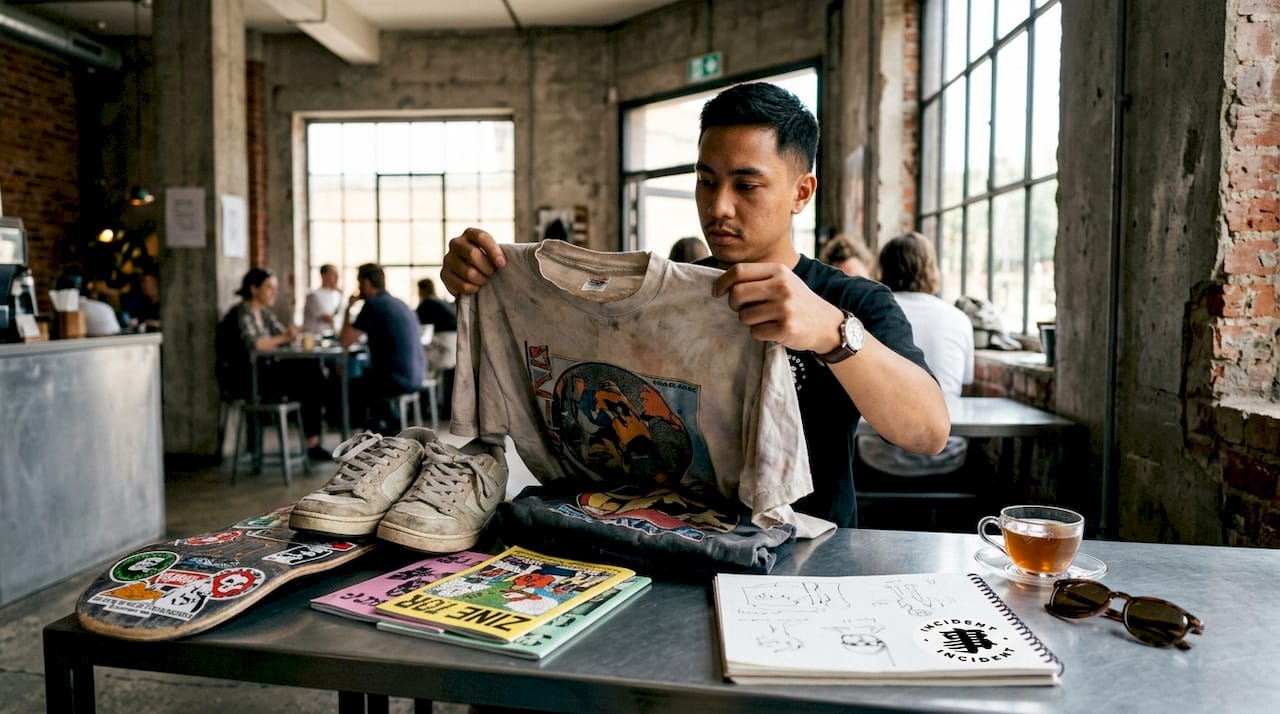
The style is characterised by three non-negotiable elements: graphic-led design, functional loose fit, and era-specific construction. A genuine piece from this period communicates its origins through every detail, from the weight of the cotton to the method used to apply the print. Understanding these elements is what separates a knowledgeable collector from someone who simply likes the aesthetic.
The cultural significance of these garments extends well beyond skateboarding. Vintage skate pieces fed directly into the development of 1990s streetwear, influencing brands and designers who would go on to shape global fashion. Recognising that lineage gives old school skate fashion a credibility that purely trend-driven clothing rarely achieves.
2. The defining features of 1980s skate wear
The 1980s produced the most visually distinctive era in skate fashion history. 1980s skate style is characterised by bright colours, bold graphic tees, loose-fitting trousers or shorts, and high-top sneakers designed for board control and impact absorption.
Key features of the decade include:
- Graphic tees with large front or back prints: Powell Peralta, Santa Cruz, and Vision Skateboards produced some of the most recognisable artwork in fashion history, with skeletal figures, screaming hands, and surrealist imagery printed in vivid, high-contrast colours.
- Loose trousers and shorts: Fit was dictated by function. Skaters needed freedom of movement, which produced the relaxed silhouettes now central to nostalgic skate fashion.
- Vans Sk8-Hi and similar high-tops: The ankle support and flat sole of the Vans Sk8-Hi made it the defining skate shoe of the decade, and it remains the most era-accurate footwear choice for recreating an 80s skate look.
- Bright colour palettes: Neon accents, contrasting panels, and saturated primaries were standard. The visual loudness of 80s skatewear was deliberate, reflecting the decade’s broader aesthetic confidence.
- DIY customisation: Skaters frequently cut sleeves, added patches, or hand-painted boards and clothing. This DIY spirit is a core part of the era’s visual identity and adds authenticity to any vintage-inspired outfit.
Pro Tip: When sourcing genuine 1980s pieces, prioritise garments with single-stitch hem construction. Single-stitch finishing was the industry standard before the mid-1990s, making it one of the most reliable indicators of authentic era production.
3. The defining features of 1990s skate fashion
The 1990s shifted the aesthetic considerably. 1990s skate fashion moved away from the bright, graphic-heavy energy of the previous decade toward darker colour palettes, heavier fabrics, and even more exaggerated proportions. Baggy cargo trousers with multiple pockets became the signature silhouette, paired with oversized tees that often fell to mid-thigh.
Durable, practical fabrics replaced the lighter cotton of 80s tees. Brands like Etnies, DC Shoes, and éS Footwear produced chunky, heavily padded skate shoes that defined the decade’s footwear aesthetic. The overall look was deliberately anti-fashion, which paradoxically made it one of the most influential style movements of the era.
The 1990s also saw the rise of skate-specific brands producing complete lifestyle wardrobes rather than just tees and shoes. Companies like World Industries, Girl Skateboards, and Blind Skateboards created apparel lines that extended the graphic identity of their decks onto clothing. These pieces are now among the most sought-after in the vintage skate accessories market.
Colour restraint was a defining shift. Where the 80s celebrated brightness, the 90s favoured blacks, greys, and earthy tones, punctuated by bold logo graphics rather than full illustrative prints. This contrast makes it straightforward to date a piece by its palette alone.
4. How to authenticate vintage skatewear: essential signals and checks
Authenticating vintage skatewear requires treating each garment as an evidence set rather than judging it on a single feature. A multi-signal authentication approach examines hem construction, tag era, fabric weight, print method, and copyright markings together to build a reliable picture of a garment’s origins.
Follow this verification sequence:
- Check the hem construction first. Single-stitch hems indicate pre-1995 production. Double-stitch hems became standard from the mid-1990s onward. A garment claiming to be from 1988 with a double-stitch hem is immediately suspect.
- Examine the tag and label. Era-specific tags from manufacturers like Fruit of the Loom, Screen Stars, and Hanes carry distinct fonts, logo styles, and country-of-origin markings that changed decade by decade. Era-specific tags and stitching styles are among the most reliable authentication signals available.
- Assess the print method and condition. Authentic screen-printed plastisol develops natural micro-cracking that follows the fabric’s stress lines after years of wear and washing. Reproduction prints often show uniform or artificially applied cracking that does not correspond to actual fabric movement.
- Evaluate the fabric weight and hand feel. Genuine vintage cotton from the 1980s and early 1990s has a distinct weight and texture. Modern reproductions typically use lighter, softer cotton blends that feel noticeably different to the touch.
- Look for copyright markings and graphic accuracy. Authentic pieces carry copyright dates and brand marks consistent with the graphic’s known production period. A ‘Ripper’ tee without the correct copyright year is a significant red flag.
- Identify red flags immediately. Tag-to-graphic mismatches, artificially uniform fading, and overly clean graphics on supposedly aged garments all indicate reproduction rather than genuine vintage.
Pro Tip: Collectors prioritise era-correct blanks and print methods. A mismatch between the blank manufacturer and the graphic’s known production period can invalidate a piece’s resale value entirely, even if the graphic itself appears authentic.
| Authentication signal | What to look for |
|---|---|
| Hem construction | Single-stitch for pre-1995; double-stitch for mid-90s onward |
| Tag and label | Era-specific fonts, country of origin, manufacturer markings |
| Print cracking | Natural stress-line cracking, not uniform or artificial patterns |
| Fabric weight | Heavier cotton typical of 80s and early 90s production |
| Copyright markings | Date and brand marks consistent with graphic’s known era |
5. What role iconic skate brands and media play in vintage culture
The collectibility of vintage skatewear is inseparable from the brands and media that created it. Thrasher magazine’s launch in 1981 established the visual and cultural vocabulary of skate fashion, turning logos into high-signal markers of authenticity and subcultural belonging. Wearing a Thrasher tee in 1984 communicated something specific about who you were and where you spent your time. That communicative power is precisely why these logos retain such cultural weight today.
The brands that shaped this era each brought a distinct visual identity:
- Powell Peralta produced the most iconic graphics in skate history, with artist Vernon Courtlandt Johnson creating imagery that merged fine art sensibility with subcultural energy. The Ripper, the Skull and Sword, and the Ray Rodriguez Skull and Sword are now as recognisable as any luxury fashion house logo.
- Santa Cruz Skateboards contributed the Screaming Hand, designed by Jim Phillips in 1985, which became one of the most reproduced graphics in streetwear history and remains a definitive symbol of classic skate style.
- Vision Skateboards brought a more psychedelic, art-forward aesthetic that distinguished it from the harder-edged imagery of its competitors. Vision pieces are particularly prized by collectors for their relative scarcity.
- Thrasher transcended its origins as a magazine to become a lifestyle brand whose flame logo functions as cultural shorthand for skate authenticity across generations.
The connection between skate media and skateboard apparel trends is direct and documented. Thrasher’s editorial coverage of professional skaters wearing specific brands created demand that shaped what companies produced. This feedback loop between media representation and consumer desire is why certain logos carry more cultural weight than others, and why brand identity elevates specific items above generic vintage clothing in terms of both desirability and value.
Understanding the cultural roots of streetwear makes it clear that skate brands were not simply clothing manufacturers. They were cultural institutions whose visual output defined a generation’s self-expression.
6. How to style vintage skatewear today for an authentic look
Styling vintage skatewear correctly means respecting the original proportions and functional logic of the garments, not simply applying vintage graphics to modern slim-fit silhouettes. Authentic vintage styling requires adopting the loose, functional silhouettes of the era rather than treating graphic tees as interchangeable with contemporary fitted styles.
Practical guidance for building an authentic look:
- Prioritise silhouette over graphics. A genuine 80s Powell Peralta tee worn with slim trousers reads as costume rather than style. Pair it with relaxed, straight-leg trousers or wide-leg cargo trousers to honour the original proportions. Understanding streetwear silhouettes is the foundation of getting this right.
- Choose era-correct footwear. Vans Sk8-Hi or Era for 80s looks; chunky, low-profile skate shoes for 90s references. Footwear is the single most powerful signal of era accuracy in a vintage skate outfit.
- Mix vintage graphics with considered modern pieces. A genuine vintage Santa Cruz tee works well with contemporary wide-leg trousers in a neutral colour. The key is letting the vintage piece lead and keeping surrounding garments understated.
- Incorporate accessories with intention. Beanies, snapback caps, and canvas belts were standard accessories in both decades. Adding one or two era-accurate accessories strengthens the overall reference without tipping into fancy dress.
- Embrace the DIY aesthetic selectively. Visible repairs, patches, and customisation were authentic expressions of skate culture. Incorporating these elements deliberately, rather than artificially distressing new pieces, adds genuine character to an outfit.
- Study original source material. Thrasher magazine archives, Powell Peralta’s original catalogues, and early skate video footage provide the most accurate reference for how these garments were actually worn. Styling guides and lookbooks are useful, but primary sources are irreplaceable.
For those looking to integrate vintage skate references into a broader streetwear wardrobe, guidance on styling oversized pieces provides a practical framework for balancing proportion and proportion across an outfit.
7. Where to source authentic vintage skatewear pieces
Sourcing genuine vintage skatewear requires knowing where authentic pieces surface and what to expect in terms of condition and pricing. Charity shops and car boot sales occasionally yield genuine finds, but the most reliable sources for authenticated pieces are specialist vintage retailers, dedicated online platforms, and estate sales in regions with strong skate histories.
Depop, Grailed, and eBay remain the largest online marketplaces for vintage skate clothing, with Grailed offering the most rigorous seller verification for higher-value pieces. Specialist vintage stores in cities like Los Angeles, Tokyo, London, and Berlin carry curated selections with provenance documentation. Tokyo’s vintage market is particularly significant: Japanese collectors have preserved 1980s and 1990s American skate clothing with exceptional care, and pieces sourced from Japanese vintage shops frequently arrive in better condition than those found in their country of origin.
Pricing reflects both rarity and cultural significance. A genuine Powell Peralta ‘Ripper’ tee in excellent condition commands significantly more than a generic 1990s skate brand tee, because the graphic carries documented cultural weight. Understanding brand hierarchy within vintage skatewear prevents overpaying for lesser pieces and underpaying for genuinely significant ones.
Condition grading matters enormously. Vintage collectors use a scale from “deadstock” (unworn with original tags) through “excellent” and “good” to “distressed.” For wearable pieces, “good” condition with natural fading and minor wear is often preferable to artificially preserved pieces that feel museum-like rather than lived-in.
Key takeaways
Vintage skatewear is authenticated through construction signals, cultural brand knowledge, and era-accurate styling rather than graphics alone.
| Point | Details |
|---|---|
| Authentication is multi-signal | Check hem, tag, print cracking, fabric weight, and copyright marks together. |
| Era defines silhouette | 1980s favours bright, loose fits; 1990s shifts to darker, baggier proportions. |
| Brand identity drives value | Powell Peralta, Santa Cruz, and Thrasher graphics carry the highest cultural and resale significance. |
| Styling requires proportion | Vintage graphics worn with modern slim fits lose their era accuracy and cultural coherence. |
| Sourcing rewards knowledge | Japanese vintage markets and specialist retailers offer the best-preserved authentic pieces. |
Why vintage skatewear still speaks to us at Incident
What strikes us most about vintage skatewear is how little of its appeal is actually about nostalgia. The people wearing Powell Peralta tees and 90s cargo trousers today were not alive when those garments were first produced. What draws them in is something more fundamental: the conviction that these pieces carry. Every graphic, every construction detail, every worn hem tells you that someone made a deliberate choice. There was no algorithm involved, no trend forecasting committee. A skater needed a tee that could survive a session, and a brand put its most arresting artwork on it. That directness is rare in contemporary fashion.
We have spent considerable time studying how authentic vintage pieces communicate their origins, and the lesson we keep returning to is that quality and intention are always legible. You can feel the difference between a garment made with care and one produced to approximate the look of care. This is precisely why we approach our own collections at Incident the way we do: premium fabrics, considered construction, and graphic identity rooted in genuine cultural reference rather than surface-level trend adoption.
The cyclical nature of style trends is well documented, but vintage skatewear’s current prominence feels different from a standard revival. It is being adopted by a generation that has done the research, that knows the difference between a single-stitch Screen Stars blank and a modern reproduction, and that cares about the story behind what they wear. That level of engagement with clothing history is something we find genuinely admirable. It reflects a broader shift toward intentional consumption that aligns closely with the values we build into every Incident piece.
— Incident
Discover authentic streetwear at Incident
At Incident, we design garments for people who understand that clothing carries meaning. Our Japanese-inspired streetwear collections share the same commitment to considered construction and graphic integrity that defines the best vintage skate pieces. From premium oversized tees with bold graphic prints to carefully crafted hoodies built for longevity, every piece in our range is made to be worn with conviction. If you appreciate the heritage and craft behind old school skate fashion and want contemporary pieces that honour that tradition without imitating it, explore the full collection at Incident Store. Quality you can feel, identity you can wear.
FAQ
What is vintage skatewear exactly?
Vintage skatewear refers to skate apparel produced during skateboarding’s formative commercial era, roughly 1978 to 1999, characterised by era-specific graphics, loose functional silhouettes, and authentic construction from brands like Powell Peralta, Santa Cruz, and Thrasher.
How do I spot a fake vintage skate tee?
Examine the hem construction, tag era, print cracking pattern, and fabric weight together. Authentic vintage tees show natural micro-cracking along fabric stress lines, single-stitch hems on pre-1995 pieces, and era-correct manufacturer tags.
Which vintage skate brands are most collectible?
Powell Peralta, Santa Cruz, and Thrasher are the most culturally significant and collectible brands in vintage skatewear. Their graphics carry documented historical importance and command the highest resale values among collectors.
How should I style vintage skate pieces today?
Respect the original proportions by pairing graphic tees with relaxed or wide-leg trousers rather than slim-fit styles. Era-correct footwear such as Vans Sk8-Hi for 80s references completes the look and signals genuine understanding of the aesthetic.
Where is the best place to buy authentic vintage skatewear?
Specialist vintage retailers, Grailed, and Japanese vintage shops offer the most reliably authenticated pieces. Japanese collectors have preserved 1980s and 1990s American skate clothing with exceptional care, making Tokyo-sourced pieces particularly desirable for condition and authenticity.

Share:
Otaku clothing: the 2026 guide to authentic anime style
Manga inspired fashion: your 2026 style guide