

TL;DR:
- Influencer marketing drives rapid streetwear sales by building community trust and authenticity.
- Micro-influencers often deliver higher engagement and trust than macro-influencers in niche streetwear.
- Long-term, authentic relationships with trusted voices sustain brand relevance and loyalty.
When AMA Studios launched its debut collection, €1.2 million sold in under sixty minutes, driven almost entirely by influencer marketing. No legacy advertising spend. No billboard campaigns. Just the right voices, speaking to the right communities, at exactly the right moment. This result is not a fluke; it reflects a fundamental shift in how streetwear brands build relevance and revenue. For those of us drawn to Japanese minimalism and authentic craftsmanship, understanding these dynamics is essential to appreciating which brands are worth your loyalty, and why.
Table of Contents
- Why influencer marketing drives streetwear success
- Types of influencers in streetwear: macro vs. micro impact
- How streetwear brands choose and activate influencers
- Risks and pitfalls: what to watch for with influencer marketing
- The ROI of influencer campaigns for streetwear brands
- Rethinking influence: what most streetwear brands get wrong
- Take your style further with authentic streetwear
- Frequently asked questions
Key Takeaways
| Point | Details |
|---|---|
| Influencer impact is measurable | Influencer marketing can directly drive outsized sales and rapid awareness for streetwear brands. |
| Authenticity beats hype | Trust and relevance matter more than raw follower numbers or celebrity status in fashion marketing. |
| Micro-influencers excel | Using niche voices often yields better engagement and brand loyalty, especially for Japanese streetwear. |
| Quality partnerships reduce risk | Carefully choosing the right influencers helps brands avoid greenwashing and inauthentic campaigns. |
| Short-form video drives results | Platforms like TikTok and Instagram enable brands to double campaign engagement with creative, brief content. |
Why influencer marketing drives streetwear success
Streetwear and influencer culture grew up together. From the early days of skate videos and hip-hop lookbooks to today’s short-form content ecosystems, the genre has always relied on trusted voices within tight-knit communities. What has changed is the scale, sophistication, and measurability of those relationships.
The business case is clear. Streetwear brands allocate 20% of their total marketing budget to influencer campaigns, a figure that outpaces many other fashion segments. That level of investment reflects a simple truth: influencer marketing works in ways that traditional advertising cannot. When a credible figure within your community wears a piece and speaks genuinely about it, the message carries weight that no paid placement can replicate.
Understanding the streetwear origins and evolution of this genre helps explain why authenticity is so central. Streetwear was never built on glossy editorial spreads. It was built on community trust, scarcity, and the feeling that wearing the right piece placed you within something meaningful. Influencers who embody that sensibility do not simply advertise products. They affirm belonging.
What makes influencer marketing particularly powerful in the streetwear space is the credibility transfer that happens organically. When a well-respected creator is genuinely enthusiastic about a brand, their audience perceives it as a recommendation from a peer rather than a pitch from a company. That distinction matters enormously to buyers aged 18 to 35, who have grown up navigating digital advertising and developed a sharp instinct for what feels genuine versus manufactured.
Several qualities define the most effective streetwear influencer partnerships:
- Deep community alignment: The influencer’s aesthetic genuinely reflects the brand’s values, not just their follower count
- Consistent stylistic identity: Partners who maintain a coherent personal brand create more memorable associations
- Transparent communication: Followers increasingly expect honest disclosure, and campaigns that honour this build lasting trust
- Cultural fluency: Particularly relevant for Japanese-inspired labels, where misrepresenting heritage or aesthetics can damage credibility immediately
“Audiences can detect inauthenticity within seconds. In streetwear, credibility is the currency, and it cannot be manufactured.”
Furthermore, micro-influencers deliver engagement rates of between 2.5 and 5 percent, outperforming macro-influencers in fashion by a significant margin. This tells us something important: reach alone does not create results. Depth of connection does.
Types of influencers in streetwear: macro vs. micro impact
The influencer spectrum in streetwear spans an enormous range, from global celebrities with tens of millions of followers to niche creators whose audiences number in the thousands. Each tier plays a distinct role, and the most sophisticated brands know precisely when to deploy each one.
Macro-influencers, those with audiences above 100,000, provide unmatched visibility. A single post from a prominent creator can introduce a brand to millions of potential customers in hours. BAPE’s collaboration with Kai Cenat illustrates this beautifully. By aligning with a figure who bridges streetwear culture and entertainment, BAPE blended streetwear with entertainment in a way that felt both current and culturally coherent. The campaign generated enormous awareness quickly.
However, raw awareness rarely converts to the deep loyalty that sustains a brand long-term. This is where micro-influencers become indispensable. Creators with between 1,000 and 50,000 followers typically foster tight, engaged communities where their word carries genuine authority. For Japanese streetwear innovation specifically, this intimacy is valuable because the aesthetic itself rewards discernment over spectacle.
Brands like Atmos have built their reputation in part through partnerships with creators who live and breathe the culture rather than simply inhabit it for a campaign cycle. The result is content that feels earned, and audiences that remain loyal well beyond a single drop.
Here is how the two tiers compare in practical terms:
| Factor | Macro-influencers | Micro-influencers |
|---|---|---|
| Audience size | 100k to millions | 1k to 50k |
| Engagement rate | 0.5 to 1.5% | 2.5 to 5% |
| Cost per post | High | Low to moderate |
| Trust and authenticity | Variable | High |
| Best for | Launch awareness | Community conversion |
| Cultural fit | Harder to ensure | Easier to verify |
Pro Tip: For Japanese-inspired or minimalist streetwear labels, prioritise micro-influencers whose personal style already mirrors your design philosophy. A post from someone who genuinely wears clean lines and premium basics will always outperform a paid placement from a creator whose content clashes with your aesthetic.
When choosing the right partner for your brand, consider working through this sequence:
- Define the specific community you want to reach, not just demographically, but culturally and aesthetically
- Audit potential partners’ past content for genuine alignment with your values and visual identity
- Evaluate engagement quality, not just quantity. Are followers asking genuine questions? Sharing the content?
- Assess the creator’s history with disclosure and brand partnerships. Transparency is a positive signal
- Start with a small, well-defined collaboration and measure results before scaling
Understanding brand identity in streetwear is foundational here. Without a clear identity, even the best influencer partnership will feel directionless.
How streetwear brands choose and activate influencers
The process of selecting and activating influencer partners has become far more rigorous than it was even five years ago. Leading brands, particularly those rooted in Japanese streetwear culture, now treat influencer selection as a data-informed, values-led discipline rather than a popularity contest.
Atmos uses data-driven influencer selection to identify creators with authentic connections to their target audience. Rather than simply looking at follower counts, Atmos analyses audience demographics, engagement patterns, content quality, and cultural alignment. This approach reduces wasted spend and increases the likelihood that a campaign resonates meaningfully with the people who actually matter to the brand.

Platform selection is equally important. Short-form video content on platforms like TikTok and Instagram Reels has fundamentally changed how streetwear is discovered and desired. The immediacy of video, combined with the algorithmic reach of these platforms, creates conditions where a well-executed campaign can spread far beyond a creator’s existing audience. Understanding Japanese streetwear hype mechanics means recognising that a single genuinely captivating video can do the work of dozens of static posts.
The collaboration formats that perform best in streetwear tend to share a few characteristics:
- Limited edition co-creations: When an influencer co-designs or curates a capsule, their audience becomes invested in the product’s success, not just aware of it
- Live stream drops: Real-time urgency creates genuine excitement, especially when the influencer is visibly enthusiastic and knowledgeable
- Experiential content: Behind-the-scenes access to a brand’s craft process, production ethos, or design philosophy creates content that is both compelling and credibility-building
- Sustained storytelling: A series of posts over several weeks, each revealing a different facet of the product or brand, builds anticipation more effectively than a single announcement
Here is how campaign metrics typically break down across different collaboration styles:
| Collaboration type | Engagement lift | Conversion rate | Brand recall |
|---|---|---|---|
| Limited edition drop | High | High | Very high |
| Live stream event | Very high | Moderate | High |
| Ongoing ambassadorship | Moderate | High | Very high |
| Single sponsored post | Low | Low to moderate | Moderate |
Pro Tip: When building a campaign brief, give your influencer partner genuine creative latitude within clear aesthetic parameters. Over-scripted content reads as inauthentic. The best results come when a creator speaks in their own voice about something they actually value.
Following streetwear trends guide insights can sharpen your ability to identify which campaign formats align with current audience behaviour and platform dynamics.
Risks and pitfalls: what to watch for with influencer marketing
For all its power, influencer marketing carries real risks, and the streetwear world has seen its share of campaigns that damaged rather than elevated brand perception. Understanding these pitfalls is not just useful for brands. It is essential knowledge for discerning consumers who want to support labels that operate with integrity.
Challenges include greenwashing, inauthenticity detection, and consumer resistance to overt advertising. Each of these deserves careful attention.
Greenwashing occurs when a brand uses the language of sustainability or ethical production without genuine substance behind those claims. In streetwear, this is particularly damaging because the community values authenticity above almost everything else. A brand that positions itself as conscious while cutting corners on materials, labour practices, or supply chain transparency will eventually be exposed, often spectacularly, by the very influencer network it cultivated.
Inauthenticity takes many forms. It might be a creator who clearly has no genuine relationship with the brand’s aesthetic. It might be overly polished, corporate-sounding captions that feel scripted. It might be engagement that drops sharply after a paid post, revealing that the creator’s audience did not find the collaboration credible. Savvy audiences notice all of these signals.
Consumer resistance to overt advertising is growing. Audiences increasingly skip, report, or mock content that feels like a sales pitch dressed up as a lifestyle post. The brands that navigate this well are those that invest in real relationships with creators over time, rather than transactional placements.
Key risk factors to monitor include:
- Undisclosed partnerships: Regulatory bodies in the UK, EU, and US are increasingly enforcing disclosure requirements. Failure to disclose paid partnerships can result in significant reputational and financial penalties
- Misaligned values: A creator whose behaviour or public statements conflict with your brand’s values can create association problems that are difficult to reverse
- Audience scepticism: If a creator is perceived to promote any brand willing to pay, their endorsement of yours carries diminished weight
- Cultural misstep: For Japanese-inspired labels especially, collaborators who engage with the aesthetic superficially rather than respectfully risk trivialising the heritage that gives the brand its meaning
“The most credible influencer partnerships are those that would have happened even without payment. The commercial arrangement simply formalises a genuine connection.”
Grounding your approach in artisanal streetwear meaning helps clarify which partnerships genuinely serve your brand’s story and which simply chase numbers.
The ROI of influencer campaigns for streetwear brands
Numbers matter, and the influencer marketing landscape has matured to a point where returns can be measured with real precision. The results, when campaigns are well-executed, are compelling.
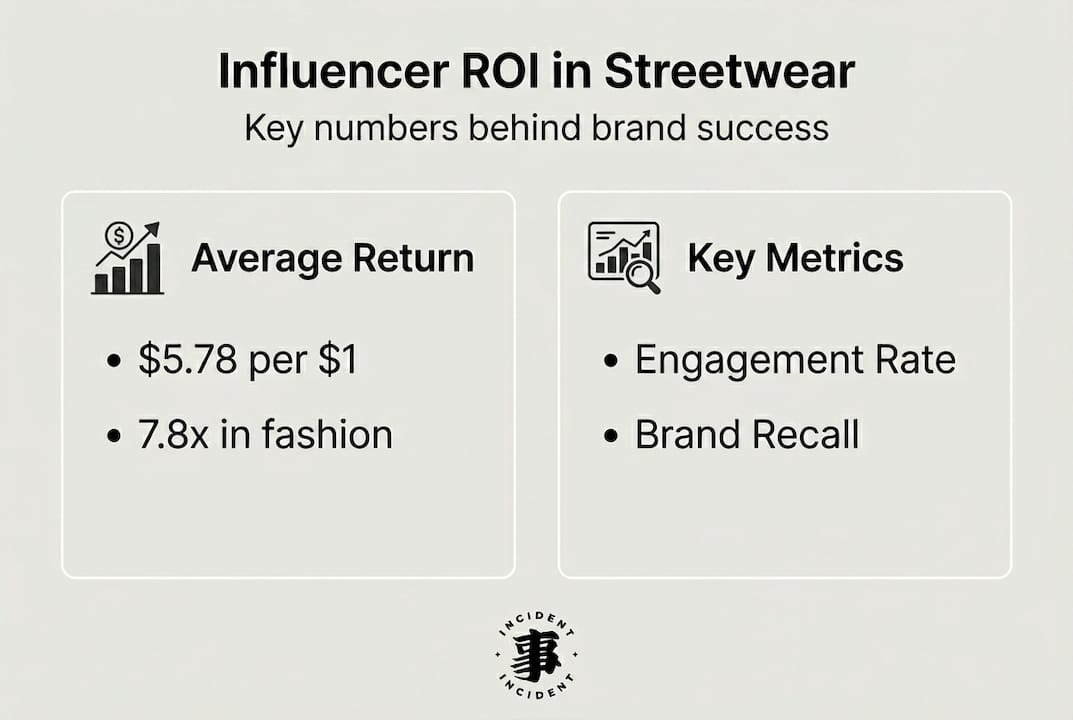
Average ROI in fashion retail reaches 7.8x, with the broader influencer marketing average sitting at $5.78 returned for every $1 spent. These figures are not anomalies. They reflect the compounding effect of credibility, community, and well-timed creative content.
The AMA Studios example stands as one of the most dramatic illustrations of this potential. €1.2 million in sixty minutes is not simply a headline. It is evidence of what happens when a brand builds genuine anticipation through influencer storytelling before a single product is available to purchase. The launch was the culmination of weeks of content, each piece building desire and credibility in equal measure.
BAPE’s sustained use of influencer partnerships across decades speaks to a different dimension of ROI: brand longevity. By consistently aligning with culturally relevant voices, BAPE has remained desirable to each new generation of streetwear consumers. The return is not always measured in a single launch window. Sometimes it is measured in decades of sustained cultural relevance.
For brands using streetwear on social media effectively, the key performance indicators that matter most include:
- Earned media value: The equivalent advertising spend that organic influencer content generates
- Engagement rate per post: Particularly important when evaluating micro-influencer partnerships
- Conversion tracking: Using unique discount codes or affiliate links to attribute direct sales
- Audience growth rate: New followers during and after a campaign indicate broadened awareness
- Sentiment analysis: Qualitative review of comments and shares reveals whether the campaign resonated emotionally, not just algorithmically
Up-and-coming brands should resist the temptation to measure success purely through immediate sales. The brand-building effect of a well-aligned influencer partnership accumulates over time. A creator who introduces your label to 5,000 highly engaged followers today might contribute to 50,000 brand-aware consumers a year from now, as content is shared, referenced, and rediscovered.
The discipline lies in choosing the right metrics for each campaign goal. Awareness campaigns are best measured by reach and sentiment. Conversion campaigns demand hard attribution data. Retention and loyalty programmes require longer-term tracking of repeat purchase behaviour among audiences acquired through influencer channels.
Rethinking influence: what most streetwear brands get wrong
Here is the uncomfortable truth that most conversations about influencer marketing in streetwear avoid: the hype-first mentality destroys more brands than it builds. We see it repeatedly. A label invests heavily in a macro-influencer campaign, generates enormous short-term buzz, and then watches as the community moves on without any lasting loyalty having been formed.
The brands that endure, particularly in Japanese streetwear, are those that treat influence as a long-term relationship rather than a short-term transaction. They are patient. They are selective. And they understand that the most powerful form of influence is not the loudest voice in the room; it is the most trusted one.
Audience fatigue is real and accelerating. Consumers who once responded enthusiastically to influencer recommendations have become adept at recognising when a partnership lacks genuine conviction. The solution is not to abandon influencer marketing but to invest more deeply in fewer, better-aligned relationships. Quality of connection will always outperform quantity of reach over any meaningful time horizon.
What Japanese streetwear teaches the global fashion world is that sustained relevance comes from disciplined restraint. The limited edition streetwear model, done well, is not just a sales tactic. It is a statement of values: this brand does not produce more than can be made with care, and it does not partner with more voices than it can genuinely support.
We believe the future of influencer marketing in streetwear belongs to brands that have the confidence to say no to the wrong opportunities and the patience to build the right ones. A single sincere partnership with a creator who genuinely lives your aesthetic will outlast ten transactional placements every time.
The brands worth following, and worth wearing, are those that understand this. Their influencer relationships are not marketing exercises. They are extensions of the brand’s identity, told through voices that were already believers before the collaboration began.
Take your style further with authentic streetwear
Understanding how influence works in streetwear is one thing. Building a wardrobe that reflects genuine craft and cultural intelligence is quite another. The same principles that make a great influencer partnership work, authenticity, quality, aesthetic coherence, apply to the pieces you choose to wear every day.
At INCIDENT, we design for people who value what is underneath the hype. Our garments draw on Japanese minimalism and Japandi craftsmanship, offering clean lines and premium materials that speak quietly but carry real substance. Whether you are drawn to the textural richness of our premium Pima T-shirt collection or exploring the broader world of INCIDENT Japanese streetwear, every piece is made to earn its place in your wardrobe through quality that lasts. The best style decisions, like the best influencer partnerships, are the ones grounded in genuine conviction.
Frequently asked questions
What is the average ROI for influencer marketing in streetwear?
The average return is $5.78 for every $1 spent on influencer marketing, rising to 7.8x in fashion retail, making it one of the most measurable channels available to streetwear brands.
Why do micro-influencers matter for Japanese streetwear?
Micro-influencers achieve engagement rates of 2.5 to 5 percent, delivering stronger community trust and higher ROI than macro-influencers, which aligns naturally with the niche, craft-focused values of Japanese streetwear.
What risks should brands consider in influencer marketing?
Key challenges include greenwashing, inauthenticity, and growing consumer resistance to obvious advertising, all of which can undermine brand credibility if not managed with transparency and genuine alignment.
How do Japanese brands like Atmos select influencers?
Atmos employs data-driven selection processes, analysing audience demographics, content quality, and genuine cultural alignment rather than simply choosing the creators with the largest follower counts.
Which platforms boost influencer campaign results for streetwear?
Short-form video on TikTok and Instagram Reels doubles engagement rates compared to static content, making these platforms essential for streetwear brands looking to generate genuine excitement and reach new audiences efficiently.
Share:
Why young Europeans embrace Japanese fashion aesthetics
How tailoring shapes streetwear: elevating urban style