


TL;DR:
- True fashion innovation enhances garment performance, longevity, and sustainability through advanced materials and processes.
- Japanese minimalism emphasizes functional fabrics, subtle branding, and disciplined craft over fleeting trends.
- Emerging technologies like AI and digital prototyping streamline design, production, and promote eco-friendly practices.
Most people assume fashion innovation means neon runways, sculptural silhouettes, and designs that look unwearable on any real street. But the most powerful shifts in modern fashion are quieter than that. They live in a fabric engineered to retain body heat, in a seam finished with laser precision, in a silhouette so clean it renders branding nearly invisible. Fashion innovation is the deliberate introduction of novelty across the entire fashion ecosystem, from materials to supply chains. This guide explores what fashion innovation truly means, how Japan leads its quiet revolution, and what it signals for premium minimalist streetwear today.
Table of Contents
- Defining fashion innovation: Beyond the buzzwords
- Japanese fashion innovation: Minimalism, technology, and LifeWear
- Technologies shaping modern fashion innovation
- Sustainability and the new rules of value creation
- Why quiet innovation is the future of premium streetwear
- Experience next-level innovation: Discover premium Japanese streetwear
- Frequently asked questions
Key Takeaways
| Point | Details |
|---|---|
| Fashion innovation redefined | True innovation blends technology, materials, and process to solve real problems—not just create trends. |
| Japanese streetwear leads | Japan’s approach values minimalist design, fabric technology, and lasting functionality over loud branding. |
| Technology drives the shift | AI, predictive analytics, and process integration shape how clothing is designed, made, and chosen. |
| Sustainability as the foundation | Modern fashion must prioritise eco-design, durability, and circular practices to create genuine value. |
| Quiet innovation prevails | The future of premium streetwear lies in subtle, useful, and sustainable advancements, not just in visual novelty. |
Defining fashion innovation: Beyond the buzzwords
Fashion innovation is routinely misunderstood. It gets conflated with trend cycles, seasonal collections, or the loudest looks on a catwalk. In reality, it is far more disciplined. It is about solving problems, creating lasting value, and engineering garments that serve people better over time.
Fashion innovation includes material, technological, process, and supply chain advancements that transform how clothing is conceived, produced, and experienced. That is a wide canvas. And it means that a plain white T-shirt made from a revolutionary fibre can be more innovative than an avant-garde sculptural jacket.
The core areas of fashion innovation break down as follows:
- Material innovation: New fibres, bio-based fabrics, heat-responsive textiles, and ultra-soft constructions that elevate the wearer’s experience
- Technological innovation: AI-driven design tools, digital prototyping, smart factories, and precision finishing techniques
- Process innovation: Incremental improvements in manufacturing, quality control, and craft, often informed by Japanese philosophies like kaizen
- Supply chain innovation: Leaner, more responsive distribution models that reduce waste and improve efficiency
This matters because fast fashion largely operates at the surface level. It optimises speed and price, not craft or longevity. True innovation operates differently.
| Type of innovation | Example | Impact |
|---|---|---|
| Material | Bio-based fibres, HEATTECH | Durability, comfort, sustainability |
| Technological | AI design, laser finishing | Efficiency, precision, lower waste |
| Process | Kaizen, SPA model | Quality consistency, reduced excess |
| Supply chain | On-demand production | Responsiveness, lower environmental cost |
“Fashion innovation is not about newness for its own sake. It is about meaningful change that improves how a garment performs, endures, and connects to the wearer.”
For those who appreciate high-quality Japanese garments, understanding these categories changes the way you evaluate every piece you wear. The construction and the fabric choice are where the real conversation begins. A thoughtful guide to Japanese fabrics reveals precisely why certain textiles feel and perform so distinctly.
Japanese fashion innovation: Minimalism, technology, and LifeWear
Japan has long approached fashion with an engineer’s precision and an artist’s restraint. These values are not contradictory. They are complementary. And nowhere is this more visible than in how Japanese brands treat fabric science and functional design as the true markers of quality.
Uniqlo’s HEATTECH is perhaps the clearest example. 1.5 billion HEATTECH units sold since 2003 makes it one of the most successful fabric innovations in modern fashion history, with Uniqlo reporting revenue of 3.4 trillion yen in FY2025. That is not the story of a trend. That is the story of a solution people refuse to live without.
Japanese streetwear innovation is defined by minimalist design, functional fabric technology, and subtle branding, qualities seen in Uniqlo’s LifeWear philosophy and in Fujiwara’s collaborative work that brings understated elegance to street-ready silhouettes.
Here is what separates Japanese fashion innovation from its Western counterparts:
- Function is never sacrificed for aesthetics. Both must coexist.
- Fabric science is treated as a creative discipline, not a manufacturing afterthought
- Branding is restrained, allowing the garment’s construction to speak for itself
- Heritage craft traditions inform modern production at every stage
| Japanese approach | Fast fashion approach |
|---|---|
| Fabric-first design philosophy | Trend-first design philosophy |
| Long product lifecycles | Short seasonal cycles |
| Functional aesthetics | Visual novelty |
| Subtle, refined branding | Logo-heavy, high-visibility branding |
| Kaizen-driven process improvement | Speed-driven output maximisation |
Pro Tip: When shopping for minimalist streetwear, turn the garment inside out. Finished seams, consistent stitching, and considered interior construction are signatures of genuine craft innovation.
For a visual feel of how these principles translate into wearable style, our streetwear lookbook captures the Japanese minimalism aesthetic in action. Understanding what elevates Japanese streetwear to luxury is about recognising that the quiet details carry the most weight.
Technologies shaping modern fashion innovation
Beyond philosophy, fashion innovation is increasingly powered by specific technologies that are quietly reshaping the entire industry. These are not distant concepts reserved for tech conferences. They are present in the garments you wear and the brands you admire.
The key technologies transforming fashion today include:
- AI-driven design and prototyping: Algorithms that analyse aesthetic trends, predict consumer preferences, and accelerate the design process
- 3D modelling and digital sampling: Virtual prototypes that reduce material waste before a single physical sample is cut
- Predictive analytics: Data-driven stock and demand forecasting that eliminates overproduction
- Ecodesign tools: Life Cycle Assessment (LCA) and Multi-Criteria Decision Making (MCDM) frameworks that embed sustainability into design from the start
- Robotics and precision finishing: Automated systems that deliver consistent, high-quality results at scale
AI, 3D modelling, and predictive analytics are now central methodologies in leading fashion operations, alongside ecodesign strategies that treat sustainability as a design constraint rather than an afterthought.
Here is how a modern, tech-powered garment travels from concept to your wardrobe:
- A designer uses AI tools to explore silhouettes and fabric combinations rapidly
- A 3D digital prototype is refined without wasting physical materials
- Predictive analytics inform production volumes, reducing unsold stock
- Robotics assist with precision cutting and finishing
- Supply chain software tracks each component from mill to delivery
Levi’s FLX system illustrates this vividly. The brand uses AI-powered laser finishing to create on-demand denim treatments, replacing chemical-heavy processes and cutting production time significantly.

The AI in fashion market is projected to grow from $2.47 billion in 2026 to $9.45 billion by 2030, a compound annual growth rate of 40.8%. That trajectory signals how deeply technology will continue to define what premium fashion means.
Understanding the evolution of streetwear helps contextualise why these technologies matter. They are the infrastructure behind what we recognise as authentic, lasting style. The influence of movements like the Harajuku fashion revolution shows that bold ideas and disciplined craft have always worked in tandem.
Sustainability and the new rules of value creation
Technology and process improvements mean little if they contribute to waste. This is why sustainability has become inseparable from genuine fashion innovation in 2026. The industry is rewriting its own definition of value, and premium minimalist streetwear sits at the centre of that shift.
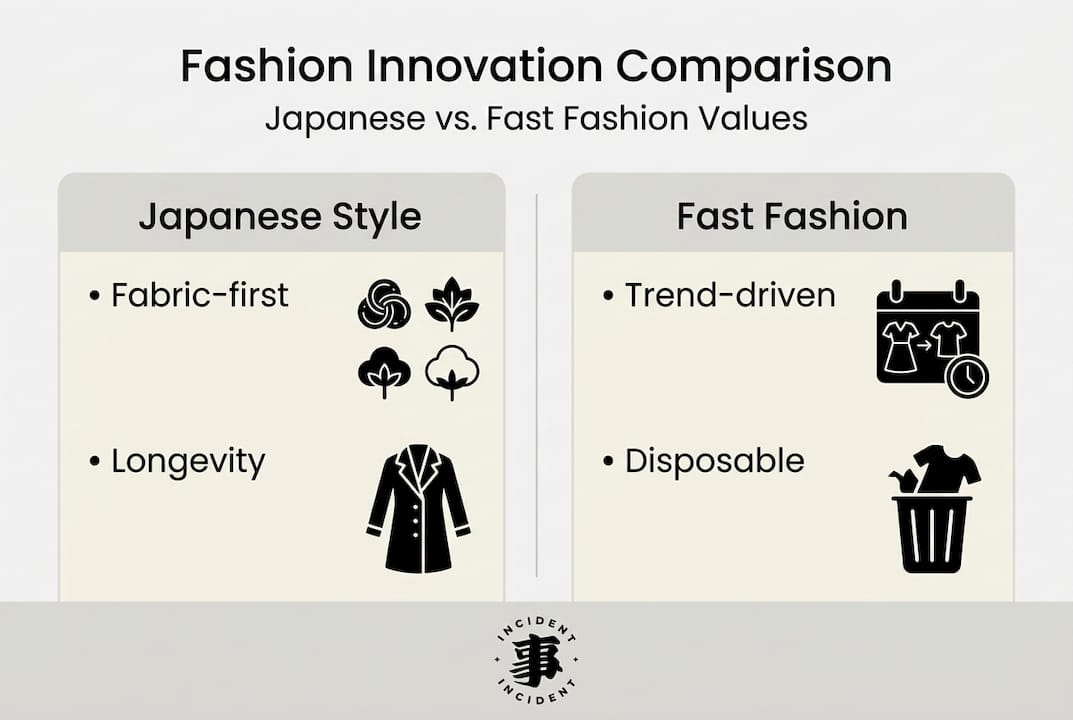
Sustainability via ecodesign and circular practices is now critical, prioritising durability, recyclability, and low-impact materials over novelty for its own sake.
For a discerning consumer, this changes what to look for in any garment:
- Fabric longevity: Does the material maintain its structure, colour, and feel across hundreds of wears and washes?
- Low-impact materials: Are fibres sourced responsibly? Do they require less water, dye, and energy to produce?
- Circularity: Is the garment designed to be repaired, repurposed, or recycled at the end of its life?
- Transparent production: Does the brand communicate how and where garments are made?
“True innovation in fashion is not about what is new. It is about what lasts, what respects its origins, and what leaves less behind.”
Pro Tip: Care labels are underrated design documents. Cold washing, air drying, and avoiding tumble drying can extend a premium garment’s lifespan by years. The innovation is in the fabric; the responsibility is in how you maintain it.
Building a wardrobe around these values takes intention. Our timeless streetwear wardrobe guide offers a practical framework for curating pieces that last, while exploring the types of Japanese minimalism reveals just how many ways restraint can be expressed through clothing.
Why quiet innovation is the future of premium streetwear
Here is the perspective that most coverage misses: the loudest innovations rarely last. The quiet ones become part of daily life so seamlessly that we forget they were ever new.
Japanese fashion has understood this intuitively for decades. While Western markets chased disruption, Japan refined. It treated fabric as a form of engineering, process as a form of respect, and simplicity as a form of ambition. The result is a design tradition that looks effortless precisely because it is so deeply considered.
At INCIDENT Clothing, we believe that real innovation lives in the weight of a fabric, the tension of a stitch, and the restraint of a silhouette that needs nothing added. The garments that earn a permanent place in your wardrobe are rarely the ones that shout. They are the ones that feel right from the first wear and better still after the fiftieth.
We would encourage you to train your eye for those quiet cues. Reach for a seam before you reach for a logo. That shift in attention is where luxury minimalist design becomes genuinely legible. Innovation, at its finest, is invisible.
Experience next-level innovation: Discover premium Japanese streetwear
If this exploration of fashion innovation has shifted how you see the garments in your wardrobe, the next step is experiencing that craft for yourself.

At INCIDENT Clothing, we bring these principles to life through every piece we design. Rooted in Japanese aesthetics and Swiss precision, our collections are built on the belief that minimalism and quality are not compromises; they are the most ambitious choices a brand can make. Our premium Pima T-shirts are a perfect entry point: ultra-soft, considered in every detail, and engineered to last far beyond a single season. Browse the full range at incident.store and discover what it feels like when innovation is something you can genuinely wear.
Frequently asked questions
What is an example of fashion innovation in streetwear?
HEATTECH by Uniqlo is a key example, blending advanced fabric science with minimalist design and selling over 1.5 billion units since 2003, making it one of the most enduring fabric innovations in streetwear-adjacent fashion.
How does AI impact fashion innovation?
AI accelerates design, prototyping, and supply chain decisions, with the market projected to reach $9.45 billion by 2030, while brands like Levi’s already use AI for laser finishing on demand.
Why is sustainability crucial to fashion innovation?
Modern innovation now focuses on creating durable, recyclable, and low-impact materials, recognising that ecodesign and circular practices deliver more lasting value than novelty alone.
How can I recognise innovation in minimalist streetwear?
Look for advanced fabrics, refined interior construction, and minimalist design with functional branding; Japanese brands and their collaborative works consistently set the strongest benchmarks for this approach.
Recommended
- What makes streetwear luxury: Japanese minimalist design – INCIDENT
- What is luxe streetwear? A 2026 guide to Japanese style – INCIDENT
- Street fashion types: Japanese minimalism & modern styles – INCIDENT
- Defining high-quality garments in Japanese streetwear – INCIDENT
- Role of headwear in streetwear: 73% identity boost


Share:
Women's streetwear: 5 Japanese-inspired examples for 2026
Japandi style: minimalism meets comfort and quiet luxury