

TL;DR:
- Efficient folding preserves garment shape, maximizes space, and enhances wardrobe longevity.
- Vertical folding emphasizes visibility and minimizes fabric creases, aligning with Japanese minimalism principles.
- Proper methods depend on fabric type, garment size, and storage needs for optimal results.
There is a particular frustration that arrives when you reach into a drawer and pull out a creased, crumpled hoodie that was once pristine. For those of us who invest in carefully crafted minimalist streetwear, that moment feels like a small betrayal of everything the garment represents. Clean lines deserve clean storage. The good news is that efficient folding, rooted in Japanese minimalist tradition, can transform not just your wardrobe but your entire relationship with the clothes you love. This guide walks you through everything from essential preparation to advanced techniques, so every piece you own looks exhibition-ready from the moment you open the drawer.
Table of Contents
- What you need for efficient streetwear folding
- Step-by-step folding techniques for classic streetwear pieces
- Japanese minimalist folding principles for streetwear
- Advanced solutions: Oversized, delicate, and unique streetwear items
- Mistakes to avoid and how to spot perfect folds
- The truth about minimalist folding: Our take
- Level up your streetwear with premium folding and pieces
- Frequently asked questions
Key Takeaways
| Point | Details |
|---|---|
| KonMari saves space | Vertical folding using the KonMari method boosts drawer space and visibility for streetwear collections. |
| Fabric matters | Folding techniques should be adapted to fabric type—cotton for sharp folds, fleece for minimal folds or hanging. |
| Avoid unnecessary creases | Never fold prints on the graphic and prevent stacks larger than eight to protect design integrity. |
| Minimalism is practical | Applying minimalist folding creates both aesthetic and functional order in your wardrobe. |
| Spot-check your techniques | Uniform rectangles and garments standing upright signal a well-folded, easy-to-access streetwear wardrobe. |
What you need for efficient streetwear folding
Before diving into folding steps, it is important to gather the right materials and understand your wardrobe’s needs. The difference between a well-folded drawer and a messy one often starts long before you touch the first garment.
Essential tools and surfaces
You do not need a professional laundry station to fold well. What you do need is consistency and a few reliable items:
- A flat, clean surface (a bed, table, or ironing board all work well)
- Clean, dry hands to avoid transferring oils or moisture to fabric
- A folding board (optional, but excellent for achieving uniform rectangles every time)
- Shallow storage boxes or designated drawer sections to keep folded stacks upright
- Light clips or dividers for maintaining vertical rows
Pro organisers recommend basing your row layout on drawer width, using folding boards to achieve uniformity across every garment. This single adjustment, choosing the right fold width for your specific drawer, can dramatically increase how many items fit without compression.
Fabric awareness before you fold
Not all streetwear fabrics behave the same way. Understanding the material in front of you is foundational. Our Japanese fabrics guide explores how different weaves and fibres each carry their own storage requirements. The three categories you will encounter most often are:
| Fabric type | Fold behaviour | Best storage method |
|---|---|---|
| Cotton (jersey, French terry) | Sharp folds hold well | Vertical fold or flat stack |
| Fleece / heavyweight sweatshirt | Prone to compression marks | Minimal folds, hang where possible |
| Polyester / nylon blends | Resilient, holds shape | Any method, including roll |
Choosing your method before you start
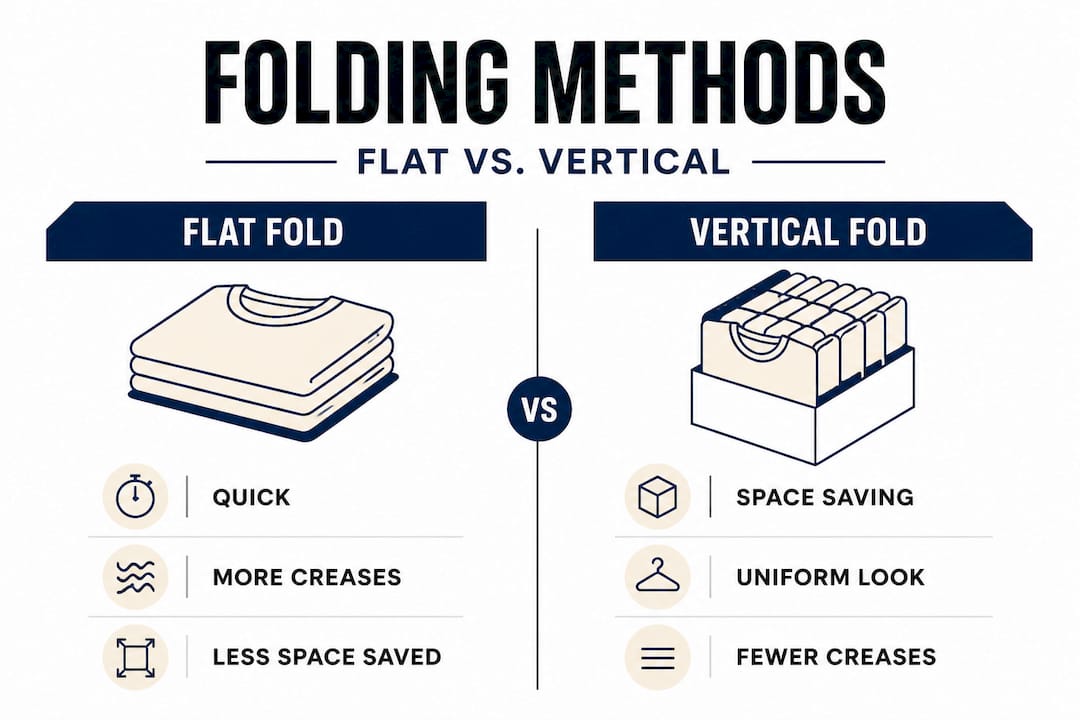
There are three primary folding approaches covered in this guide: the basic flat fold, the KonMari vertical fold (a method popularised by organising consultant Marie Kondo, based on standing garments upright in rows), and the military roll (a compact cylinder fold used for travel). Knowing which method suits which garment, and which drawer, saves time and prevents wasted effort.
Pro Tip: Before folding anything, sort your wardrobe into fabric categories first. Treating each pile as its own project means you can maintain consistent fold dimensions throughout, rather than switching mentally between approaches for each garment.
Step-by-step folding techniques for classic streetwear pieces
With everything prepared, let us break down folding methods for your most-worn streetwear essentials. Hoodies, oversized tees, sweatshirts, and joggers each have their own folding personality, and mastering the steps for each one pays off immediately in drawer space and garment care.
The basic flat fold
The basic fold takes roughly 15 seconds and delivers approximately 40% space reduction compared to unfolded storage. It is the fastest method and works well for items stored on shelves rather than drawers.
- Lay the garment face down on a flat surface and smooth out all wrinkles with your palms.
- Fold one side (with the sleeve) inward to the centre line of the garment.
- Fold the other side in to mirror the first, creating a long rectangle.
- Fold the bottom third up towards the collar.
- Fold the top third down to complete the rectangle.
- Flip the garment so the clean side faces up for presentation.
The KonMari vertical fold
The KonMari method takes around 45 seconds but rewards you with low crease risk and outstanding drawer visibility. According to space-saving benchmarks, vertical folding saves between 25% and 50% more space than conventional stacking, while keeping every garment immediately visible without digging.
- Begin as with the basic fold: garment face down, sleeves folded to the centre.
- Fold the bottom third up, then the top third down, matching the basic method.
- Rather than placing it flat, continue folding the rectangle in half again to create a compact, self-supporting packet.
- Stand this packet upright in the drawer so the folded edge faces up.
- Repeat for every garment, placing them in a neat vertical row from front to back.
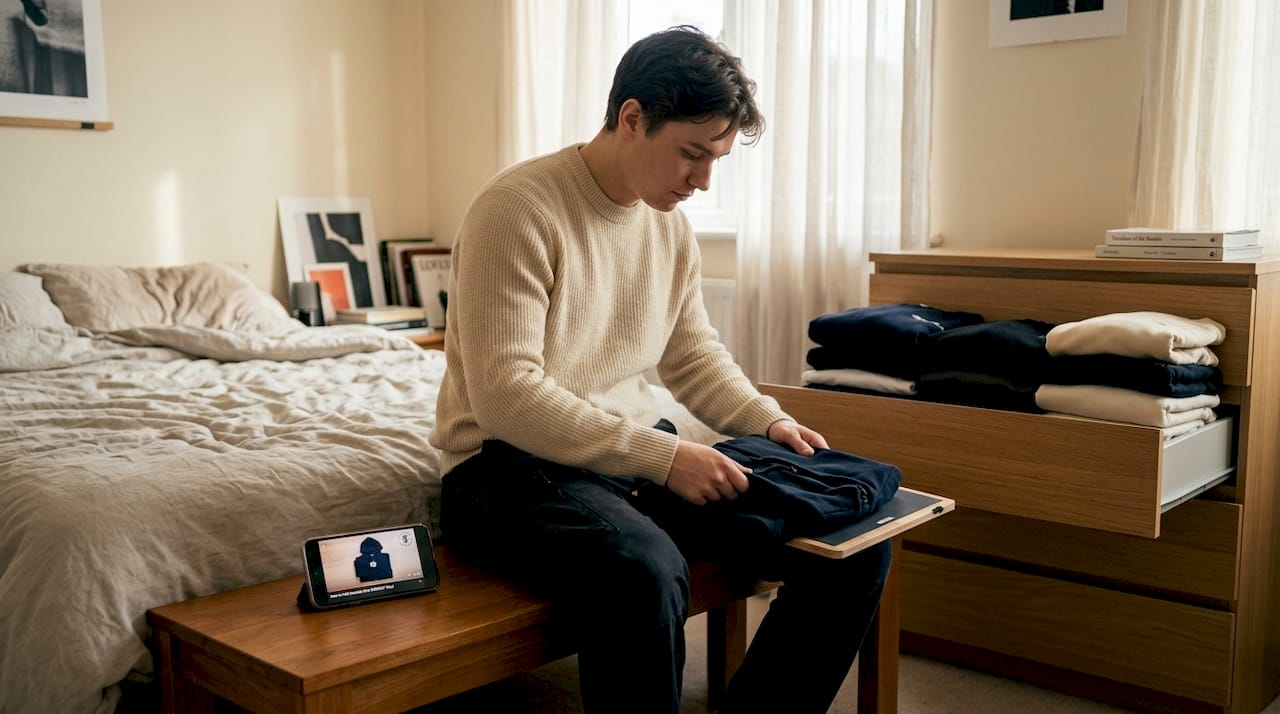
For hoodies and sweatshirts specifically, a well-established technique recommends laying the garment face-down and folding sleeves diagonally to the centre before folding bottom to top, then flipping to create a clean rectangle. The KonMari variant of this folds the finished rectangle once more so it stands upright independently, which is exactly what makes this method so satisfying.
The military roll
The military roll achieves up to 60% space reduction but carries a notable crease risk, making it ideal for travel bags rather than permanent wardrobe storage.
- Lay the garment flat and fold the bottom hem up by about 10 cm to create a cuff.
- Fold the sides inward so they overlap slightly in the centre.
- Starting from the collar, roll the garment tightly downward toward the cuffed hem.
- Fold the cuff back over the roll to secure it.
| Folding method | Time required | Space saving | Crease risk | Best use |
|---|---|---|---|---|
| Basic flat fold | ~15 seconds | ~40% | Low to medium | Shelving |
| KonMari vertical | ~45 seconds | 25 to 50% | Low | Drawers |
| Military roll | ~30 seconds | ~60% | High | Travel |
Understanding your streetwear silhouettes matters here too. Oversized pieces fold differently to slim-cut garments, and Japanese streetwear styling often relies on the garment keeping its intended shape, which means choosing the fold that best protects proportion.
Pro Tip: For KonMari vertical folding, adjust the width of your fold to match your drawer depth so each packet stands upright without leaning or collapsing. A well-measured fold means the row holds itself in place without clips.
Japanese minimalist folding principles for streetwear
Now that you know the techniques, understanding the philosophy behind them will help you perfect your folding and storage. Japanese minimalism is not simply about neatness. It is a framework for how objects occupy space and how that space, in turn, shapes the mind.
The concept of Ma
In Japanese aesthetics, Ma (間) refers to negative space, the intentional gap between things that allows each element to breathe and be truly seen. Applied to wardrobe organisation, Japanese folding emphasises vertical Ma folds for minimalist wardrobes, avoiding stacks specifically to prevent crushing and to stop items from being forgotten. The principle is simple but profound: when every garment stands upright and visible, nothing goes overlooked, and nothing is mistreated.
“A well-organised drawer is not a full drawer. It is a considered one, where every item has been given its own space, its own standing, and its own voice in the collection.”
Why stacking is the enemy of minimalist wardrobes
Stacking feels natural because it mirrors how we pile things in other areas of life. But for streetwear, stacking is quietly destructive. Items at the bottom of a stack absorb the weight of everything above them, causing fibres to compress and fabric to crease in ways that steaming alone cannot fully reverse. Beyond the physical damage, stacking hides garments. You tend to reach only for the top items, while the rest of the stack becomes a forgotten archive.
Vertical folding, by contrast, treats every garment as equally important. KonMari vertical folding aligns perfectly with minimalist streetwear aesthetics by maximising visibility, preserving garment shape, and creating a clean, uniform presentation that actually makes choosing an outfit faster and more pleasurable.
Uniformity as a form of respect for your garments
One of the most overlooked aspects of Japanese folding is the emphasis on uniform dimensions. Every piece, regardless of its original size, should fold down to the same height rectangle to sit neatly in a row. This discipline requires a little practice, but it transforms a drawer into something that genuinely reflects a minimalist sensibility.
When you are transitioning between streetwear seasons, uniform folding also makes rotating pieces in and out of storage far simpler. For a deeper look at how Japanese minimalism continues to influence modern streetwear beyond the wardrobe, the principles extend into silhouette, colour, and layering with the same quiet consistency.
Practical checklist for Japanese-inspired folding
- Fold every garment to the same rectangular dimensions
- Store all items vertically, with the fold facing upward
- Leave a small gap between rows to allow airflow and easy retrieval
- Group garments by category, then by colour within each category
- Never overfill a drawer; the goal is access, not maximum quantity
Advanced solutions: Oversized, delicate, and unique streetwear items
Some streetwear pieces require extra care. Here is how to handle the exceptions for flawless presentation across every corner of your wardrobe.
Handling oversized garments
Oversized streetwear presents a real folding challenge because standard fold dimensions produce a rectangle that is simply too large to stand upright in most drawers. Two approaches work well here. The first is an inside-out fold, where you turn the garment inside out before folding, which protects the outer surface and reduces the visual bulk of seams. The second is a scarf roll, a loose, elongated roll that keeps fabric from compressing at any single point.
For styling oversized streetwear the way it was intended, preserving the drape and structure of the fabric during storage is essential. A garment that has been compressed into a too-small fold will not fall correctly when worn, and that affects the entire look.
Fabric-specific storage guidance
The relationship between a garment and its storage method should always be informed by the fabric. Cotton and polyester blends hold sharp folds well and can be stored using any of the three primary methods. Fleece and cashmere, however, are a different matter entirely. These fabrics rely on their loft, the soft, dimensional quality created by their fibres, and compression collapses that loft permanently over time.
For premium fabrics in streetwear, the rule is simple: if in doubt, hang it. A good hanger preserves structure across the shoulders and allows the fabric to breathe between wears.
Logo print care
Printed graphics on streetwear require specific attention. Sharp creases directly across a print cause the ink or vinyl to crack over time, particularly on garments that have been through multiple washes. The approach is to fold in a way that places the crease at the side or hem of the garment rather than across the chest or back where the print sits.
Key points for edge cases, as folding research highlights:
- Never fold damp cotton; moisture trapped inside a fold creates the conditions for mildew
- Avoid placing sharp creases across any screen-printed or embroidered area
- Do not stack more than 8 garments at any point, as compression damage begins below that threshold
- For Japanese oversized tees, a wider fold rectangle that mirrors the garment’s intended drape is the most protective approach
Pro Tip: If a garment is too large or too delicate to fold comfortably, consider a breathable fabric storage bag hung flat. This preserves the garment’s structure without any fold lines whatsoever, ideal for limited-edition or heavily printed pieces.
Mistakes to avoid and how to spot perfect folds
Perfect execution means knowing what to avoid and how to recognise a job well done. Even experienced folders make habits out of small errors that accumulate into real wardrobe damage over time.
The most common folding mistakes
- Folding garments while still slightly damp, which creates permanent crease lines and enables mildew growth inside the fold
- Pressing creases directly over logo prints or embroidery, accelerating surface cracking
- Building stacks taller than 8 items, which creates compressive force that distorts shape in the lower garments
- Mismatching fold dimensions across a drawer, creating uneven rows that collapse and tangle
- Folding too tightly for the drawer space, leaving no room to retrieve a single garment without disturbing the entire row
Visual cues that signal a perfect fold
You can read the quality of a fold at a glance. In a well-organised drawer:
- Every garment forms a uniform rectangle of roughly the same height
- Items stand upright without leaning or collapsing to one side
- No deep, angular creases are visible on the garment’s front surface
- The tops of all garments are visible simultaneously, like a library of fabric
“The goal is not a drawer that looks impressive in a photograph. The goal is a drawer that works for you every single morning, making the act of choosing an outfit a pleasure rather than a search.”
Understanding how vertical folding compares to stacking makes the case clearly: stacks crush bottom items, create wrinkles, and hide pieces from view, while vertical folding distributes weight evenly and can reduce creases by up to 70% when combined with light steaming after folding. That is a meaningful difference in how your garments age.
As streetwear trends for 2026 continue to favour clean silhouettes and understated presentation, the way you store your clothes becomes an extension of your aesthetic discipline. Even photographing streetwear for social media becomes simpler when your garments hold their shape straight from the drawer.
The truth about minimalist folding: Our take
There is a tendency in the organising world to reduce Japanese folding to an aesthetic exercise, something you do so your wardrobe photographs beautifully. We think that misses the point almost entirely.
Minimalist folding is, at its core, a practice of intentionality. When you take thirty seconds to fold a garment properly, you are making a quiet decision about what matters. You are saying that this piece is worth the effort. You are also, in a very practical sense, learning your wardrobe. The act of folding and placing each item individually forces you to confront what you actually own, what you wear regularly, and what has been sitting untouched at the bottom of a pile for months.
The uncomfortable truth is that most wardrobe problems are not storage problems. They are curation problems. Too many garments competing for the same space means no single piece gets the attention it deserves. Minimalist folding does not solve overcrowding on its own, but it does make overcrowding impossible to ignore. A vertical drawer that refuses to close cleanly is telling you something important.
We have also noticed that the search for the “perfect” fold often becomes an obstacle. People experiment with methods, find them imperfect, and give up before forming any habit at all. Our honest advice is this: pick one method that suits your most-used drawer and practise it for two weeks before judging the results. Consistency builds the habit, and the habit builds the wardrobe you actually want to live with.
The connection between caring for premium streetwear and folding it well is not incidental. It is the same craft sensibility expressed at a different scale. When a garment is made with precision and intention, storing it with the same care is simply the logical continuation of that respect.
One small change, adopting a single favourite folding method and using it every time, can shift how you feel about your wardrobe entirely. Not because the drawer looks better, though it will, but because the repetition itself becomes a form of mindful engagement with the things you have chosen to keep in your life.
Level up your streetwear with premium folding and pieces
Your folding technique deserves garments that are worth the effort. At INCIDENT Clothing, every piece we craft is designed with the same minimalist precision you are now applying to your storage. Clean construction, considered proportions, and premium fabric choices mean that our garments hold their shape beautifully whether worn or folded.
Explore our latest collection at incident.store, where Japanese-inspired streetwear meets Swiss precision. From heavyweight cotton pieces to carefully structured oversized silhouettes, every garment in our range is built to reward thoughtful care. Browse our new arrivals and discover the pieces that belong in the front row of your newly organised drawer, ready for the day you reach for them.
Frequently asked questions
Which folding method saves the most space for streetwear?
The military roll saves up to 60% in space but carries a high crease risk, making it best suited to travel. For everyday wardrobe use, the KonMari vertical fold offers the ideal balance between space efficiency and shape preservation.
How do I keep my printed streetwear graphics from cracking?
Avoid placing any fold crease directly across a printed or embroidered area, and keep stacks to a maximum of 8 garments. The risk of print cracking increases significantly with compression and sharp fold lines over time.
What is the advantage of vertical folding over stacking?
Vertical folding distributes weight evenly across all garments rather than concentrating it at the bottom of a stack, keeping every item visible and accessible. Combined with light steaming, vertical storage reduces creases by up to 70% compared to conventional stacking.
Can I use these methods for delicate or bulky fabrics like fleece?
For fleece and cashmere, minimal folds or hanging are strongly recommended, as repeated compression collapses the loft of the fibres permanently. Cotton and polyester blends handle sharp folds well and suit any of the three primary methods described in this guide.
Recommended
- Build a timeless streetwear wardrobe: Japanese minimalist guide – INCIDENT
- Streetwear lookbook: Japanese minimalism for your style – INCIDENT
- Men’s streetwear essentials: refined Japanese-inspired style – INCIDENT
- Street fashion types: Japanese minimalism & modern styles – INCIDENT
- Minimalist streetwear: Self-expression for urban youth – Memento Vivere Co
- Packing minimalist: chic capsule wardrobe tips for stylish travel – Be Juliet

Share:
Create versatile Japandi outfits: a step-by-step guide
How to match Japanese prints for a sharp, refined look