


TL;DR:
- Urban luxe emphasizes understated craftsmanship and quality materials over branding and hype culture. It blends relaxed, city-inspired silhouettes with deliberate detail and restraint, inspired by Japanese minimalism. Building an authentic wardrobe requires patience, focus on fit and fabric, and a personal sense of restraint rather than following trends or displaying logos.
There’s a persistent misconception drifting through fashion circles: that urban luxe is simply expensive streetwear. Throw on a designer logo hoodie and a pair of premium trainers, and you’re there. But that reading misses the point entirely. True urban luxe operates on a different frequency. As the style community increasingly recognises, “urban luxe” isn’t a single standardised fashion category — it describes outfits that feel streetwear in silhouette and attitude, but read as luxury through materials, fit, and restraint. This guide will walk you through exactly what that means and how to build it with intention.
Table of Contents
- Defining urban luxe: more than expensive streetwear
- Key elements of urban luxe style
- Urban luxe meets Japanese minimalism
- Curating your urban luxe wardrobe: practical tips
- Why authenticity and restraint define true urban luxe
- Find your statement: Japanese-inspired urban luxe
- Frequently asked questions
Key Takeaways
| Point | Details |
|---|---|
| Urban luxe defined | It fuses city-inspired silhouettes with high-quality materials, minimalism, and polished construction. |
| Japanese influence | Japanese minimalism takes urban luxe deeper by focusing on neutral palettes, fit, and precise layering. |
| Essentials matter | A successful urban luxe wardrobe begins with quality basics, versatility, and careful outfit layering. |
| Authenticity counts | True urban luxe expression relies on intention, not hype or price, for personal, lasting style. |
Defining urban luxe: more than expensive streetwear
Many people arrive at urban luxe through the wrong door. They see a price tag, a famous logo, or a runway moment and assume that’s the destination. But the truth is quieter than that, and considerably more interesting.
“Urban luxe isn’t a single standardised, universally defined fashion category; in practice it’s used to describe outfits that feel streetwear/urban in silhouette and attitude but read as luxury through materials, fit, and restraint.”
This distinction matters. Urban luxe is a sensibility before it is a category. It draws from the energy and movement of city dressing — relaxed shapes, functional layering, ease of wear — and elevates those forms through craft, quality, and deliberate understatement. The result is clothing that feels unhurried. Confident without shouting.
What separates urban luxe from pure hype culture is precisely what it refuses to do. It doesn’t chase seasonal drops or plaster logos across every surface. It doesn’t reach for attention through noise. Instead, it reaches for attention through stillness. The quality of a seam. The weight of a fabric. The precise way a silhouette falls.
To understand what is luxe streetwear at a foundational level, consider what both halves of that phrase actually demand. “Streetwear” brings ease, adaptability, and cultural fluency. “Luxe” brings patience, investment, and craft. Urban luxe is the conversation between those two values.
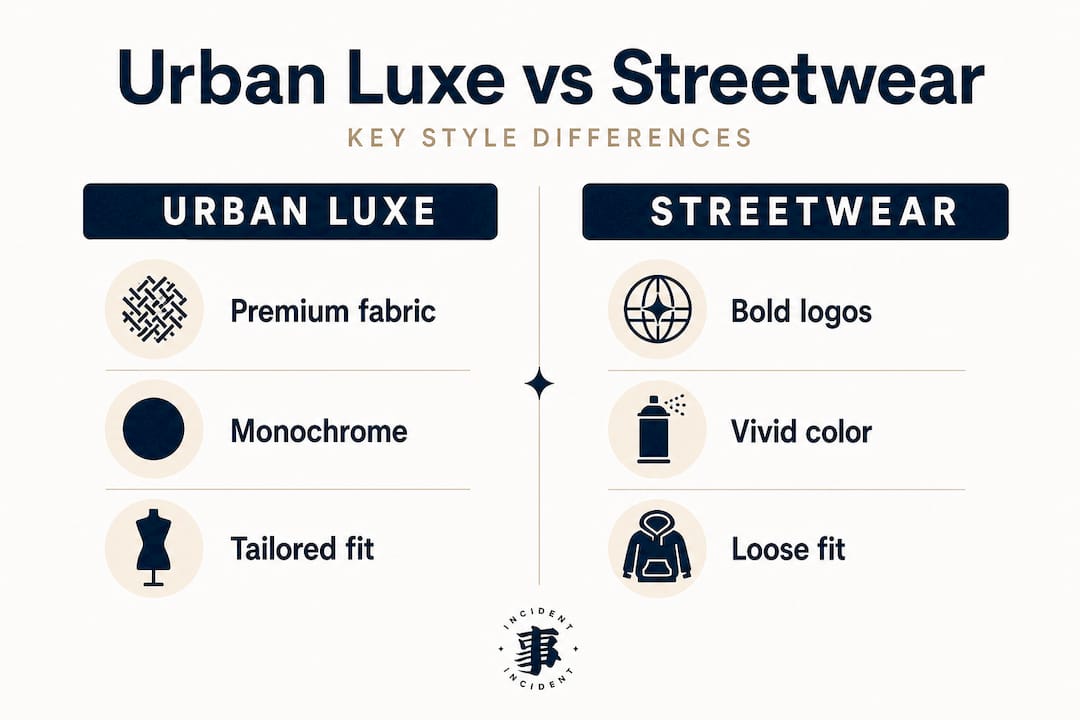
Here are the core qualities that separate urban luxe from regular streetwear:
- Fabric quality takes priority over graphic design or branding
- Silhouettes are relaxed but intentional, never sloppy or oversized without purpose
- Details such as stitching, drape, and construction are visible in the garment’s behaviour, not on its surface
- Colour palette is typically restrained: neutrals, monochromes, or carefully considered tonal combinations
- Branding is subtle or absent, letting the garment itself communicate
This is a style built on what you notice on second glance, not first. And that subtlety is precisely its strength.
Key elements of urban luxe style
Now that we’ve addressed what urban luxe is not, it’s vital to break down what actually creates that effortless luxury feel. There are specific, repeatable pillars that appear across every strong urban luxe look. Learn them, and you’ll be able to identify the style anywhere — and build it yourself.
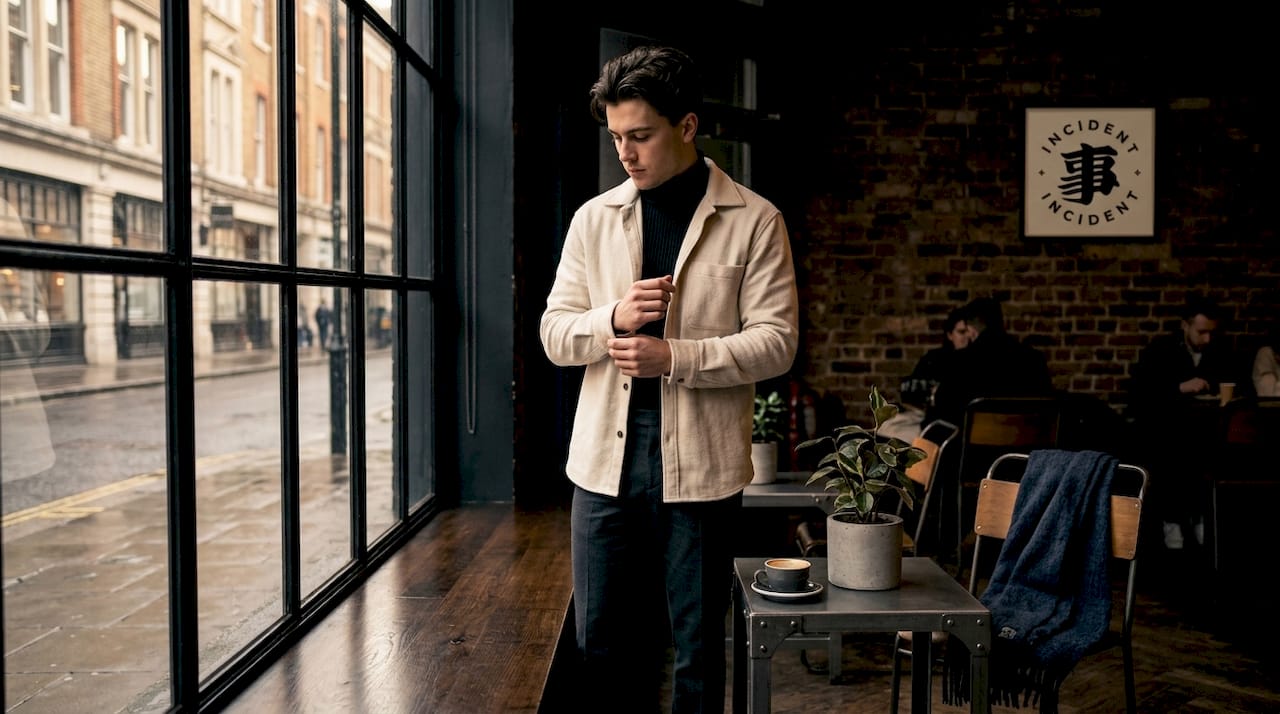
A common recipe for urban luxe is minimalist and clean silhouettes, quality fabrics, and intentional layering for a polished but not overly formal city vibe. Each of those elements deserves close attention.
Neutral and monochrome palettes
Colour is the first signal your outfit sends. Urban luxe speaks softly here. Palettes lean towards warm whites, stone, charcoal, slate, black, and deep earth tones. When colour does appear, it’s usually a single, deliberate accent rather than a full statement. This restraint creates visual cohesion and allows the fabric and silhouette to carry the look rather than competing with it.
Premium fabrics as the centrepiece
This is perhaps the most defining characteristic. Urban luxe relies on materials that reward proximity: heavy cotton jersey that holds its shape, structured wool that drapes rather than stiffens, silk blends that catch light gently, and brushed fleece that communicates comfort through touch rather than novelty. Understanding premium minimalist streetwear fabrics is genuinely transformative when you begin building this wardrobe. You stop asking “what does it look like?” and start asking “how does it feel, and how does it behave?”
Precision tailoring alongside relaxed forms
Urban luxe does not default to fitted tailoring the way traditional luxury dressing does. It incorporates relaxed, sometimes oversized, proportions. But crucially, those proportions are chosen with care. A wide-leg trouser is cut to a specific width. A drop-shoulder tee has a deliberate sleeve length. Nothing is accidental.
Intentional layering
Layering in urban luxe is structural, not decorative. A ribbed turtleneck under an unlined jacket creates visual depth without clutter. A lightweight overshirt worn open above slim trousers grounds the silhouette. Each layer performs a function: thermal, structural, or tonal.
Details over decoration
The stitching on a cuff, the way a collar lies flat, the weight of a zip pull — these are the details that separate well-crafted pieces from mass-produced alternatives. Urban luxe invites you to look closer. The reward is always there.
Pro Tip: Before purchasing any new piece for your urban luxe wardrobe, handle it. Rub the fabric between your fingers, examine how it drapes, and check the seams. Quality announces itself through touch far more reliably than through price or branding.
Here’s a comparison to clarify where urban luxe sits relative to adjacent styles:
| Style | Silhouette | Fabric focus | Branding | Formality |
|---|---|---|---|---|
| Urban luxe | Relaxed, intentional | High priority | Minimal or absent | Elevated casual |
| Hype streetwear | Oversized, graphic-led | Low to medium | Prominent | Casual |
| Traditional luxury | Fitted, structured | High priority | Moderate to prominent | Formal to semi-formal |
| Fast fashion casual | Trend-driven, inconsistent | Low | Variable | Casual |
| Minimalism meets Japanese urban style | Clean, precise | Very high | Near absent | Elevated casual |
The table above shows why urban luxe, particularly through a Japanese minimalist interpretation, occupies such a distinctive and desirable position. It borrows the comfort and cultural awareness of streetwear, the craftsmanship of traditional luxury, and the restraint of minimalism. Nothing else quite fills that space.
Urban luxe meets Japanese minimalism
Understanding urban luxe and understanding Japanese minimalism are, in many ways, the same journey. Both philosophies reject excess. Both elevate the detail over the declaration. Both believe that what is left out of a design is as important as what remains.
Japanese aesthetic philosophy — rooted in concepts like wabi-sabi (the beauty of imperfection) and ma (the significance of negative space) — translates remarkably well into garment design. Clean lines. Unhurried silhouettes. Fabrics that speak without embellishment. These are the qualities that make Japanese minimalist design so compelling for anyone drawn to urban luxe.
The shift from traditional Japanese streetwear into quieter, more refined territory is also well underway. The movement from Japanese streetwear to quiet luxury reflects a broader cultural appetite for clothing that communicates identity through craft rather than through trend. This is not a passing moment. It is a maturing of taste.
If you want your urban luxe wardrobe to carry genuine Japanese minimalist energy, the guidance is clear. As style direction from urban-chic sources emphasises, look for neutral palettes, quality fabrics, and careful fit, then apply those principles to streetwear foundations — hoodies, long-sleeve tops, relaxed trousers — through precise layering rather than loud graphics. That is the formula.
Here are the practical principles for a Japanese-inspired urban luxe wardrobe:
- Prioritise tonal dressing: build outfits within a single colour family rather than mixing contrasting tones
- Choose relaxed trousers with structure: wide-leg or straight-cut styles in heavyweight fabrics, free from excessive detailing
- Layer soft under hard: a fine-gauge knit beneath an unlined overshirt, or a turtleneck beneath a loose blazer
- Avoid visible branding entirely: let the garment’s construction and fabric do the communicating
- Select footwear that recedes: simple low-profile trainers or plain leather shoes that don’t compete with the outfit above
Here’s how Japanese minimalist urban luxe looks in practice across different settings:
| Setting | Top layer | Mid layer | Base | Footwear |
|---|---|---|---|---|
| City daywear | Lightweight overshirt | Premium long-sleeve tee | Relaxed straight trousers | Low-profile canvas trainers |
| Evening casual | Unlined structured blazer | Fine-knit turtleneck | Slim-cut dark trousers | Simple leather loafers |
| Weekend leisure | Soft cotton hoodie | None | Wide-leg heavy jersey joggers | Clean white leather trainers |
| Creative workspace | Oversized linen shirt | Ribbed vest | Straight-leg chinos | Minimalist leather shoes |
Pro Tip: The most powerful Japanese minimalist looks often feel almost incomplete to Western eyes at first. Resist the urge to add another layer or accessory. Sit with the restraint. That pause is precisely where the elegance lives.
The beauty of this intersection is that it removes the anxiety of over-dressing or under-dressing. A wardrobe built on quality, neutral-toned, carefully proportioned pieces works across nearly every urban context without effort.
Curating your urban luxe wardrobe: practical tips
With a clear understanding of the principles, the next step is building something real. Wardrobe curation for urban luxe is not about wholesale replacement. It is about making deliberate decisions, one piece at a time, until the overall collection reflects a coherent sensibility.
A good starting point: layering like a blazer over a hoodie or a slip dress over a turtleneck — in clean or monochrome looks with quality fabrics — consistently defines what urban luxe looks like in practice. Use these combinations as anchors when building your wardrobe.
Follow these steps to build your own urban luxe wardrobe with intention:
-
Audit your current wardrobe for fabric quality. Set aside any pieces made from premium or interesting fabrics. These are the bones of your urban luxe foundation, regardless of brand or price paid.
-
Establish your palette. Choose two or three neutral tones that you’ll commit to. For many people this means black, stone, and charcoal. Others lean towards cream, slate, and warm brown. The exact tones matter less than your consistency.
-
Invest in three essentials first. A well-made premium T-shirt or long-sleeve base in your core neutral. A structured but unlined overshirt or lightweight blazer. A pair of well-cut relaxed trousers. These three alone can generate dozens of outfits.
-
Build layering skills deliberately. Practise putting combinations together before you need them. Lay pieces out flat, photograph the combinations, and note what works. Urban luxe layering is a learned skill, not an intuitive one for most people.
-
Replace rather than accumulate. Every time you consider adding a new piece, ask whether it replaces something lower-quality or merely adds to the pile. Urban luxe wardrobes are typically concise — around 20 to 30 core pieces — rather than sprawling.
-
Assess fit as a non-negotiable. Urban luxe tolerates relaxed silhouettes, but never poor fit. A piece that is simply too large without intention, or that bags in the wrong place, undermines everything. Tailor what needs tailoring. Edit ruthlessly.
The daily application of Japanese styling in everyday outfits reinforces the same principle again and again: simplicity is the result of difficult choices, not the absence of thought. Every strong urban luxe outfit is the product of restraint exercised multiple times.
Consider these specific wardrobe essentials worth investing in first:
- Premium heavyweight tee or long-sleeve: The true foundation of any urban luxe look. The fabric must earn its keep here.
- Structured overshirt or light blazer: Your primary layering tool. Unlined for movement, structured for presence.
- Relaxed-fit quality trousers: In a heavy jersey, fine wool, or quality cotton twill. Not slim, not baggy — considered.
- Versatile neutral knitwear: A ribbed crewneck or turtleneck in a mid-weight yarn. Works over a base and under a blazer.
- Clean, simple footwear: Leather trainers in white or black, or simple leather shoes. Nothing that competes.
Understanding what defines high-quality garments in Japanese streetwear is enormously helpful at this stage. Quality is visible in the density of a weave, the evenness of a hem, the stability of a colour after washing. These are not abstract ideals — they are observable properties you can check before you buy.
Pro Tip: When in doubt between two similar pieces, always choose the one with better fabric weight and construction, even if it costs more. In a small, carefully curated wardrobe, every piece carries its weight. One excellent garment outperforms three mediocre ones every time.
Why authenticity and restraint define true urban luxe
Here’s an uncomfortable observation: most people building an “urban luxe” wardrobe are still building it for other people. They’re choosing pieces that signal wealth, or cultural awareness, or a knowledge of current trends. And the moment that’s your motivation, you’ve missed the point.
True urban luxe is not a performance. It is a personal standard. The Japanese aesthetic traditions that underpin so much of the best contemporary minimalist streetwear — the emphasis on shokunin (artisan) craft, on the quiet pride of a well-made object — are fundamentally internal values. They don’t require an audience to have meaning.
What we’ve observed, working closely with this aesthetic, is that people who genuinely embody urban luxe have a different relationship with their clothing. They’re not asking “does this look expensive?” They’re asking “does this feel right? Does this hold up? Does this reflect something true about how I want to move through the world?” That’s a much more interesting question.
The mistake most style guides make is treating urban luxe as a checklist. Buy these fabrics. Avoid these patterns. Stick to these colours. But authentic urban luxe comes from developing a point of view, not from following instructions. Restraint is only meaningful when it costs you something. Choosing not to buy a heavily branded piece you genuinely like, because you know it would undercut the quiet coherence of what you’re building — that’s the real discipline.
Building a wardrobe around refined Japanese-inspired style means accepting that the payoff is slow. You won’t have 40 outfits next month. But in two years, you’ll have a wardrobe that genuinely feels like yours — coherent, considered, and lasting. That’s the offer. It demands patience, but it pays back in something that seasonal hype never can.
Find your statement: Japanese-inspired urban luxe
If this guide has clarified what urban luxe truly means, and sparked a sense of where you want to take your own style, we’d love to be part of that next step. At INCIDENT Clothing, we design with precisely these values in mind: clean lines, premium fabrics, and a Japandi-influenced sensibility that speaks quietly but distinctly.
Our Pima collection is a strong starting point for anyone building a Japanese-inspired urban luxe wardrobe. Crafted from ultra-soft Pima cotton, these pieces offer that rare combination of exceptional fabric quality and understated design that urban luxe demands. Each garment is designed to layer, to endure, and to improve with wear. Follow our community and updates to stay connected with new releases, styling ideas, and the wider world of Japanese minimalist streetwear. We’re always glad to welcome those who share a genuine appreciation for craft.
Frequently asked questions
What makes urban luxe style unique from regular streetwear?
Urban luxe stands out by combining relaxed, city-ready silhouettes with premium materials and restraint, prioritising craftsmanship and understated tailoring over logos, graphics, or trend-driven statements.
How can you style urban luxe to fit Japanese minimalist trends?
Focus on neutral palettes and quality fabrics applied to streetwear foundations — hoodies, turtlenecks, relaxed trousers — layered with precision and kept free of visible branding or busy graphics.
What wardrobe essentials should you invest in for urban luxe?
Start with quality basics: a premium base tee, a structured overshirt or unstructured blazer, and well-cut relaxed trousers, prioritising quality fabrics like heavyweight cotton or fine wool in neutral, cohesive tones.
Does urban luxe style require expensive designer brands?
Not at all. Urban luxe is defined by materials, fit, and restrained polish rather than logos or price tags — thoughtfully chosen quality basics from any source can carry this aesthetic with full conviction.
Share:
Japanese pattern guides: Minimalist streetwear styles explained
Real advantages of global streetwear for minimalists