

TL;DR:
- Japanese sewing patterns emphasize visual diagrams and symbols over text, fostering intuitive understanding of construction. They often exclude seam allowances, requiring manual additions, allowing personalized adjustments suited to minimal and streetwear styles. These guides promote precision, creativity, and intentionality, unlocking innovative designs through systematic pattern engineering.
There is something quietly magnetic about Japanese sewing patterns. They arrive looking almost like art — dense with symbols, sparse on words, trusting you to read the diagram rather than the instruction booklet. For fashion-forward dressers drawn to minimalism and Japanese aesthetics, they represent far more than a technical guide; they are a direct line into a design philosophy built on precision, restraint, and visual intelligence. Japanese sewing patterns emphasise visual diagrams over text, using symbols like notches, circles, and arrows for assembly instructions, and once you learn to read that language, your approach to building a wardrobe changes entirely.
Table of Contents
- How Japanese pattern guides work: Visual language and key features
- Core methods: Bunka fashion, Pattern Magic and Yukata drafting
- Comparison: Japanese guides versus Western patterns
- Who Japanese pattern guides are best for, and when to adapt
- Bringing Japanese pattern guides into your streetwear wardrobe
- Why conventional approaches miss the power of Japanese guides
- Explore minimalist Japanese streetwear pieces
- Frequently asked questions
Key Takeaways
| Point | Details |
|---|---|
| Visual-first instructions | Japanese guides prioritise diagrams and symbols over text, ideal for visual learners. |
| Minimalist aesthetic base | Bunka and Pattern Magic methods underpin the clean lines in streetwear essentials. |
| Fit customisation needed | European wearers should adjust length and bust for best results from Japanese patterns. |
| Sustainable, simple choices | Yukata designs provide zero-waste, easy-to-sew options for wardrobe basics. |
| Accessible creativity | Pattern Magic enables striking 3D shapes for bold streetwear with minimal sewing skills. |
How Japanese pattern guides work: Visual language and key features
With that foundation, let us break down exactly how these guides function and what sets them apart visually.
The first thing you notice when you open a Japanese pattern guide is the sheer density of diagrams. Where a Western pattern might walk you through a construction step in two or three sentences, a Japanese guide shows you with a precisely rendered illustration, an arrow pointing at the correct fold, a small circle indicating a notch or pivot point. There is very little room for linguistic ambiguity, which, paradoxically, makes the guide both more approachable for visual learners and initially puzzling for those accustomed to written instruction.
Key symbols you will encounter include:
- Notches: Small triangular or rectangular marks along the seam edge, indicating where two fabric pieces align during construction
- Circles and dots: Used to mark pivot points, button placements, or the apex of a dart
- Arrows: Indicate grain line direction, pressing direction, or the order of construction steps
- Dashed lines: Often represent fold lines, stitching lines, or placement guides for pockets and details
- Seam allowance marks: Short parallel lines or brackets indicating the width of the allowance, when it is included at all
One of the most important distinctions for anyone working with Japanese patterns is that Japanese patterns often exclude seam allowances, requiring manual addition before cutting. This is not an oversight; it is a deliberate feature of the system. By providing a clean finished-measurement pattern, Japanese guides allow you to add the exact seam allowance your sewing method requires. For a French seam, for example, you would add more than for a standard lockstitch seam. This level of customisation suits the thoughtful, intentional approach that minimalist dressers bring to building their wardrobes.
“The visual language of Japanese patterns rewards patience. Once you learn the symbols, construction becomes intuitive — almost meditative.”
This suits modern visual learners particularly well. Research consistently shows that diagram-based instruction accelerates comprehension for complex spatial tasks, and garment construction is nothing if not a spatial challenge. For those inspired by Japanese minimalism for your style, the clean visual presentation of these guides feels entirely in keeping with the aesthetic they are aiming to achieve.
The challenges for beginners are real but manageable. Reading the layout of a multi-size pattern sheet, where multiple sizes are printed as overlapping lines, requires a steady hand and a good eye. Colour-coded tracing paper is your friend here. Similarly, if the guide is written entirely in Japanese, a translation app pointed at specific symbol keys can clarify meaning quickly. Measurements are almost always metric, so ensure you are comfortable working in centimetres before you begin.
Pro Tip: When starting with a new Japanese guide, photocopy or trace your chosen size onto fresh paper before touching the master sheet. This preserves the original and lets you make fit notes directly on your working copy.
Core methods: Bunka fashion, Pattern Magic and Yukata drafting
Now that you understand the symbols, let us tour the core Japanese pattern methods shaping modern minimalist aesthetics.
Three distinct traditions dominate Japanese pattern-making, each with its own philosophy, visual identity, and suitability for streetwear applications.
1. The Bunka fashion method
The Bunka Fashion College method uses Japanese Industrial Standards (JIS) sizes based on bust, waist, and centre back length, with bodice blocks featuring multiple darts and geometric precision. This is the most technically rigorous of the three traditions, producing clean geometric shapes that translate beautifully into structured outerwear, minimal trousers, and sharp-shouldered tops. The precision of Bunka drafting means that, once you have your block, modifications are reliable and repeatable. For streetwear, this is invaluable: you can draft a relaxed-fit blouson once and then rework it endlessly with sleeve variations or pocket placements.
2. Pattern Magic
Pattern Magic uses Bunka-style slopers for advanced manipulations like dart absorption, 3D effects, and origami-inspired geometry with over 250 patterns. Created by Tomoko Nakamichi, it sits at the intersection of fashion design and sculptural art. Despite its reputation for complexity, many of its manipulations require only basic sewing skills applied to clever pattern engineering. A flat piece of fabric is slashed, pivoted, or folded according to the guide, producing three-dimensional volume or unexpected surface texture. For streetwear, Pattern Magic opens the door to statement outerwear, architecturally draped tops, and pieces with origami-inspired hem details that photograph extraordinarily well.
3. Yukata drafting
Yukata patterns use measurement-based rectangular panels, straight seams, no darts or set-in sleeves, and are almost paperless. This zero-waste tradition produces garments from simple rectangular cuts of fabric joined along straight lines. The resulting silhouette is relaxed, draped, and entirely consistent with contemporary oversized streetwear aesthetics. Because there are no curved seams, construction is genuinely beginner-friendly, and the tradition’s origins in sustainable fabric use align well with the values of a conscientious, modern wardrobe.
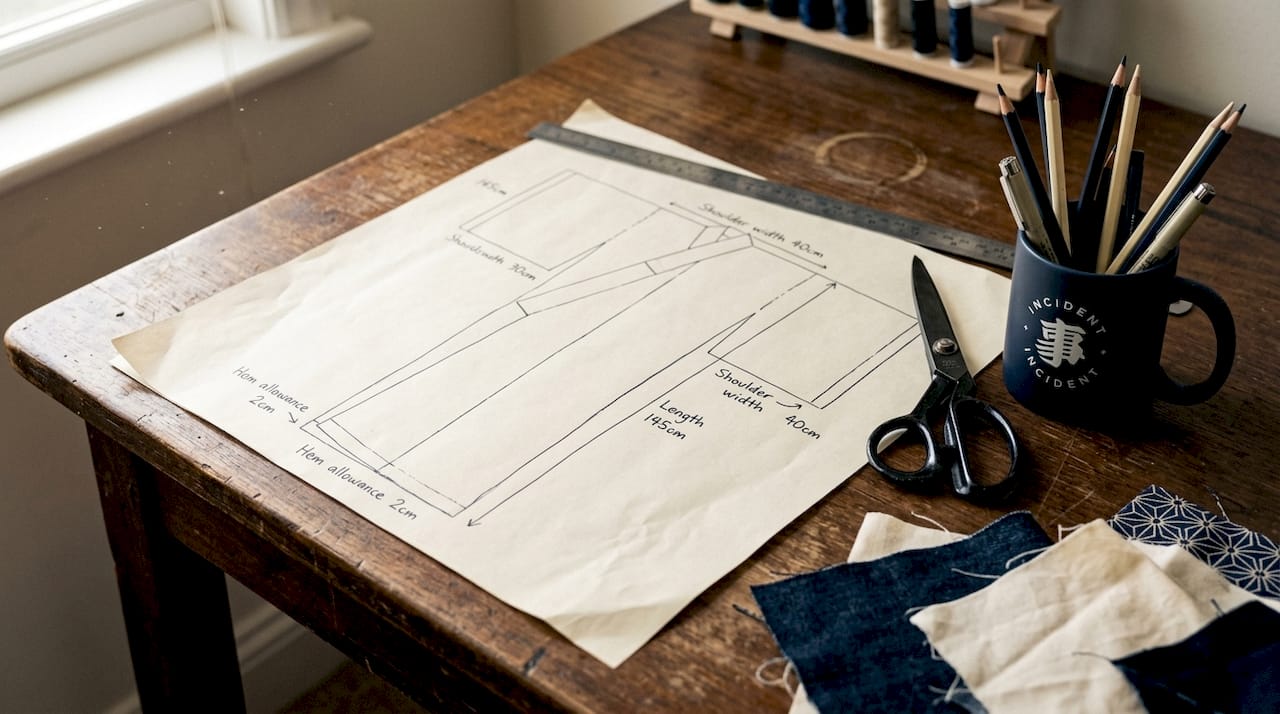
When choosing between methods for your wardrobe, consider what you want to make. Structured minimal pieces benefit from Bunka’s geometric rigour. Sculptural or statement layers are the domain of Pattern Magic. Relaxed, oversized, and sustainable everyday pieces are perfectly served by Yukata drafting principles.
Explore how Japanese fabrics for minimalist streetwear interact with each of these methods — fabric behaviour changes dramatically between a stiff cotton canvas and a fluid linen, and the pattern method you choose should complement the fabric’s natural properties.
Pro Tip: Try drafting a Bunka basic block first to understand your precise measurements, then apply Pattern Magic modifications to add volume or origami-inspired surface detail. You get the precision of the former with the creative freedom of the latter — a powerful combination for streetwear experimentation.
Comparison: Japanese guides versus Western patterns
To help you make the best decision, see how these innovative guides stack up against familiar Western patterns.
| Feature | Japanese guides | Western patterns |
|---|---|---|
| Instruction style | Visual diagrams and symbols | Written step-by-step text |
| Seam allowances | Usually excluded; add manually | Usually included in pattern pieces |
| Size system | JIS (bust, waist, CB length) | EU/US sizing (varies by brand) |
| Learning curve | Steeper initially; faster once learned | Shallower initially; less transferable |
| Fit for slim/short frames | Excellent out of the pattern | May require fewer adjustments |
| Fit for taller/curvier frames | Requires lengthening and FBA | Often better initial fit |
| Visual appeal of guide | Exceptionally clean; diagram-led | Variable; often text-heavy |
| Adaptability for streetwear | High; especially for relaxed and minimal silhouettes | Moderate; depends on brand |
The differences extend beyond mere instruction style. Japanese patterns are tailored for shorter, less curvy bodies, often needing adaptation for European wearers. This is not a flaw; it is simply the result of designing for a different population’s average measurements. The adaptation process is well-documented and entirely manageable once you understand the principles.
Key contrasts at a glance:
- Japanese guides reward visual learners and suit those who prefer learning through seeing rather than reading
- Western patterns tend to include more written context, which some sewists find reassuring during complex construction
- Size translation between JIS and EU systems requires checking specific measurements rather than relying on size labels
- Japanese seam allowance exclusion allows greater sewing technique flexibility; Western inclusion can feel more immediately practical
For those building a minimalist Japanese streetwear identity, the Japanese system’s visual clarity and the discipline it encourages around precise measurement feel entirely natural. It mirrors the wardrobe philosophy itself: intentional, uncluttered, and deliberate.
Who Japanese pattern guides are best for, and when to adapt
Understanding the differences, let us pinpoint exactly who will benefit most, and how to make sure the fit is perfect for your frame.
Not every sewist will have the same experience with Japanese patterns, and being honest about your body’s measurements relative to the pattern’s standards will save you significant time and fabric.
| Body type / preference | Japanese guide suitability | Adaptation needed |
|---|---|---|
| Slim frame, 165cm and under | Excellent; often fits with minimal changes | Little to none |
| Average European frame, 170-175cm | Good; some lengthening required | Add length at designated lines |
| Taller frame, 180cm and above | Moderate; more extensive adjustments | Lengthening throughout plus sleeve |
| Curvier build (full bust adjustment) | Moderate; manageable with practice | FBA, hip adjustments, waist shaping |
| Visual learner with design background | Excellent | Focus on symbol decoding first |
| Beginner with limited sewing experience | Start with Yukata method | Keep to straight seams initially |
Adaptations for Western bodies include adding length at designated lines and considering full bust adjustments (FBA). Here is how to approach those adjustments systematically:
- Measure first: Before cutting anything, compare your bust, waist, hip, and centre back length measurements against the pattern’s finished measurements, not the size label.
- Identify lengthen/shorten lines: Most Japanese patterns include horizontal lines specifically placed for length adjustments. Add paper to these lines and true your seams afterwards.
- Perform FBA if needed: A full bust adjustment pivots the side seam dart or creates a new dart to add circumference at the bustline without distorting the shoulder seam.
- Test in inexpensive fabric: Always sew a toile (a test garment) in a similar weight fabric before cutting into your chosen material. This catches fit issues without wasting precious fabric.
- Adjust your ease: Japanese patterns typically allow less wearing ease than many Western designs, resulting in the close but relaxed fit associated with contemporary minimalist silhouettes. Decide whether you want to preserve that quality or add further ease.
Integrating Japanese pattern pieces into an existing European wardrobe is straightforward once fit is confirmed. A Bunka-drafted minimal coat worn over familiar European basics creates instant visual interest. A Yukata-inspired wide-leg trouser pairs naturally with structured tops. The key is treating Japanese pattern pieces as modular additions to a thoughtfully built streetwear wardrobe rather than a wholesale replacement of your existing style language.
Bringing Japanese pattern guides into your streetwear wardrobe
With the right fit in mind, you are ready to take Japanese pattern strategies straight into your wardrobe.
The most rewarding part of working with Japanese patterns is discovering how naturally they translate into contemporary urban dressing. Clean geometry, minimal detailing, and thoughtful volume make these patterns exceptionally compatible with the streetwear aesthetic that values proportion and restraint above trend-driven excess.
Patterns that work especially well for streetwear basics:
- Relaxed-fit T-shirts and long-sleeves: Bunka-drafted tops have a clean shoulder line and consistent body width that suits the oversized-but-intentional silhouette central to modern streetwear
- Wide-leg and tapered trousers: The geometric construction of Bunka trouser blocks creates a precise inseam angle and seat shape that flatters without excess fabric pooling
- Kimono-style jackets and overshirts: Yukata drafting principles produce zero-waste rectangular construction that lends itself beautifully to open-front outerwear
- Structured outerwear: Bunka’s precision is perfect for minimal bomber jackets, dropped-shoulder coats, and clean-lined blazers
- Statement draped pieces: Pattern Magic modifications produce voluminous hoods, origami-pleated sleeves, and three-dimensional collar constructions that elevate basics into pieces with visual narrative
Volume and layering deserve particular attention. Japanese pattern design naturally embraces the idea of garments worn in layers — a lighter, longer piece beneath a structured shorter one, or an oversized top over tapered trousers. Expert nuance confirms that these methodologies prioritise adaptability for diverse bodies, aligning with European 18-35 demographics seeking Japanese minimalist aesthetics, and the layering philosophy makes that adaptability even more accessible.
For quick customisation, consider contrast-stitched seams using a thread colour that reads against the base fabric. Even a subtle tonal contrast on an otherwise plain minimal garment adds depth and craft. Equally effective are dropped hems, asymmetric side seams, and angled pocket entries — all of which exist within the Japanese pattern canon and can be lifted directly from existing guides without requiring original drafting skill.
Explore the full design language through resources on Japanese minimalism and modern styles to see how pattern-based thinking connects to finished garment aesthetics and everyday outfit building.
Pro Tip: If you are new to Japanese pattern guides, begin with a Yukata-style wide-leg trouser pattern. Straight seams, generous ease, and minimal construction steps mean you will have a wearable, genuinely cool result quickly — and the confidence to move on to more complex methods.
Why conventional approaches miss the power of Japanese guides
Having explored practical applications, it is time for some myth-busting perspective.
The most common mistake people make when encountering Japanese pattern guides for the first time is focusing on what they perceive as complexity. The symbols look unfamiliar, the guide appears dense, and the absence of written instruction feels like a barrier. So they step back, return to familiar Western patterns, and miss something genuinely transformative.
Here is the truth: the perceived difficulty of Japanese pattern guides is largely a first-impression problem, not a real one. Within a single project, most of the symbol vocabulary becomes intuitive. The notch is always the notch. The circle always marks the same type of point. The diagram, by its very nature, shows you exactly what the finished construction should look like at each stage. That clarity, once accessed, is actually less ambiguous than pages of written instruction translated through language, cultural context, and individual interpretation.
The Bunka method offers precision for contemporary minimalist designs via geometric drafting, ideal for streetwear’s clean lines, and contrasts Western text-heavy patterns with visual, symbol-based guides that suit visual learners far more than many realise. For the generation raised on visual media, Japanese pattern guides are arguably the more natural format.
The “Japanese means difficult fit for European bodies” myth is equally worth questioning. Yes, adjustments are needed for taller or curvier frames. But Western patterns require adjustments too — for different heights, weights, and body proportions — and those adjustments are rarely discussed with the same urgency. The assumption that Western patterns are a neutral baseline and Japanese patterns are the deviation is simply a cultural bias, not a technical reality.
What truly excites us about recommending Japanese guides is the creative freedom they unlock once you move past the initial learning curve. Pattern Magic, in particular, produces results that look genuinely complex but are built on straightforward sewing skills applied to cleverly engineered pattern shapes. You do not need years of tailoring experience to produce a sculptural dropped-shoulder piece with origami-influenced sleeve volume. You need a good block, the right guide, and the willingness to try.
Japanese guides also cultivate a deeper relationship with your clothing. When you have carefully traced a pattern, manually added seam allowances, sewed a test garment, and made precise adjustments, the finished piece carries a weight of intentionality that ready-to-wear simply cannot replicate. That spirit sits at the heart of minimalism meets Japanese urban style — clothing that is considered, purposeful, and genuinely yours.
Explore minimalist Japanese streetwear pieces
Inspired to experiment further? Start with curated streetwear that channels these minimalist values.
At INCIDENT, we translate the same precision and restraint that defines Japanese pattern design into ready-to-wear pieces built for the modern European wardrobe. Each garment in our collections reflects a deep appreciation for clean lines, thoughtful construction, and the kind of quiet confidence that comes from wearing something genuinely well-made.
Whether you are building your first capsule wardrobe or adding statement layers to an established aesthetic, our Pima streetwear collection offers an ideal starting point. Crafted from premium Pima cotton with the precise, minimal silhouettes that characterise Japanese-influenced design, these pieces embody the values you have been exploring throughout this guide. Soft, considered, and built to last, they sit alongside pattern-made pieces as naturally as if they were designed together, because in spirit, they were.
Frequently asked questions
Do Japanese pattern guides include seam allowance?
Most Japanese patterns do not include seam allowances, so you will need to add them manually before cutting into your fabric, which gives you flexibility to match your preferred sewing technique.
How do I adjust a Japanese pattern for a taller or curvier body?
Use the designated lengthen/shorten lines for height and consider a full bust adjustment (FBA) for curvier frames, always comparing your actual measurements to the pattern’s finished dimensions before cutting.
What is the easiest Japanese pattern guide for beginners?
Yukata-style patterns are the most beginner-friendly option because they use rectangular panels with straight seams, no darts, and no set-in sleeves, making construction straightforward and the results immediately wearable.
How does Pattern Magic differ from other pattern books?
Pattern Magic transforms basic Bunka-style slopers into sculptural, origami-inspired shapes through dart absorption and three-dimensional manipulation, producing striking minimalist results that go far beyond conventional garment construction.


Share:
Incident Style Identity Template
Urban luxe style: minimalist streetwear defined