


TL;DR:
- Japanese-inspired minimalist streetwear emphasizes fewer, high-quality garments that are versatile and communicate intentionality. Building a capsule wardrobe with core essentials like neutral tees, woven shirts, and tailored trousers enables numerous outfit combinations suited for urban life. This approach values genuine craftsmanship and subtle details, creating an enduring, personalized city style.
Standing in front of a full wardrobe and feeling like you have nothing to wear is one of the most familiar frustrations in modern city life. Urban dressing demands style and function simultaneously, yet most wardrobes are cluttered with impulse purchases that rarely combine well. Japanese-inspired minimalist streetwear offers a clear alternative: a considered approach built around fewer, better garments that actually work together. This article breaks down the criteria for genuine urban essentials, presents the core items worth investing in, and gives you a practical framework to build a wardrobe that serves every dimension of city life.
Table of Contents
- How to define urban fashion essentials: Minimalist criteria
- Core items for an urban minimalist streetwear wardrobe
- Comparison table: Mix-and-match power of minimalist staples
- Layering fundamentals: Adapting essentials for city climates
- Edge cases and alternative perspectives: Minimalism vs. urban diversity
- Why minimalist urban fashion is a deliberate system, not a one-size-fits-all rule
- Upgrade your city style with premium minimalist streetwear
- Frequently asked questions
Key Takeaways
| Point | Details |
|---|---|
| Capsule mindset | Building around a few versatile staples maximises outfit possibilities with minimal effort. |
| Japanese design principles | Purposeful restraint and clean silhouettes create refined city looks. |
| Mix-and-match power | Core pieces allow flexible layering to adapt to urban weather and occasions. |
| Technical detail matters | Subtle craft, structure, and fabric choices prevent minimalist fashion from feeling bland. |
| Minimalism is a system | Adopt minimalist logic with personal adaptation for the most impact on urban style. |
How to define urban fashion essentials: Minimalist criteria
Not every garment earns the label “essential.” In the context of urban fashion explained, an essential must fulfil a specific set of demands before it earns a place in your wardrobe. The criteria are straightforward but demanding.
A true essential is:
- Versatile: wearable across multiple settings, from morning commutes to evening outings
- Mixable: compatible with at least three or four other pieces already in your wardrobe
- Made from quality material: able to withstand repeated wear, washing, and city conditions without losing its form
- Practical: offering physical comfort and functional details suited to urban movement
- Restrained in design: free from heavy branding, unnecessary embellishment, or trend-specific detailing that dates quickly
This is where the capsule mindset becomes genuinely useful. A capsule wardrobe is described as a collection of “dependable essentials” built around versatility and repeat-wear rather than trend-chasing. The logic is simple: ten carefully chosen pieces can generate significantly more outfit combinations than forty poorly chosen ones.
Japanese minimalist fashion pushes this thinking even further. Rather than simply paring things back, it asks you to consider what each garment communicates through its silhouette, its drape, and its material honesty. Japanese minimalist fashion is characterised by celebrating essence over excess, prioritising clean lines, negative space, and subtle complexity over overt decoration. The philosophy is not about dressing down. It is about dressing with intention.
The mindset shift here is important. You are not choosing garments to fill a wardrobe. You are selecting tools to build a visual language that is distinctly yours. Every piece should carry its own quiet authority.
Pro Tip: Before purchasing any new item, ask whether it works with at least four existing pieces in your wardrobe. If it cannot pass that test immediately, it is unlikely to earn its place in a minimalist capsule.
Explore versatile streetwear minimalism to understand how Japanese urban aesthetics apply to everyday city dressing in practice.
Core items for an urban minimalist streetwear wardrobe
Once the criteria are clear, the actual selection becomes considerably more focused. A Japanese-inspired urban capsule does not require many items. It requires the right items, chosen with care and worn with confidence.
Here are the foundational pieces for a well-constructed urban minimalist wardrobe:
-
Premium neutral tee: The single most important item in any minimalist wardrobe. A well-constructed tee in off-white, black, or stone grey serves as the foundation for nearly every outfit combination. Look for weight, structure, and a clean neckline that holds its shape after multiple washes. The UNIQLO crewneck shirt has been praised as a top minimalist wardrobe pick, setting a widely recognised benchmark for quality and wearability at this level.
-
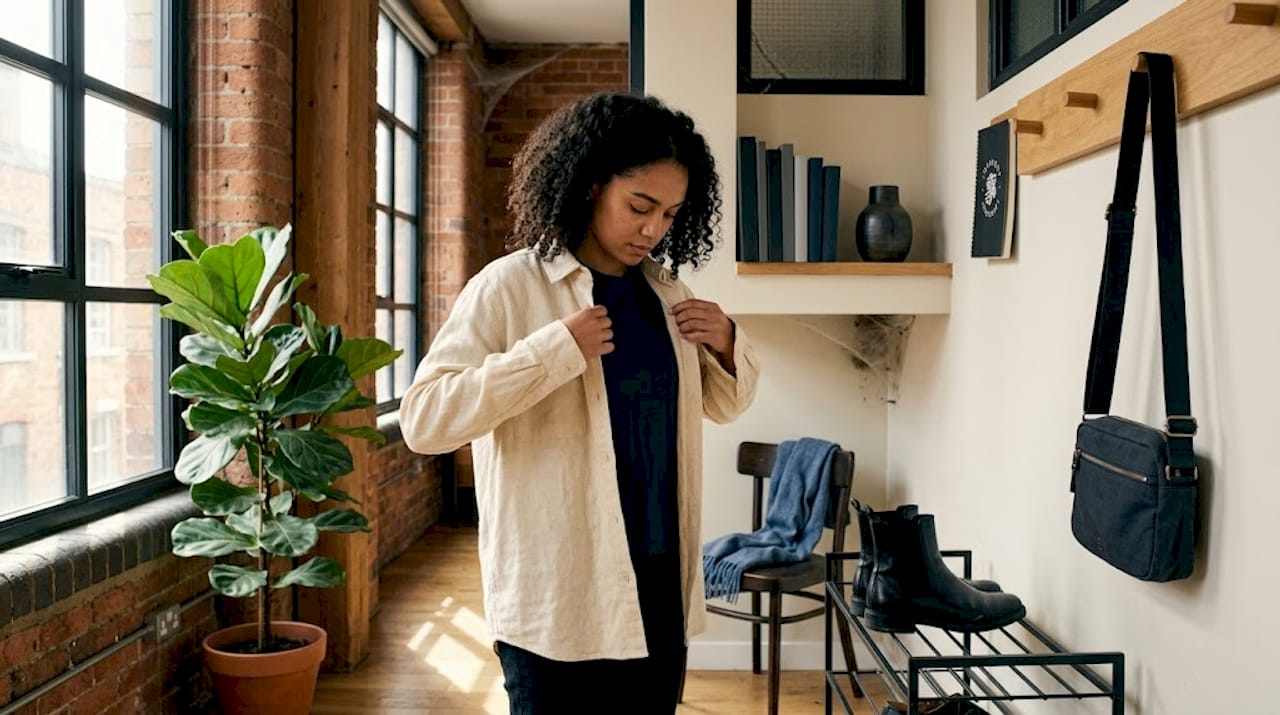
Relaxed-fit shirt in woven fabric: A long-sleeved shirt in a soft, breathable fabric bridges casual and semi-formal settings effortlessly. Worn open over a tee or buttoned as a standalone piece, it adds a layer of visual complexity without demanding attention.
-
Structured mid-layer sweater: A mid-weight sweater in merino, cotton, or a premium blend provides warmth without bulk. Choose a minimal construction with a simple silhouette. This is the layering piece that holds the capsule together across seasons.
-
Well-fitted minimalist trousers: Whether tapered, straight, or slightly wide-legged, a quality pair of trousers in charcoal, navy, or sand forms the lower anchor of every look. Avoid decorative detailing. Focus instead on clean seams, quality fabric, and a cut that flatters without constricting.
-
Adaptable outer layer: A lightweight jacket or overshirt in a neutral tone completes the system. It should be structured enough for cooler days and refined enough to wear over smarter outfits. Functional pockets are a genuine asset in city life.
“The best basics are the ones you never think about wearing — they simply belong. When the shirt is right, the silhouette is right, and the fabric feels honest on the body, dressing becomes effortless.”
Each of these items is chosen for its ability to serve multiple roles. Together, they represent the core of a streetwear essentials guide that values quality over quantity.
Pro Tip: Invest in a premium fabric guide before making purchasing decisions. Understanding the difference between combed cotton, Pima cotton, and jersey will significantly improve your ability to select pieces that actually hold up to city life. Our Japanese fabrics guide is a strong starting point.
For a longer view on building an enduring wardrobe, explore our timeless streetwear wardrobe guide, which covers the philosophy behind long-term capsule construction.
Comparison table: Mix-and-match power of minimalist staples
Understanding each item individually is useful. Seeing how they interact is where the real value of a capsule wardrobe becomes visible. The table below illustrates how each core piece functions across different urban settings and how many distinct outfit combinations each enables.
| Garment | Casual day | Work setting | Evening out | Layering role | Estimated outfit combinations |
|---|---|---|---|---|---|
| Neutral tee | ✓ | ✓ (under shirt) | ✓ (under jacket) | Base layer | 8 to 12 |
| Woven shirt | ✓ | ✓ | ✓ | Mid or outer layer | 10 to 14 |
| Mid-layer sweater | ✓ | ✓ | ✓ | Mid layer | 8 to 10 |
| Minimalist trousers | ✓ | ✓ | ✓ | Anchor piece | 10 to 15 |
| Adaptable jacket | ✓ | ✓ | ✓ | Outer layer | 12 to 16 |
The numbers are not arbitrary. A capsule of five core pieces, each combining with the others in at least two or three configurations, can realistically generate thirty or more distinct looks. That is the architectural logic of a well-built minimalist wardrobe.
Layering combinations worth building into your rotation:
- Neutral tee beneath an open woven shirt, with tapered trousers and clean trainers for a relaxed daytime look
- Sweater over a tee, jacket on top, and trousers for cooler mornings transitioning into warmer afternoons
- Woven shirt tucked into wide-leg trousers with a minimal jacket for semi-formal evening wear
- Tee alone with well-fitted trousers when the weather holds and simplicity is the entire point
Japanese minimalist fashion mastery goes well beyond simply removing excess. It requires attentiveness to tailoring, proportion, and the relationship between garments. Japanese streetwear and garment architecture describes how outfits can appear effortlessly simple while remaining deeply intentional, through consistent silhouettes, considered pocket placement, and coherent fabric pairings.
The streetwear lookbook on our blog demonstrates several of these combinations in real editorial contexts, while our guide to expressing individuality through minimalism shows how subtle choices communicate a great deal.
Layering fundamentals: Adapting essentials for city climates
Cities are unpredictable. A morning that begins with clear skies can shift dramatically by early afternoon, and evening temperatures in European cities regularly drop further than expected. Layering is not a stylistic affectation within a minimalist wardrobe. It is a functional necessity.
The key principles for effective urban layering:
- Match fabric weight to garment role: lighter fabrics belong closest to the body, with progressively denser or more structured materials moving outward
- Prioritise texture contrast over colour contrast: pairing a fine-knit sweater with a woven shirt creates visual interest without introducing new colours
- Ensure each layer can stand alone: if removing a layer mid-day breaks the outfit entirely, the layering logic is flawed
- Keep silhouettes consistent across layers: mixing a very fitted base with an oversized mid-layer and a boxy jacket creates visual confusion rather than intentional depth
- Limit the palette to two or three tones per outfit: this is where Japanese minimalist discipline is most clearly expressed
A compact capsule of the five items listed earlier, worn in different configurations, can realistically generate dozens of layered combinations across the seasons. Esquire’s spring layering guide frames the discipline as matching fabrics to form, texture, and tone rather than simply stacking items for warmth.
The most elegant city outfits often come from the simplest layering decisions. A fine merino sweater over a white tee, paired with tapered charcoal trousers, requires almost no effort and communicates precisely the kind of quiet confidence that Japanese minimalist style is built around.
For practical wardrobe management between wears, our guide on how to fold streetwear efficiently covers storage techniques that preserve garment shape and longevity.
Edge cases and alternative perspectives: Minimalism vs. urban diversity
Minimalist urban style is not without its critics, and it is worth engaging with those perspectives honestly. The most common objection is that restraint, taken too far, produces outfits that feel flat or generic. This is a fair point, and it has genuine implications for how you approach the capsule.
Japanese-inspired minimalism can appear plain or uninspired when the technical and craft emphasis is stripped away entirely. The beauty of Japanese minimalist garments lies not in their blankness but in their depth: indigo variations in denim, carefully engineered stitching along seams, fabric textures that respond differently to light throughout the day. Remove those details and you are left with bland basics rather than elevated essentials.
Ways to add subtle complexity without abandoning restraint:
- Seek out garments with considered seam placement or unusual stitch construction
- Choose fabrics with natural texture variation, such as slubbed cotton, brushed fleece, or washed linen
- Introduce tonal contrast through layering pieces in similar but distinct shades of the same neutral
- Pay attention to hem lengths, cuff widths, and collar construction as quiet differentiators
- Invest in one or two pieces with a subtly refined fit rather than defaulting entirely to relaxed silhouettes
It is also worth acknowledging that urban fashion is not a single language. Bold and maximal urban fashion thrives in several European cities, where intentional clashing, statement pieces, and maximalist layering are equally valid forms of personal expression.
“Minimalism is not the only answer to urban dressing. In cities like Milan, Amsterdam, and Antwerp, fashion often leans deliberately into volume, contrast, and visual tension. Minimalism functions best when it is chosen consciously, not adopted by default.”
This is the most important reframe: minimalism is a system, not a universal rule. It works extraordinarily well when you understand why you are choosing it. It becomes a costume when adopted without that understanding. Choose your street fashion types deliberately, knowing what each approach demands and delivers.
Why minimalist urban fashion is a deliberate system, not a one-size-fits-all rule
Here is the perspective we hold at INCIDENT, shaped by years of working within Japanese-inspired design principles: the capsule wardrobe concept is genuinely powerful, but it is regularly misunderstood.
Most guides treat minimalism as a reduction exercise. Remove enough items, choose neutrals throughout, keep silhouettes simple, and you will arrive at a refined wardrobe. That logic is partially correct but fundamentally incomplete. The real discipline lies not in subtracting but in selecting with genuine intention. Two people can own identical capsule wardrobes and produce utterly different results, because the difference lies in how those items are worn, combined, and adapted to the individual’s physical presence and daily context.
The Japanese methods we draw from at INCIDENT offer tools, not prescriptions. Wabi-sabi teaches you to find beauty in imperfection and natural variation, which translates directly into choosing fabrics with character rather than factory-uniform finishes. Ma, the concept of negative space, teaches you that what you leave out of an outfit is as significant as what you include. These are frameworks for thinking, not formulas for dressing.
Following capsule logic blindly produces generic dressing. You see it frequently in cities: the uniform of grey tee, black slim-fit trousers, and white trainers repeated without variation or personal signature. That is minimalism as default rather than minimalism as choice, and it lacks the quiet authority that genuine Japanese-inspired style carries.
Our advice is to use timeless Japanese streetwear principles as a foundation for building your own visual language. Begin with the essentials outlined here. Learn how they interact. Then start making subtle adjustments: a slightly longer hem here, a refined fabric upgrade there, a tonal palette that feels distinctly yours rather than universally safe. That is when minimalism stops being a trend and becomes a genuinely personal statement.
The most enduring city wardrobes we have seen are not the most minimal. They are the most considered. And consideration, ultimately, is what Japanese design philosophy has always been about.
Upgrade your city style with premium minimalist streetwear
The principles in this article are only as valuable as the garments you build them around. Thoughtful design decisions and everyday practicality should exist in the same piece, and that is precisely what we set out to achieve at INCIDENT Clothing.
Our garments are crafted for fashion-forward individuals who move through European cities with purpose and care. If you are ready to build the kind of wardrobe described in this article, start with the Pima T-shirt collection, where ultra-soft Pima cotton meets clean minimalist construction designed to serve as the foundation of every layered combination. Browse the full range of premium Japanese-inspired essentials at INCIDENT, and discover pieces that earn their place in your wardrobe with every wear.
Frequently asked questions
What are the most versatile items for an urban minimalist wardrobe?
Neutral tees, well-fitted shirts, premium trousers, and adaptable jackets are the most versatile, allowing for easy layering and mix-and-match combinations. A capsule wardrobe built around ten core items can prioritise versatility and repeat-wear effectively.
How do Japanese minimalist principles improve urban streetwear?
Japanese minimalism brings restraint, purposeful design, and subtle detailing, creating refined outfits well suited to city life. The approach emphasises clean silhouettes and subtle complexity over overt decoration, which translates directly into timeless urban dressing.
Can minimalist fashion feel boring or too plain?
Minimalism can feel flat if technical and craft details are absent, but subtle fabric textures, considered structure, and tonal palette choices add genuine depth. Without that craft emphasis, Japanese-inspired minimalism risks appearing plain rather than purposeful.
Are minimalist streetwear essentials suitable for all city environments?
Minimalist essentials are highly adaptable across most urban contexts, but some cities favour bolder, more maximal expression. As urban fashion contrast in European cities illustrates, minimalism functions best as a conscious system rather than a universal default.
What is a ‘capsule wardrobe’ and why is it popular for urban fashion?
A capsule wardrobe groups a small number of high-quality basics that combine easily, offering practical style with fewer items for urban living. The capsule wardrobe approach prioritises versatility and repeat-wear over trend-led purchasing, making it particularly well suited to the demands of city life.

Share:
Real advantages of global streetwear for minimalists
Master Japanese-inspired colour palettes for effortless style