

TL;DR:
- “Made in Japan” signifies a product’s full assembly under strict Japanese standards, reflecting a cultural commitment to quality. It embodies centuries of craftsmanship, continuous improvement, and a philosophy that prioritizes process over inspection, earning global trust and prestige. This label exemplifies a tradition of responsible manufacturing rooted in pride, mastery, and meticulous attention to detail.
There is a common assumption that “Made in Japan” is simply a geographical label, a line of text on a product tag that tells you where something was assembled. But once you look closer, you realise why made in Japan matters in a way that goes far beyond logistics. It speaks to a philosophy of making, a cultural commitment to quality that took decades to build and continues to shape global consumer trust today. From precision machinery to considered fashion design, the label carries weight because the values behind it are genuinely distinctive.
Table of Contents
- Key takeaways
- Why made in Japan matters: a history worth knowing
- The philosophy behind the craft
- Functional beauty and the mingei legacy
- Labels, process control, and what truly sets products apart
- Global trust and consumer confidence
- My perspective on what the label really means
- Wear the tradition: Incident’s Japanese-inspired craft
- FAQ
Key takeaways
| Point | Details |
|---|---|
| A label with cultural depth | “Made in Japan” reflects centuries of craft tradition, not merely a country of origin. |
| Philosophy drives quality | Monozukuri, kaizen, and shokunin culture shape every stage of the production process. |
| Process over inspection | Japanese manufacturers build quality into each production stage rather than catching faults at the end. |
| Trust is globally recognised | Japan holds a 63% consumer trust score for its made-in label, ranking among the world’s most respected. |
| Cultural heritage in design | The mingei tradition and minimalist aesthetics continue to influence fashion, tools, and everyday objects. |
Why made in Japan matters: a history worth knowing
To understand the significance of the label today, you need to start several decades back. Japan’s post-war industrial story is one of the most remarkable reversals in manufacturing history. In the 1950s and early 1960s, Japanese goods were widely dismissed in Western markets as cheap imitations. Toys, textiles, and early electronics exported during this period carried a reputation for low cost and low reliability.
What changed was not a single event but a sustained, deliberate commitment to improvement. The Japanese reputation shifted from cheap to competitive across a period of roughly 35 years, with consumer perception lagging approximately 15 to 20 years behind the actual industrial improvements taking place. This gap is telling. It shows that reputation built on real quality takes time to earn, and that Japan did not take shortcuts.
By the 1980s, Japanese automobiles and consumer electronics had begun to displace Western competitors on quality grounds. Sony, Toyota, and Canon became household names not through marketing alone but through products that consistently performed. The 1990s and early 2000s cemented this transformation as luxury watchmakers, precision toolmakers, and apparel manufacturers carried the standard further.
| Decade | Perception of Japanese goods | Key development |
|---|---|---|
| 1950s to 1960s | Cheap, imitative | Low-cost export market entry |
| 1970s to 1980s | Improving, competitive | Automotive and electronics quality growth |
| 1990s to 2000s | Premium, trusted | Luxury goods, precision instruments, global brand recognition |
| 2020s | Cultural and luxury symbol | Japanese exports rose 14.8% year-on-year in April 2026 |
The economic proof is now consistent. Japan’s April 2026 trade surplus reached 301.9 billion yen, surpassing projections and reflecting sustained global demand across automobiles, chemicals, and machinery. That is not a coincidence. It is the result of generations of disciplined manufacturing practice.
Pro Tip: When evaluating any Japanese product, look beyond the price point. The cost often reflects labour intensity, material quality, and a production philosophy that treats defects as cultural failures, not just operational problems.
The philosophy behind the craft
You cannot separate the quality of Japanese products from the mindset of the people who make them. Three concepts sit at the heart of this: monozukuri, kaizen, and shokunin. Together, they form a philosophy that has no direct equivalent in Western manufacturing culture.
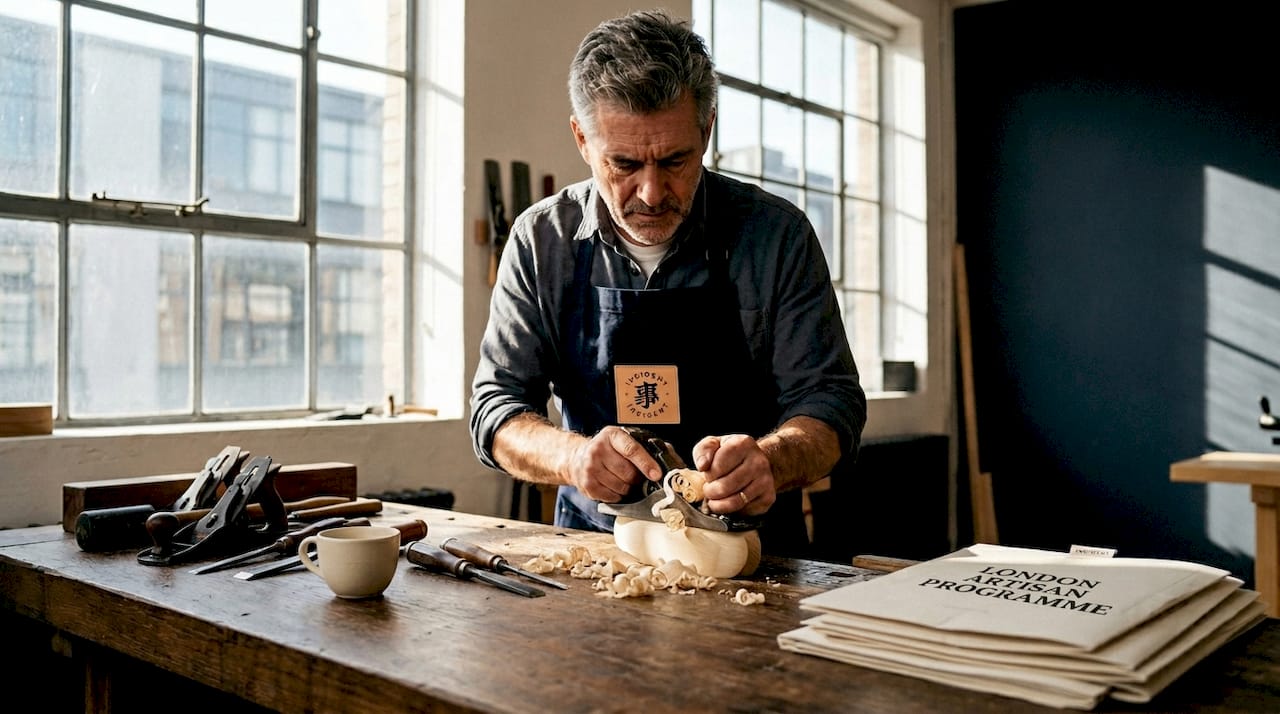
Monozukuri translates loosely as “the making of things,” but that translation loses most of its meaning. Monozukuri culture integrates craftsmanship pride with modern manufacturing in a way that treats process quality as inseparable from product quality. It is a moral and cultural imperative, not a production methodology. A maker practising monozukuri does not simply complete a task. They are accountable to the object itself, to the person who will use it, and to the tradition of the craft they represent.
Kaizen means continuous improvement, and it operates at every level of an organisation. It is not about dramatic overhauls. It is about small, consistent refinements made daily, weekly, across years. This is why Japanese manufacturing processes tend to accumulate precision over time rather than plateau.
Shokunin is the most personal of the three. It describes a craftsperson who dedicates their life to a single craft, pursuing mastery with a discipline that can take decades to develop. A shokunin sushi chef, a shokunin ceramicist, a shokunin textile maker: each embodies a standard of dedication that the finished product quietly carries.
“Monozukuri is more than manufacturing; it is a moral and cultural imperative that shapes how products are made and how workers identify with their craft.” — drawn from Japanese manufacturing culture
Beyond these philosophies, Japanese production employs jidoka, a concept that combines automation with human judgement. A machine on a Japanese production line is often designed to stop itself when it detects an anomaly, prompting human review rather than allowing a defect to continue downstream. This is the opposite of the “fix it later” mentality common in high-volume production environments elsewhere.
- Monozukuri: The cultural obligation to make things with full commitment and pride
- Kaizen: Continuous incremental improvement embedded at every level of production
- Shokunin: Lifelong mastery of a single craft, with personal identity tied to quality
- Jidoka: Automation that stops and signals human attention at the first sign of a fault
- Zero-defect culture: Preventing problems during production rather than filtering them out afterwards
The Western approach to manufacturing quality has historically leant toward inspection at the end of a production line. Japan inverted this. Japanese manufacturers focus on making the production process itself incapable of producing defects. That is a fundamentally different relationship with quality, and it shows in the results.
Functional beauty and the mingei legacy
The importance of Japanese craftsmanship is not limited to industrial manufacturing. It has deep roots in folk craft traditions that shaped how Japanese society views everyday objects. The mingei movement, which began 100 years ago, was built on a simple and quietly radical idea: that ordinary objects used by ordinary people deserve the same care and beauty as fine art.
Mingei challenged the separation between art and utility. A well-made ceramic bowl, a hand-woven textile, a pair of quality scissors: these were not lesser objects because they served a function. They were worthy of the same craft and attention precisely because they were used every day. This philosophy has quietly shaped Japanese design for generations and continues to resonate in contemporary fashion and product culture.
The practical outcomes of this tradition are visible in the following ways:
- Durability as design intent. Japanese products are often made to last far longer than their Western counterparts because longevity is treated as a quality marker, not an optional premium.
- Repairability as a value. Many Japanese goods, from clothing to tools, are designed to be repaired and maintained rather than discarded, which connects directly to the mingei respect for material integrity.
- Subtlety over spectacle. Decoration and ornamentation in Japanese design are restrained. Quality speaks through precision of construction and the character of materials, not surface embellishment.
- Harmony between form and function. The role of craftsmanship in clothing reflects this balance clearly: a garment is considered well-made when it moves with the body, wears beautifully over time, and requires nothing superfluous.
This is why the mingei ethos connects so naturally to minimalist streetwear in the contemporary moment. Clean lines, honest materials, and considered construction are not trends. They are expressions of a tradition that asks makers to show respect for the person who will live with the object.
Pro Tip: When shopping for Japanese-made or Japanese-inspired clothing, examine the seams, stitching, and fabric weight. These details reveal whether the garment was made with genuine craft attention or simply styled to look the part.
Labels, process control, and what truly sets products apart
One of the most common sources of confusion around Japanese goods involves labelling. Not everything described as “Japanese” carries the full standard of manufacture that the term implies. Understanding this distinction helps you make more informed choices.
Take watches as a clear example. “Japan Movt” indicates only that the movement, the internal mechanism, was sourced from Japan. The case may have been assembled elsewhere, the finishing work may have been done at significantly lower cost, and the final quality control may bear no relation to Japanese standards. “Made in Japan,” by contrast, indicates that the full final assembly took place within Japan under Japanese oversight.
| Label | What it guarantees | What it does not guarantee |
|---|---|---|
| Made in Japan | Full final assembly within Japan | Material origin in all components |
| Japan Movt | Japanese-origin movement or mechanism | Japanese assembly or quality oversight |
| Japanese-inspired | Aesthetic influence from Japan | Any connection to Japanese manufacturing |
| Japan components | Some parts sourced from Japan | Assembly location or process standard |
The distinction between these labels affects perceived quality significantly, particularly in precision goods such as watches, optics, and electronic instruments. Full Japanese assembly is rare because it is expensive to maintain. That rarity is part of what makes the label meaningful.
Japan’s quality assurance approach operates through process control rather than final inspection. Raw materials are assessed on arrival. In-process checks happen at multiple stages. Finished goods are evaluated against strict documented standards before they leave the facility. The goal is to make a defective product structurally impossible to produce, not merely unlikely.
There is, however, a human cost to this standard that deserves acknowledgement. Estimated 1,304 karoshi deaths in 2024 were linked to Japan’s overwork culture, reflecting the intense workforce commitment that underpins these quality standards. The word karoshi means “death from overwork.” It is a reminder that the precision and dedication admired in Japanese goods comes from people, and that admiring the output without acknowledging the human dimension is an incomplete picture.
This does not diminish the value of Japanese craftsmanship. But it does place it in honest context. The standards are extraordinary, and they carry a genuine human weight.
Global trust and consumer confidence
Consumers around the world have registered their judgement clearly. Japan holds a 63% consumer trust score for its made-in label, placing it just behind Germany and Switzerland in global rankings. That figure reflects consistent delivery across sectors: automobiles, electronics, fashion, precision instruments, and food products.
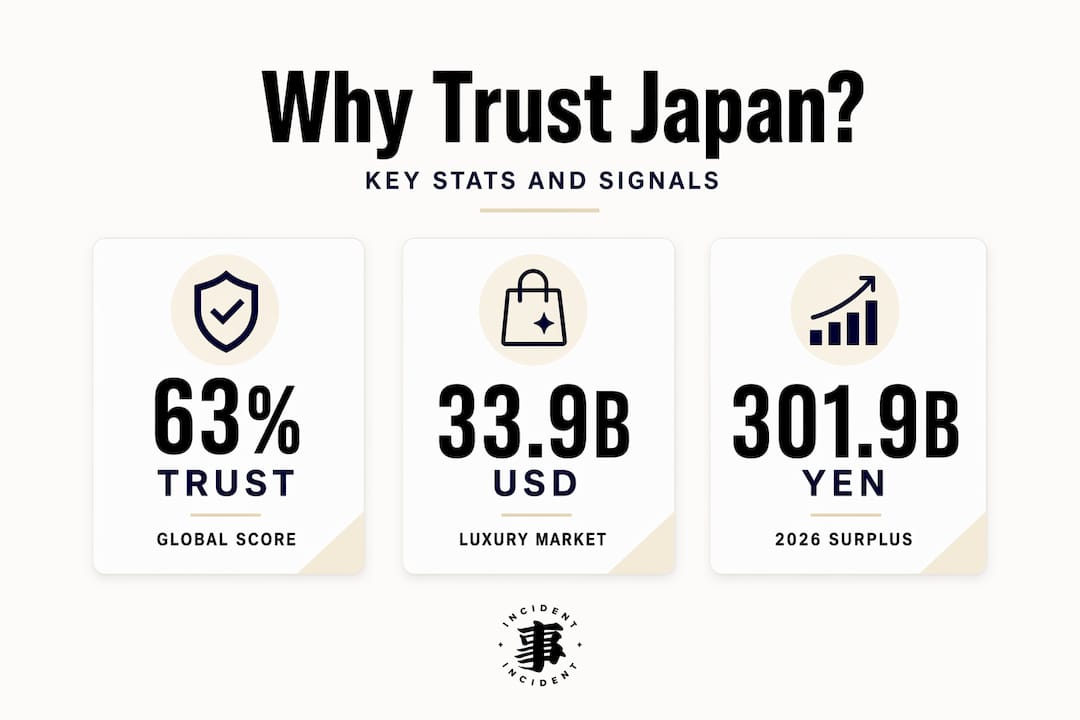
The luxury segment tells a particularly strong story. The Japanese luxury goods market was valued at USD 33.9 billion in 2025 and is projected to reach USD 54.7 billion by 2032, a growth trajectory driven explicitly by consumer preference for human craftsmanship over mass production. Buyers in this segment are not simply paying for a product. They are paying for a relationship with a tradition.
Japanese companies have also influenced the manufacturing culture of some of the world’s most recognisable technology brands. Japan’s monozukuri culture served as a blueprint for modern high-performance hardware manufacturing, shaping approaches to component reliability and product design at the highest levels of the global technology industry.
The cross-sector consistency of this trust is what makes the label durable. When a consumer encounters “Made in Japan” on a camera, a garment, a kitchen knife, or an automobile, they bring the same expectation: that what they are holding was made with care, discipline, and a genuine commitment to quality.
My perspective on what the label really means
I’ve spent considerable time studying and working with Japanese aesthetic traditions, and what strikes me most is how little the label has to do with nationalism and how much it has to do with responsibility. The craftspeople behind these goods feel accountable to the object they are making in a way that is genuinely unusual.
What I’ve observed is that many Western consumers approach “Made in Japan” as a quality signal without fully understanding why the signal is reliable. They trust it because it has been consistently right. But the deeper story, the one about monozukuri and shokunin and the mingei tradition, is far more interesting and far more instructive than the trust score alone.
I’ll be honest about the tension, too. The human cost behind these standards is real. The culture that produces extraordinary precision also produces extraordinary pressure. I don’t think the answer is to romanticise one without the other. The most honest appreciation of Japanese craftsmanship holds both things at once: the beauty of the standard and the weight of what it demands.
What I’ve learned is that the rising presence of Japanese street style in global fashion is not a coincidence. It reflects a genuine hunger for things made with intention, things that carry a story and a standard. In a culture saturated with fast and disposable, the deliberate and the durable command attention.
The value of made in Japan, ultimately, is not in the label. It is in everything the label represents when the people behind it take it seriously.
— Incident
Wear the tradition: Incident’s Japanese-inspired craft

At Incident, we are deeply shaped by the values this article explores. Our approach to design draws from the same philosophies that define Japanese craft: precision in construction, restraint in decoration, and an honest relationship between the garment and the person wearing it. Every piece we create as a premium Swiss-based Japanese streetwear brand is a considered tribute to the Japandi design philosophy, where clean lines and quality materials speak more clearly than ornamentation ever could.
Our Pima T-shirt collection embodies this directly. Crafted from ultra-soft Pima cotton with a silhouette refined for modern streetwear, these pieces carry the quiet confidence that genuine craft produces. If you are drawn to the traditions described here and want to wear something that reflects them, this is where to begin. Discover the full collection at incident.store.
FAQ
What does “Made in Japan” actually signify?
“Made in Japan” indicates that a product was fully assembled within Japan under Japanese manufacturing standards, which are known for rigorous process control and defect prevention at every production stage.
How did Japan’s manufacturing reputation develop?
Japan’s reputation transformed over roughly 35 years following post-war reconstruction, with consumer trust catching up to genuine industrial improvements by the early 2000s after decades of consistent quality delivery.
What is monozukuri and why does it matter?
Monozukuri is the Japanese philosophy of making things with complete craftsmanship pride, treating process quality as inseparable from product quality. It shapes how workers relate to their craft and how defects are culturally understood.
Is “Japan Movt” the same as “Made in Japan”?
No. “Japan Movt” only guarantees that a mechanism or movement was sourced from Japan, while “Made in Japan” confirms full assembly in Japan with Japanese quality oversight across the entire production process.
Why do Japanese goods command a premium price?
Japanese goods reflect labour-intensive production, premium materials, and a manufacturing philosophy built on defect prevention rather than defect correction. The Japanese luxury market is projected to grow to USD 54.7 billion by 2032, driven by consumers who recognise and pay for this difference.



Share:
What is quality control in fashion: a professional guide
What is limited edition fashion? A complete guide