


TL;DR:
- Minimalist streetwear appears effortless but relies on deliberate construction details that ensure durability and quality over time.
- Consumers should focus on hidden signals like seam reinforcement, hardware integrity, and fabric quality, rather than just surface visuals or branding.
Minimalist streetwear looks effortless. Clean silhouettes, restrained colour palettes, uncluttered surfaces. But beneath that composed exterior lies a world of deliberate decisions that most shoppers never notice. The same minimalist look can be achieved through either high-cost engineering and precision finishing, or cheaper construction with weaker hardware and minimal reinforcement. That gap is invisible to the eye and felt only over time. Knowing where to look changes everything about how you shop.
Table of Contents
- Why details define minimalist streetwear
- Types of subtle details in Japanese streetwear
- How to evaluate quality: reading the signals beyond the surface
- Subtle details meet Japanese minimalism: style and philosophy
- Why most buyers underestimate the power of details in streetwear
- Explore Japanese streetwear with premium minimalist details
- Frequently asked questions
Key Takeaways
| Point | Details |
|---|---|
| Details drive durability | Quality signals like reinforced seams and hardware distinguish garments that last. |
| Minimalism is not simple | Premium minimalist streetwear hides intricate engineering under clean lines. |
| Evaluate beyond visuals | Surface appearance can mislead; check construction features for true quality. |
| Japanese brands excel | Japanese streetwear designers blend subtle craftsmanship with authentic minimalist style. |
| Smart buying starts with knowledge | Understanding subtle signals empowers you to choose streetwear that lives up to its promise. |
Why details define minimalist streetwear
Minimalist design is, counterintuitively, one of the most demanding disciplines in garment construction. When there is no pattern to distract, no graphic to draw the eye, and no layering to hide imperfection, every seam, every stitch line, and every closure becomes visible in its own quiet way. A single poorly executed hem or an off-centre seam can undermine an entire piece. The discipline required to produce a garment that reads as effortlessly simple is significant.
This is precisely why artisanal streetwear craftsmanship matters so much in the Japanese aesthetic tradition. Craftsmanship is not an add-on in this design culture; it is the foundation. Japanese garment makers have long operated under the principle that the unseen aspects of a piece, the interior seam finishes, the tension of each stitch, the weight and behaviour of the fabric, are as important as the visual result.
For buyers who are newer to this world, the temptation is to evaluate a minimalist streetwear piece purely on how it looks when laid flat or displayed online. But experienced shoppers know to look deeper. They check the seam consistency across both sides of a garment. They tug gently at hardware to test its resistance. They feel for the subtle thickness at reinforced points.
“A premium minimalist garment earns its price through what you cannot immediately see. Its value is built into the architecture, not the surface.”
What separates credible streetwear from a cheaper imitation in this space comes down to a few core signals:
- Seam reinforcement: Double-stitched or chain-stitched seams at stress points indicate a garment built to endure
- Hardware integrity: Zips, rivets, and fasteners made from quality metal rather than lightweight alloys
- Internal finishing: Clean, covered seams inside the garment suggest consistent standards throughout
- Fabric weight and drape: Premium textiles behave differently, holding structure or falling with intention rather than collapsing
- Stitch density: Higher stitch counts per centimetre signal better hold and less likelihood of unravelling
Brand identity in streetwear is increasingly communicated through exactly these signals. Brands that invest in construction earn a quiet authority that transcends seasonal trends. Buyers who understand construction reward these brands with loyalty, because they have experienced the difference firsthand.
The surface of a minimalist piece, then, is almost a form of misdirection. It tells you very little about the quality of the garment beneath. What it does communicate is the design sensibility. What the construction communicates is something far more important: whether the garment was made to last.
Types of subtle details in Japanese streetwear
Japanese streetwear is distinguished by a considered attention to detail that operates across several categories simultaneously. Understanding these categories helps you assess any piece with confidence, regardless of branding or price point.
The most immediate category is fabric. As premium fabrics in streetwear significantly influence how a garment feels, moves, and ages, fabric selection is a primary quality signal. High-quality cottons, such as Pima or Supima, offer a noticeably different hand feel compared to standard ring-spun alternatives. They are softer against the skin, resist pilling over time, and maintain their colour and weight through repeated washing. Japanese selvedge denim is another classic example: a fabric that carries visible heritage through its tightly woven edge and the behaviour of its indigo dye.
Stitching is the second major category. The nuanced construction details in quality garments affect longevity in ways that are not always visible at first glance. Look for stitch consistency: a straight, even line with no skipped stitches and no puckering along the seam. Premium garments often feature flat-felled seams, where the fabric is folded over itself and stitched down twice, creating a smooth, reinforced interior.
Reinforcement points are the third category, and arguably the most telling. Wherever a garment experiences repeated stress, quality brands add structural support. Bartack stitching at pocket corners and stress points, reinforced eyelets for drawstrings, and bonded or taped seams in outerwear all indicate that the maker anticipated how the piece would actually be worn.
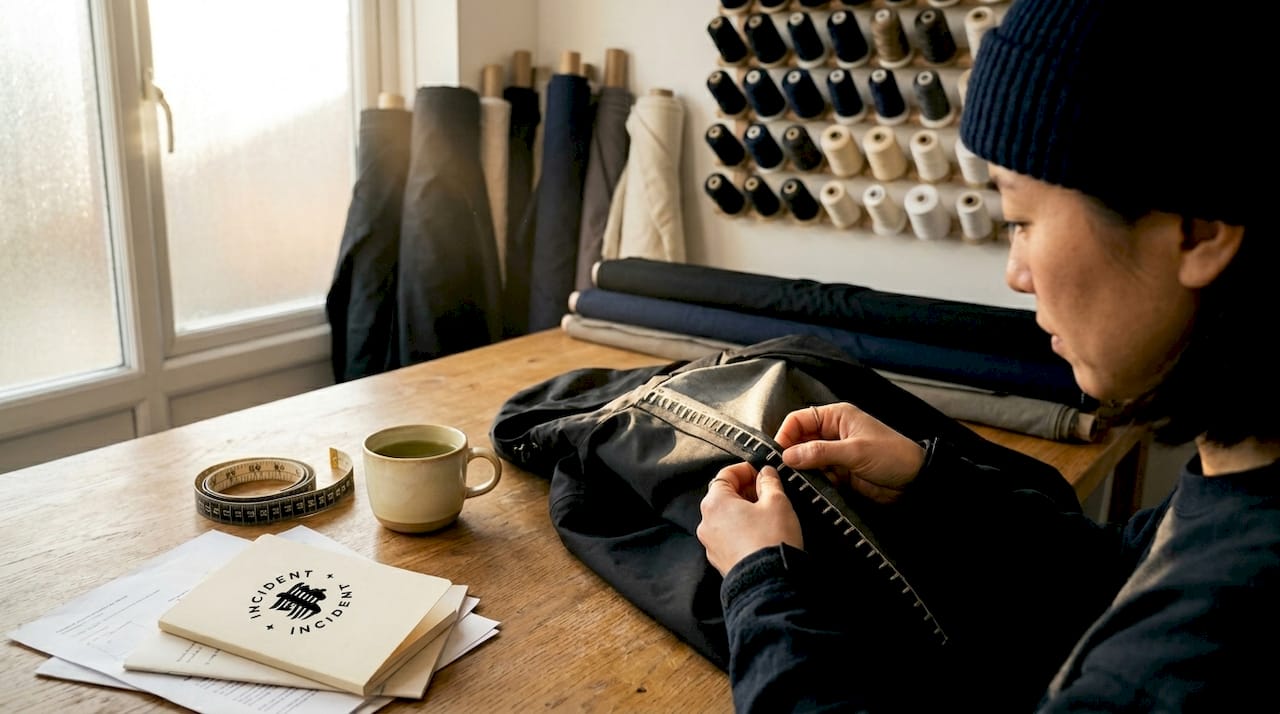
The following table illustrates common differences between premium and standard garment finishes across these categories:
| Detail category | Standard garment | Premium garment |
|---|---|---|
| Fabric composition | Standard polyester or ring-spun cotton | Pima cotton, Japanese selvedge, or GOTS-certified textiles |
| Seam finish | Single-stitched, exposed raw edges | Flat-felled, overlocker-finished, or covered seams |
| Reinforcement | None or minimal at stress points | Bartack stitching, bonded seams, riveted corners |
| Hardware | Lightweight alloy zips and buttons | YKK zips, solid metal rivets, branded closures |
| Hem finish | Single-needle with tight-roll | Chainstitch or double-needle with consistent tension |
| Washing behaviour | Fades unevenly, loses shape | Retains colour and silhouette through extended use |
Hardware deserves its own attention. The tailoring in streetwear conversation often focuses on cut and silhouette, but closures are equally crucial. A YKK zip, for example, is the industry standard for a reason: it opens and closes smoothly for years without catching or breaking. Cheaper alternatives may look identical when new but degrade quickly under regular use.
Pro Tip: When evaluating a minimalist streetwear piece for the first time, run your fingers along the inside seams. A smooth, clean interior finish almost always indicates that the same level of care was applied throughout the entire construction process, not just the visible surface.
Fabric behaviour over time is another dimension worth considering. A premium textile drapes with purpose, sits without creasing in unflattering ways, and maintains its structure after washing. Standard alternatives often develop a thin, sheer quality as they age, losing the weight and opacity that gave the garment its original appeal.
How to evaluate quality: reading the signals beyond the surface
Learning to evaluate minimalist streetwear through its construction signals rather than its surface appearance is a skill worth developing. Here is a practical approach that seasoned buyers use when assessing a new piece.
-
Start with the fabric weight. Hold the garment in your hand before putting it on. Premium fabrics have a satisfying density. Thin, light materials may suggest a lower thread count or a lesser fibre composition, both of which affect durability.
-
Examine the seams from the inside. Turn the garment inside out and check the seam quality. Flat-felled seams, chain stitching, or clean overlocker finishes indicate a considered manufacturing standard. Raw, fraying edges are a warning sign.
-
Test the stress points. Give the seams at the shoulders, underarms, and waistband a gentle, firm tug. Premium construction does not budge. You should feel the structural integrity of the piece, not the anxiety of potential tearing.
-
Check the hardware. Open and close any zips or fastenings multiple times. A quality zip moves smoothly and consistently. Buttons should be securely anchored with no visible thread loosening at the base.
-
Assess the hem finish. A well-executed hem lies flat without puckering and maintains an even width throughout. Poor hem work is one of the easiest construction flaws to spot and one of the first things to fail during wear.
-
Observe the care label and fabric composition. A garment made from a precisely described composition, for instance 100% Pima cotton or 98% organic cotton with 2% elastane, indicates a brand that knows its materials. Vague or unspecified compositions are a red flag.
| Signal | Premium streetwear | Fast-fashion streetwear |
|---|---|---|
| Fabric description | Precise, named fibre origins | Generic, unspecified composition |
| Seam interior | Clean, finished, flat | Raw, loose, or poorly overstitched |
| Hardware | Branded, smooth-running | Unbranded, stiff, or misaligned |
| Stress points | Bartacked or double-stitched | Single-stitched or absent |
| Fit after washing | Maintains original silhouette | Shrinks, distorts, or loses shape |
| Brand transparency | Shares fabric sourcing and construction | Limited or no production information |
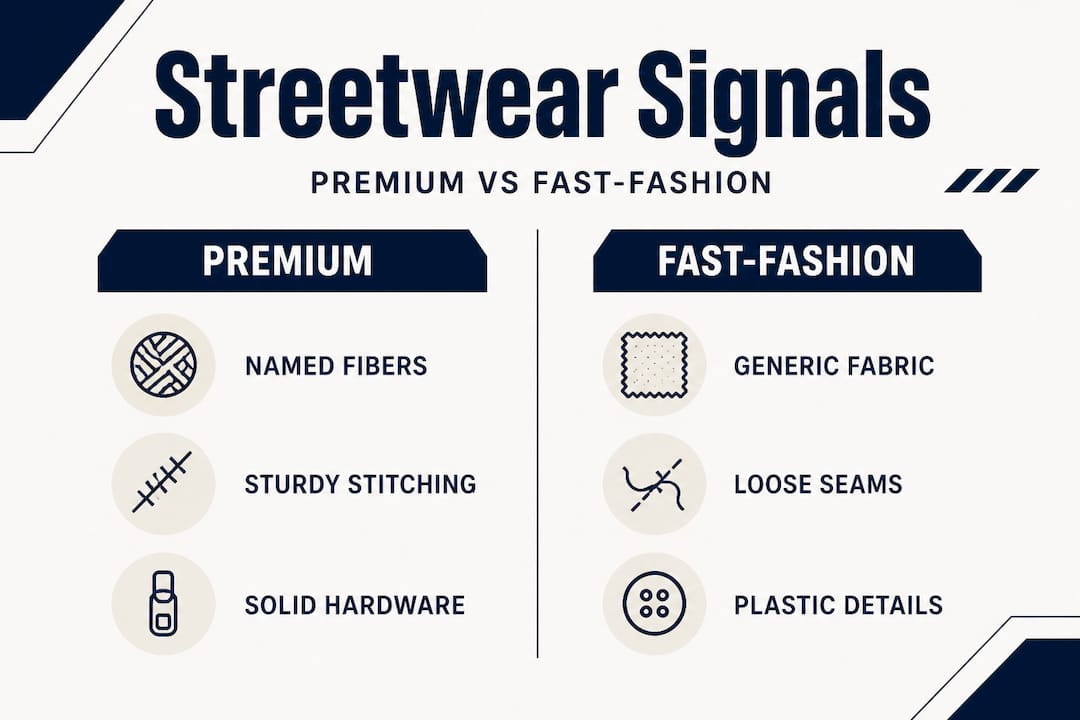
Pro Tip: Avoid relying on visual photography alone when shopping online for minimalist streetwear. Japanese minimalism and modern styles are most accurately assessed through detailed product descriptions that reference specific construction methods and fabric origins. Brands that are proud of their construction will always share these details.
How subtle signals directly impact your wearing experience is worth pausing on. A garment with proper seam reinforcement will not develop that tell-tale spreading along a stressed seam that makes a piece look worn-out after only a few months. Quality hardware means the zip on your favourite jacket still runs cleanly two years from now. A well-finished hem stays tucked and flat through dozens of washes. These are not small things. They are the cumulative difference between a garment that serves you for years and one that disappoints within a season.
Subtle details meet Japanese minimalism: style and philosophy
To truly appreciate the role of subtle details in Japanese streetwear, it helps to understand the philosophy from which this aesthetic tradition emerges. Japanese minimalism is not simply a design trend. It is rooted in centuries-old principles around simplicity, restraint, and the beauty found in things that are precisely what they need to be and nothing more.
Wabi-sabi, the Japanese concept that finds beauty in imperfection and transience, shapes how garments are designed and valued. A piece influenced by this sensibility is not trying to impress through excess. It communicates through restraint, inviting the wearer to notice the quality of the fabric, the precision of the cut, and the considered nature of every element included and excluded.
“In Japanese design, the decision not to add something is as deliberate as the decision to include it. Restraint is not emptiness. It is discipline made visible.”
This philosophy has a profound effect on how subtle details are used. Rather than decorating a piece with external embellishments, Japanese streetwear brands embed their identity in the construction itself. A signature stitch technique, a particular seam finish, or a specific weave structure becomes the mark of the brand without requiring a visible logo.
Japanese-inspired essentials built in this tradition carry a different kind of authenticity. Their quality is not announced. It is discovered over time, through wearing and living with the piece. The garment earns a relationship with its owner through consistent behaviour.
From a lifestyle perspective, this approach makes enormous practical sense. Pieces built on subtle, considered details stand up to real wear in ways that trend-driven or visually flashy alternatives do not. Consider these qualities that genuine Japanese minimalist garments offer:
- A well-constructed T-shirt in Pima cotton holds its shape and softness through years of weekly washing
- A minimalist jacket with reinforced seams and quality hardware outlasts five seasons without structural degradation
- Trousers with precise tailoring and covered interior seams maintain their silhouette and comfort as the fabric ages and softens
- Outerwear with bonded seam tape keeps its weather resistance without the tape peeling or bubbling
The minimalism lookbook aesthetic is most compelling when the garments themselves genuinely reflect the principles they represent visually. A piece that looks minimal but is poorly constructed is a contradiction. True Japanese minimalist streetwear achieves visual and structural harmony simultaneously.
For buyers, this means the act of evaluating a garment becomes something more than practical assessment. It becomes an alignment of values. When you choose a piece based on its construction integrity and its material honesty, you are participating in the same design philosophy that shaped it. You are choosing craft over convenience, and longevity over novelty.
Building a timeless minimalist wardrobe in this way is deeply satisfying precisely because each piece justifies its place. Nothing is superfluous. Every garment earns its position through quality and considered design. That is a wardrobe built not just for style, but for life.
Why most buyers underestimate the power of details in streetwear
After years of working within Japanese-inspired streetwear and observing how buyers engage with minimalist garments, we have come to a clear conclusion: most people are shopping with the wrong lens. And that is not a criticism. It is simply a reflection of how the fashion industry has trained consumers to make decisions.
The dominant shopping behaviour, shaped by social media, trend cycles, and the rise of fast fashion, is visual and immediate. You see a look, you want the look, you buy the look. The surface experience is everything. In this environment, a beautifully styled image of a minimalist T-shirt communicates exactly as much as a poorly constructed one. The image conceals the gap between them entirely.
This creates a genuine problem. Buyers who invest in what appears to be premium minimalist streetwear, based on branding alone or a clean visual identity, are sometimes left disappointed when the garment fails to live up to the promise. The zip sticks after three months. The seams spread at the shoulder after a season. The fabric goes thin and sheer after a dozen washes. None of this was visible at the point of purchase.
The uncomfortable truth is that minimalist is not automatically premium. The simplicity of the aesthetic actually makes it easier, not harder, for fast-fashion producers to imitate credible premium pieces at surface level. Without a complex pattern or visible embellishment to recreate, a cheaper producer only needs to get the silhouette approximately right to achieve a convincing visual replica.
What they cannot replicate easily is defining garment quality from the inside out. They cannot afford the time or the material cost of flat-felled seams, quality zips, or Pima cotton. The inside of a garment is where the true difference lives.
We have seen buyers return to construction-focused brands after a period of chasing visual aesthetics and find the experience revelatory. The feel of a correctly weighted fabric. The way a well-cut garment moves with the body rather than against it. The quiet confidence of wearing something built to last. These things are not abstract luxuries. They are felt every time you get dressed.
Our advice: learn to shop with your hands as much as your eyes. Read the fabric composition label with real attention. Ask brands questions about their construction methods. If a brand struggles to answer those questions, that itself is informative. The brands that know what they are making are proud to tell you.
Explore Japanese streetwear with premium minimalist details
Understanding subtle details and construction signals transforms how you shop, and now you can put that knowledge to use with a collection built around exactly these principles.

At INCIDENT, every garment we design reflects the values explored in this article. Clean lines, precision construction, and premium fabrics chosen for their behaviour and longevity rather than cost savings. Our Pima cotton pieces are a particularly strong starting point for anyone building a considered minimalist wardrobe. Pima cotton is softer, stronger, and more colour-stable than standard alternatives, and you will feel the difference immediately. Explore the full collection at incident.store and apply everything you have learned here to find the pieces that genuinely earn their place in your wardrobe.
Frequently asked questions
What construction details matter most in minimalist streetwear?
Seam reinforcement, hardware quality, and fabric selection are the three most crucial construction signals for durability and comfort in minimalist streetwear. These elements determine how a garment performs over time, not just how it appears when new.
How do subtle details influence streetwear longevity?
Hidden features such as consistent seam finishing and reinforced closures and hardware ensure a garment lasts far longer than its surface aesthetics might suggest. A clean exterior can mask either excellent or poor internal construction, making it essential to look beyond the surface.
How can buyers distinguish premium from fast-fashion minimalist streetwear?
Check for thorough construction signals including quality hardware, precision stitching, and detailed fabric composition labelling, rather than relying solely on sleek visual presentation or branding.
Why are Japanese brands renowned for subtle streetwear details?
Japanese streetwear labels blend minimalist design traditions with careful engineering, resulting in garments that communicate authenticity through construction rather than decoration. This approach is rooted in cultural values around craft, discipline, and the beauty of purposeful restraint.
Recommended
- How to use streetwear elements: Japanese styling made simple – INCIDENT
- Master key streetwear terminology for Japanese fashion – INCIDENT
- Versatile streetwear: minimalism meets Japanese urban style – INCIDENT
- Men’s streetwear essentials: refined Japanese-inspired style – INCIDENT
- Streetwear footwear: style, comfort, and culture explained – Dracoslides



Share:
A guide to Japanese street symbols: meaning and modern style
Build a versatile wardrobe with Japanese minimalist streetwear