

TL;DR:
- Quality control in fashion involves multiple stages, from pre-production to final inspection, to ensure brands meet quality standards. Integrating quality assurance and QC processes, along with digital systems, enhances defect prevention, transparency, and supply chain resilience. Modern strategies emphasize early-stage inspection, precise defect classification, and supplier performance data to maintain consistency and mitigate costly errors.
Quality control in fashion is far more than a final inspection before goods leave the warehouse. It is a structured, multi-stage discipline that governs every decision from the raw fabric bolt to the finished garment hanging on a rail. Many students entering the industry assume a quick visual check at the end of production is sufficient. It rarely is. With clothing return rates reaching 26% and generating $203.22 billion in losses in 2022 alone, the financial and reputational stakes of poor quality management are impossible to ignore. This guide walks you through every critical stage, method, and strategy you need to understand.
Table of Contents
- Key takeaways
- What is quality control in fashion production?
- The three core stages of QC
- AQL and defect classification explained
- Why QA and QC must work together
- Modern QC strategies for 2026 fashion brands
- Common QC challenges and how to overcome them
- My perspective on quality control in fashion
- How Incident brings quality control to life
- FAQ
Key takeaways
| Point | Details |
|---|---|
| QC spans the entire production process | Quality control is applied at pre-production, in-process, and post-production stages, not only at the end. |
| AQL standardises inspection decisions | Acceptable Quality Limit sampling removes subjective judgement and sets clear pass/fail thresholds for garments. |
| QA prevents, QC detects | Quality assurance is proactive and process-focused; quality control is reactive and product-focused. Together they reduce defects and costs. |
| Early inspection is cost-critical | Catching defects within the first 20% of production prevents those issues from affecting the remaining volume. |
| Digital systems are reshaping QC in 2026 | Centralised quality management platforms provide real-time defect tracking and supply chain visibility that manual tools cannot match. |
What is quality control in fashion production?
Quality control in fashion is the systematic process of inspecting, measuring, and evaluating garments and materials against predetermined standards at multiple points throughout production. The goal is to identify and correct deviations before they compound into costly defects, customer complaints, or brand damage.
The term is frequently confused with quality assurance, and many professionals use them interchangeably. They are not the same thing. Quality control is a reactive discipline. It examines a product after an action has taken place and determines whether it meets specification. Quality assurance is what happens before and during production to prevent failures occurring in the first place. Both matter, and the most effective fashion brands treat them as two complementary pillars of the same system.
Understanding what quality means in garments requires looking beyond aesthetics. Construction integrity, dimensional accuracy, colourfast dyes, seam strength, and label compliance all fall within quality control’s scope. A garment that looks right but fails a wash test or shrinks after one use has passed a subjective check and failed an objective one.
The importance of quality control in fashion cannot be overstated when 86% of consumers choose brands based on product quality. One poor season can erode trust that took years to build.
The three core stages of QC
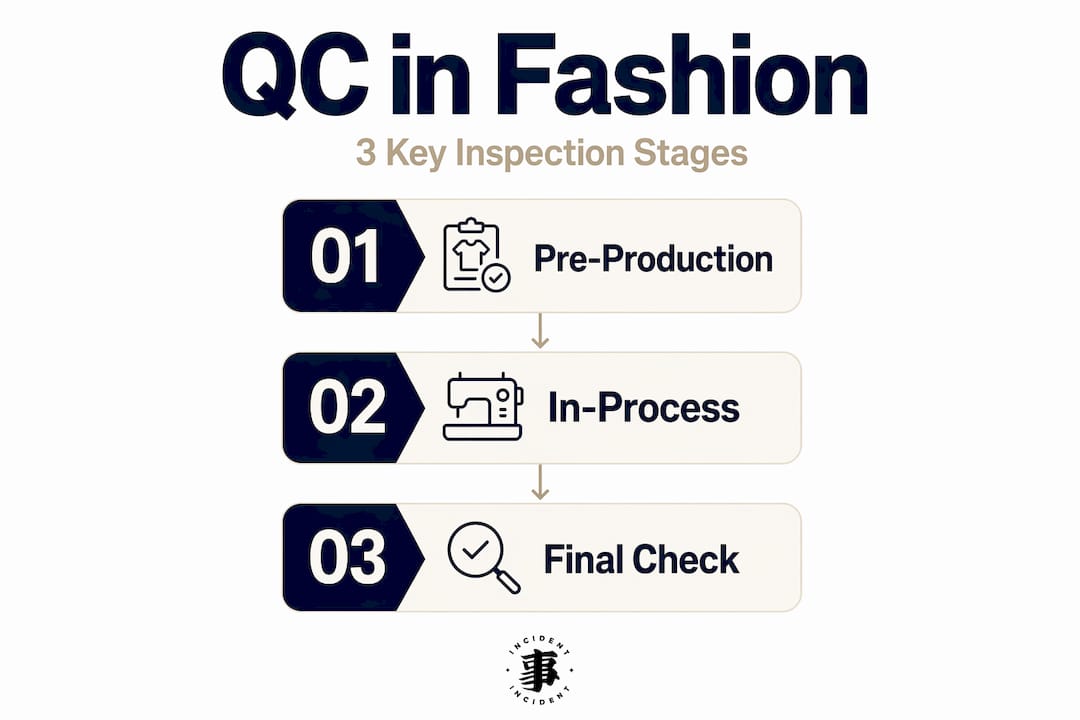
Fashion quality management strategies typically organise inspection into three distinct production phases. Each serves a different purpose and catches different types of problems.
Pre-production inspection
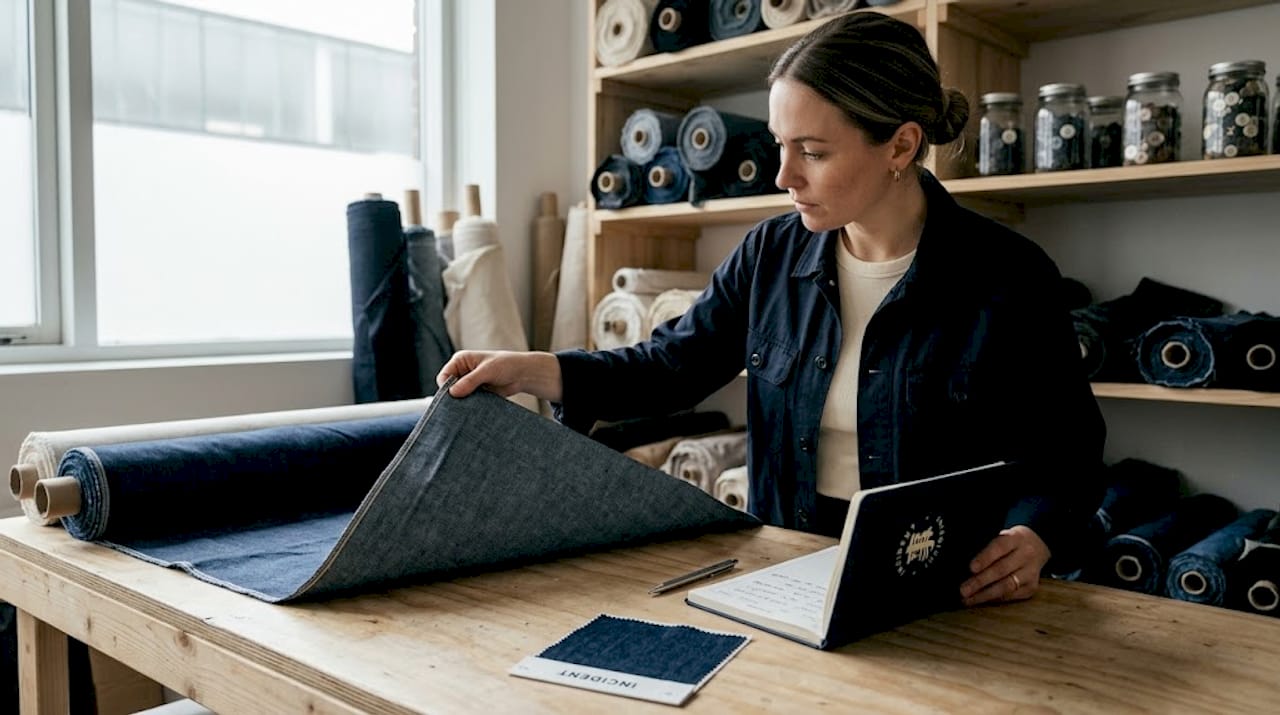
This stage happens before any bulk cutting or sewing begins. Inspectors assess incoming fabrics, trims, zips, buttons, and labels against the technical specification sheet. A fabric that arrives with the wrong weight, incorrect colour matching, or uneven weave is rejected before it wastes a single hour of labour. Pre-production checks also include evaluating the sealed sample or gold seal sample, which is the approved reference garment against which all production will be measured. If the sealed sample itself contains unresolved issues, they must be resolved here.
In-process inspection (DUPRO)
During Production inspection, often called DUPRO, typically occurs when 15% to 30% of an order is complete. At this point, inspectors visit the factory floor and examine finished pieces as they come off the line. Problems identified here, such as inconsistent stitching tension, misaligned plackets, or colour deviations, can be corrected before they affect the majority of the order. This is the stage where early defect detection generates the greatest cost savings.
Final random inspection
The final inspection takes place once 100% of production is complete and at least 80% of goods are packed. Inspectors draw a statistically representative sample from the lot and examine each piece against a defined defect classification list. Pass or fail decisions are made here based on the overall defect rate found.
- Pre-production: Verify fabrics, trims, and approved samples before cutting begins.
- In-process: Inspect at 15% to 30% completion to catch recurring production errors early.
- Final: Conduct a random inspection on packed goods using standardised sampling methods.
- Defect classification: Sort findings into critical, major, and minor categories with clear thresholds.
Pro Tip: Always request a pre-production meeting with the factory before bulk production begins. Reviewing the approved sample together with the production team reduces misinterpretation and prevents the most common defects from occurring.
AQL and defect classification explained
The Acceptable Quality Limit, known as AQL, is the backbone of standardised quality control processes in apparel. It is a statistical sampling method, based on ISO 2859-1:1999, that tells you how many units to inspect from a given lot size and how many defects are permissible before the entire shipment is rejected.
AQL works by defining a maximum number of defective pieces considered acceptable as a process average. The most common AQL levels used in fashion are 1.0, 2.5, and 4.0, where a lower number represents a stricter standard. Premium garments and childrenswear typically use AQL 1.0 or 2.5 for major defects. Mass-market apparel often accepts AQL 4.0 for minor defects.
The defect classification system that operates alongside AQL is what makes the whole framework function with precision.
| Defect type | Definition | Examples | Typical AQL threshold |
|---|---|---|---|
| Critical | Renders garment unsafe or non-compliant | Exposed wiring, toxic dye, choking hazard | AQL 0 (zero tolerance) |
| Major | Likely to cause customer rejection | Broken seam, wrong size label, visible stain | AQL 1.0 to 2.5 |
| Minor | Does not affect function but reduces quality perception | Loose thread, slight colour variation, minor measurement drift | AQL 4.0 |
The power of AQL is that it removes subjective judgement from inspection decisions. A piece either passes or fails against a measurable criterion. There is no room for the “it looks okay to me” mentality that so often allows inconsistent products to reach customers.
Pro Tip: When setting AQL levels with a new supplier, negotiate the classification of specific defects in writing before production begins. What one factory considers minor, another may consider acceptable entirely. Written agreement prevents disputes at final inspection.
Why QA and QC must work together
To understand what is quality assurance in textiles, you need to think about prevention rather than detection. While quality control catches defects that have already occurred, quality assurance prevents them from happening by controlling the processes, systems, and conditions that lead to defects in the first place.
QA activities in fashion include:
- Writing clear and detailed technical specification sheets for every garment style.
- Establishing supplier qualification procedures before awarding production orders.
- Developing standardised work instructions for each sewing operation.
- Conducting factory audits to assess capability, compliance, and working conditions.
- Running pre-production fit sessions and wash tests to validate construction before bulk production begins.
QC activities, by contrast, include the inspections described above: checking physical products against specifications at defined stages.
The impact of quality on fashion brands becomes most visible when QA and QC are misaligned. A brand that invests heavily in final inspections but has no supplier qualification process will find itself repeatedly discovering the same category of defects, lot after lot, because the root cause was never addressed. Conversely, a brand that relies entirely on process controls without physical inspection trusts that nothing will go wrong. That trust is rarely justified in complex global supply chains.
Integrating QA and QC reduces rework, delays, and production costs, while improving on-time shipment rates and the trust between buyer and supplier. The combination is not redundant. It is structural resilience.
Modern QC strategies for 2026 fashion brands
The most significant shift in fashion quality management strategies over the past five years is the move away from disconnected spreadsheets and paper-based checklists toward centralised digital quality management systems. This is not a gradual preference. It is becoming a competitive necessity.
- Adopt a centralised digital QC platform. Digital quality management systems provide real-time defect tracking, supplier scorecards, and traceability across multiple factories simultaneously. Teams can identify defect trends by supplier, product category, or season without waiting for end-of-season reports.
- Prioritise early-stage inspection. Catching issues within the first 20% of production means the remaining 80% can be corrected before reaching the packing stage. This single discipline has more cost-saving power than any final inspection.
- Use data to manage supplier performance. Real-time analytics reveal which suppliers consistently produce higher defect rates and which categories of defects recur. This data transforms QC from a pass/fail exercise into an ongoing improvement conversation with your production partners.
- Build QC requirements into your purchase orders. Specify AQL levels, defect classifications, and inspection timing directly in the contract. Suppliers who understand expectations in writing perform more consistently than those given verbal direction.
- Commission third-party lab testing for fabric compliance. In-house or factory-conducted tests are subject to bias. Independent laboratory testing for colourfastness, tensile strength, shrinkage, and chemical compliance provides objective evidence of fabric quality assurance in textiles.
“Agility and supply chain visibility in quality control cultivate competitive advantages in 2026 fashion markets, shifting QC to a data-driven culture beyond manual checks.” — Fashion quality control in 2026
How premium fabrics shape quality is a question that begins long before the first stitch. The best QC systems in 2026 treat fabric sourcing and supplier selection as the first line of quality defence.
Common QC challenges and how to overcome them
The most persistent challenge in fashion quality control processes is the “looks okay” syndrome. This is the tendency, often born from time pressure or supplier familiarity, to approve a garment based on a general visual impression rather than a structured check against specification. Subjective QC checks are inconsistent by definition, and inconsistency is the enemy of brand credibility.
Beyond subjectivity, here are the practical challenges professionals encounter most frequently, along with approaches that address them.
- Vague specifications: Technical packs without precise measurements, tolerances, and material call-outs leave too much room for interpretation. Every specification should include both a target measurement and an acceptable deviation range.
- Inconsistent supplier communication: Verbal agreements about quality standards are routinely misremembered or disregarded. All quality requirements should be confirmed in writing and acknowledged by the factory before production begins.
- Inspection cost hesitation: Inspection visits typically cost between $200 and $400 per visit. Many smaller brands see this as an avoidable expense. A single shipment of faulty garments reaching customers can cost multiples of that figure in returns, markdowns, and lost repeat purchase.
- No supplier quality tracking: Without a record of previous defect rates by supplier, every order starts from zero. Maintaining a simple defect log by supplier and style reveals patterns that would otherwise remain invisible until a crisis occurs.
- Skipping lab tests: Visual inspection cannot detect invisible quality failures such as dye that bleeds after washing or fabric that loses 15% of its dimensions in the first launder cycle. Budget for independent lab testing on key fabrics, particularly for new suppliers.
Pro Tip: When commissioning a third-party inspection, send the inspector your sealed sample and a completed measurement specification sheet in advance. An inspector who knows exactly what they are looking for produces a far more reliable report than one working from a verbal description.
My perspective on quality control in fashion
What I’ve seen, working with premium garment production, is that the brands most at risk from quality failures are rarely those with the smallest budgets. They are the brands that treat quality control as a formality rather than a philosophy.
There is a deeply rooted misconception that QC is something you do at the end of production to find out how badly things went. In my experience, that framing produces exactly the outcomes it deserves: costly surprises, rushed remediation, and damaged relationships with suppliers who were never given the tools to succeed. The real value of quality control lies in its preventive architecture, in building systems where defects are structurally unlikely rather than periodically discovered.
What I’ve found actually works is combining rigorous pre-production alignment, genuine DUPRO visits, and supplier-level data tracking into a single continuous feedback loop. When a supplier knows their defect rates are being measured, recorded, and discussed transparently, behaviour changes. Quality becomes a shared standard rather than an adversarial negotiation.
For fashion students especially, I would say this: the technical knowledge of AQL tables and defect classifications is learnable in a day. The harder skill is building the discipline to apply those standards consistently, especially when a factory manager is telling you the goods are fine and the shipment deadline is tomorrow. That discipline is what separates brands that grow with integrity from those that quietly absorb the cost of their own shortcuts.
The craftsmanship tradition in clothing that genuinely endures is always backed by a quality system, whether formalised or instinctive. Quality is not an attribute of a product. It is the result of every decision made along the way.
— Incident
How Incident brings quality control to life
At Incident, the principles discussed throughout this article are not abstract concepts. They are woven into the fabric of every piece we design, quite literally. As a premium Japanese-inspired streetwear brand based in Switzerland, we understand that quality is the foundation upon which every other element of our collection rests.
Every fabric we select undergoes rigorous assessment before it becomes part of a garment. Our Pima cotton pieces, for example, represent a deliberate choice rooted in material excellence. The Pima cotton collection reflects our commitment to sourcing fibres that meet exacting standards for softness, durability, and dimensional stability. When you hold one of our pieces, the quality you feel is the product of decisions made long before the first stitch.
Our minimalist, Japandi-influenced aesthetic demands precision at every construction stage. Clean lines and subtle details only read as intended when the garments holding them are built to specification. There is no room for tolerance drift in a design that relies on proportion and restraint.
Explore the full range of our Japanese streetwear collections and discover what genuine quality management feels like when it is expressed through garments designed to endure. When craft and control meet, the result is clothing you reach for again and again.
FAQ
What is quality control in fashion?
Quality control in fashion is the systematic inspection and evaluation of garments and materials against defined standards at multiple stages of production. It includes pre-production checks, in-process inspections, and final random inspections before shipment.
What is the difference between QA and QC in apparel?
Quality assurance is a proactive, process-focused approach that prevents defects from occurring, while quality control is a reactive, product-focused approach that detects defects after they have happened. Both are necessary for consistent fashion production quality standards.
What is AQL in fashion quality control?
AQL, or Acceptable Quality Limit, is a statistical sampling method based on ISO 2859-1:1999 that determines how many units to inspect from a production lot and how many defects are permissible before a shipment is rejected.
Why does early inspection matter so much?
Identifying defects within the first 20% of production allows corrections to be made before those issues affect the remaining 80% of the order. This single practice dramatically reduces rework costs and prevents defective goods from reaching customers.
How much does a garment inspection typically cost?
A professional garment inspection visit typically costs between $200 and $400. This is a modest expenditure compared to the cost of customer returns, markdowns, and reputational damage caused by quality failures reaching the market.
Share:
Fashion subcultures explained: origins, meaning, and style
Why made in Japan matters: craftsmanship and culture