

TL;DR:
- Utility fashion is a design philosophy that emphasizes purpose-driven, durable, and functional clothing rooted in military and workwear heritage. It features practical details like secure pockets, structured silhouettes, and a refined earthy neutral palette for versatile, trans-seasonal wear. Properly curated, utility fashion combines style and function seamlessly, offering timeless, thoughtful wardrobe staples.
Utility fashion is one of those terms that gets misread constantly. Many people hear it and picture boiler suits, steel-capped boots, or the kind of outfit that belongs on a building site. The reality is far more refined. What is utility fashion, at its core, is a design philosophy that puts purpose first without sacrificing considered aesthetics. It draws from military and workwear heritage, translates durability and practicality into wearable everyday pieces, and has quietly shaped some of the most enduring looks in contemporary streetwear. Understanding it properly changes how you see your entire wardrobe.
Table of Contents
- Key takeaways
- Where utility fashion began
- Defining features of modern utility fashion
- Style and function as a single idea
- How to wear utility fashion well
- My perspective on utility fashion’s lasting power
- Build your utility wardrobe with Incident
- FAQ
Key takeaways
| Point | Details |
|---|---|
| Rooted in wartime design | Utility fashion traces its origins to the UK’s wartime Utility Clothing Scheme and military workwear traditions. |
| Function drives every detail | Authentic utility pieces prioritise real usability: secure pockets, adjustable closures, and durable fabrics that hold up. |
| Colour palette is everything | Earthy neutrals like olive, khaki, stone, and black keep utility looks refined rather than costume-like. |
| Layering is built in | Utility fashion is designed for trans-seasonal adaptability, with silhouettes that layer cleanly without losing proportion. |
| Less is more | Starting with one or two well-chosen foundational pieces builds a flexible wardrobe far more effectively than bulk buying. |
Where utility fashion began
To understand utility fashion defined in its fullest sense, you need to go back to a moment when clothing had to earn its keep. During the Second World War, the British government introduced the Utility Clothing Scheme, which ran from 1941 to 1952. This programme regulated what could be produced, how much fabric could be used, and what garments could cost. Decoration was stripped back. Cuts were simplified. Every element of a garment needed to serve a function.
This was not merely wartime austerity. It was an accidental design revolution. The restrictions forced manufacturers to focus on the qualities that genuinely mattered: durable construction, clean silhouettes, and versatile forms that could withstand daily wear. When the scheme ended, those principles did not disappear. They embedded themselves into the broader culture of British dressing.
Military uniforms contributed their own vocabulary to this heritage. Consider the field jacket, the combat trouser, the overshirt. These pieces were designed for durability and carrying capacity long before they became streetwear staples. The multiple pockets, reinforced stitching, and adjustable waistbands were engineering solutions, not aesthetic choices. Fashion eventually recognised their visual power.
The workwear tradition added another layer. Labourers in the early twentieth century wore heavy cotton canvas, sturdy denim, and gabardine precisely because these fabrics could absorb punishment without failing. The shapes were loose enough for movement and structured enough to maintain form.
Key historical influences that shaped utility fashion include:
- The UK Utility Clothing Scheme, which codified simplicity and durability as design virtues
- Military field uniforms with their functional pocket systems and weather-resistant fabrics
- Industrial workwear traditions using cotton canvas, denim, and gabardine for demanding physical labour
- Post-war ready-to-wear, which absorbed these utilitarian principles into mainstream clothing design
- The 1990s workwear revival, which reintroduced cargo trousers and utility jackets to street-level fashion
Understanding this lineage matters because it explains why utility fashion never feels dated for long. It is not a passing trend. It is a recurring conversation between clothing and the reality of human life.
Defining features of modern utility fashion
Utility fashion today is recognisable through a consistent set of design characteristics that separate it from generic casualwear. These are not arbitrary stylistic choices. Each feature connects back to the functional DNA the style inherited from its workwear and military roots.
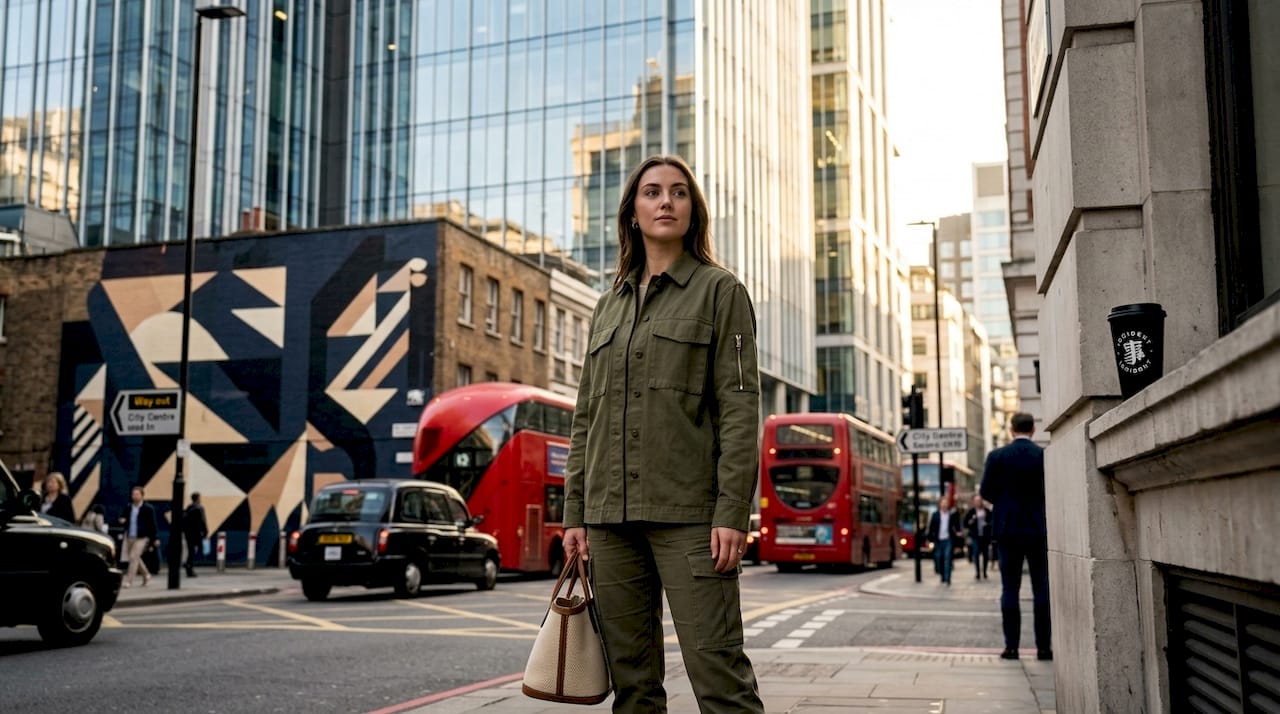
The most visible characteristic is pocketing. Authentic utility pieces prioritise secure, usable pocket openings rather than decorative flaps that serve no purpose. Cargo trousers typically feature deep side pockets with press-stud or zip closures. Overshirts carry chest pockets sized to hold real objects. Utility jackets distribute pockets across multiple panels for balanced weight and easy access. This is what separates genuine utility design from garments that merely borrow the aesthetic.
Fabric choice defines the feel and longevity of utility clothing. The most common materials are:
- Cotton canvas: heavyweight, structured, and weather-resistant
- Gabardine: tightly woven, smooth-faced, and naturally water-repellent
- Ripstop nylon: lightweight yet tear-resistant, borrowed directly from military gear
- Heavy cotton twill: durable, holds colour well, and softens with wear
- Stretch cotton blends: modern additions that maintain utility shapes while improving comfort and movement
Silhouette in utility fashion tends toward the structured and relaxed simultaneously. Shoulders are clean and defined. Trousers sit with ease through the thigh without becoming shapeless. Jackets drape with intention. The goal is a silhouette that works while you move through a real day, not one constructed purely for standing still in a studio.
Colour is where many people make their first mistake. The palette of utility fashion defined properly is narrow by design. Olive, khaki, stone, sand, black, and tobacco are the anchors. These tones emerged from workwear and military contexts, where visibility or uniformity demanded natural, muted shades. Today, an elevated palette of ecru, stone, tobacco, and khaki separates refined utility dressing from the kind of look that reads as army surplus.
Pro Tip: When choosing utility pieces, assess whether the functional details actually work before you buy. Pull the zip. Test the pocket depth. Check if the waistband adjustment has genuine range. Decorative utility is the most common disappointment in this category.
Style and function as a single idea
The most compelling thing about utility fashion is what happens when you stop treating function and style as separate concerns. Utility dressing is a deliberate design philosophy where every detail justifies its presence, making the look intentional rather than accidental. This shifts how you read a cargo pocket or a reinforced seam. It is not there because someone needed to add interest to the design. It is there because it makes the garment more capable.
This philosophy maps naturally onto the way Japanese streetwear approaches clothing. In Japanese aesthetic fashion, the principle of ma (negative space) and the discipline of removing what is unnecessary creates garments where every remaining element carries weight. Utility fashion operates on a similar logic. Strip away the decorative, keep the functional, and the result is clothing that carries a quiet authority.
Utility fashion does not ask you to choose between looking good and being prepared for your day. At its best, the two become indistinguishable.
The trans-seasonal nature of utility fashion is one of its most underappreciated benefits. Because utility pieces are designed to layer, they adapt across temperature ranges without requiring a complete wardrobe change. An overshirt worn open over a tee in September becomes a mid-layer under a field jacket in November. The proportions hold because the original design anticipated this. You are not forcing a piece to do something it was not made for.
Versatility extends beyond weather. Consider how utility fashion suits real-life movements and occasions, from running errands to styled streetwear looks. A utility jacket worn with tailored trousers and clean trainers reads as considered urban fashion. The same jacket over joggers with a Japanese graphic tee becomes a streetwear lookbook moment. The garment moves with you rather than demanding you conform to it.
Pro Tip: Use functional elements as intentional style accents. An open chest pocket with a folded cloth, a half-zipped overshirt, or rolled sleeves on a utility jacket all signal that you understand the clothing rather than just wearing it.
How to wear utility fashion well
Building a utility wardrobe does not require starting from scratch. Starting with one or two versatile utility pieces like cargo trousers or a utility jacket creates the foundation for outfit combinations that grow over time. Quality matters more than volume here. A single well-constructed cargo trouser in stone or olive will generate more outfit possibilities than three mediocre alternatives.
The following is a practical sequence for incorporating utility fashion into your existing wardrobe:
- Identify your base palette. Before buying anything, establish two or three neutral anchor colours that already appear in your wardrobe. Utility fashion integrates most naturally when its tones echo what you already own.
- Start with trousers or an overshirt. These are the most adaptable utility pieces. Cargo trousers pair with almost any top. An overshirt works as a jacket, a layering piece, or a standalone shirt across seasons.
- Choose structured but not stiff. Look for pieces with shape that does not depend on padding or interfacing. The fabric itself should carry the silhouette.
- Layer with intention. Utility layering works as a system: a base layer, a functional mid-layer like an overshirt, and a weather-resistant outer piece. Each layer should maintain its proportions when worn alone.
- Keep footwear clean. Utility clothing carries significant visual weight through pockets and structured fabric. Clean, simple footwear balances the silhouette and prevents the look from reading as workwear costume.
- Introduce one Japanese-inspired minimalist piece. A Japanese oversized tee in black or white under a utility jacket creates an immediate tension between the spare and the structured that defines contemporary streetwear fashion 2026.
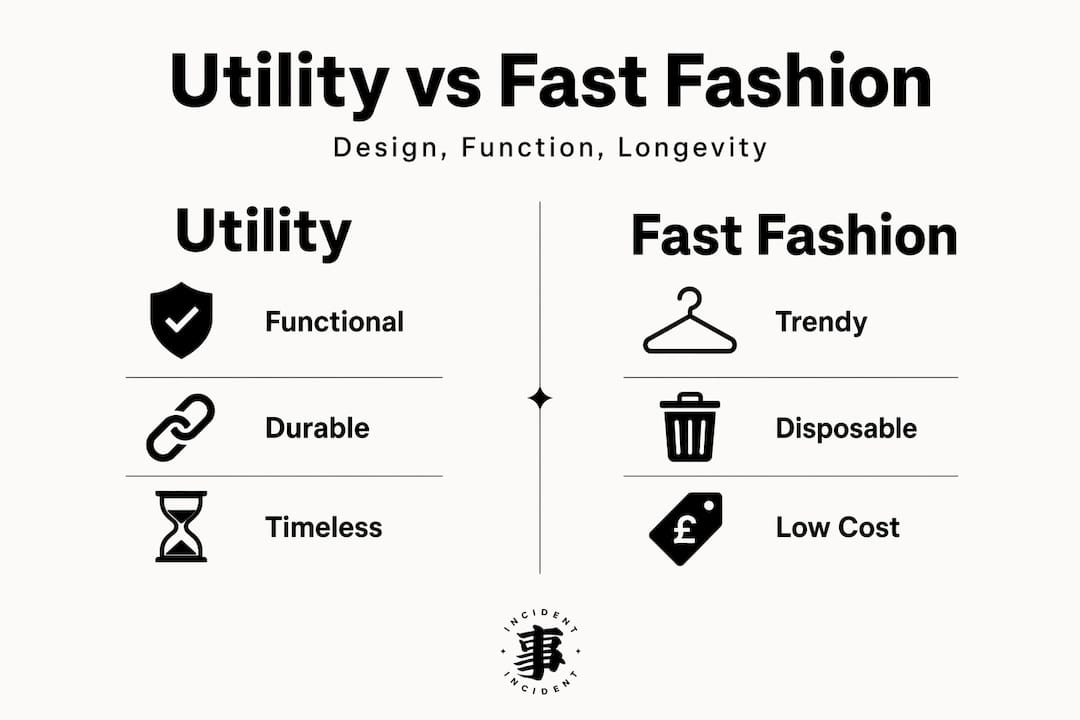
The table below compares utility fashion with fast fashion approaches to help clarify the philosophy difference:
| Consideration | Utility fashion | Fast fashion |
|---|---|---|
| Design intent | Function drives every detail | Trend replication drives production |
| Fabric quality | Durable canvas, twill, gabardine | Low-weight polyester blends |
| Pocket design | Functional, secure, usable | Decorative, shallow, or false |
| Longevity | Designed to wear in and improve | Designed for short seasonal cycles |
| Wardrobe role | Foundational, cross-seasonal | Single-season accent piece |
| Styling flexibility | High: layers across contexts | Low: trend-specific styling only |
When comparing utility vs fast fashion directly, the distinction is not just about price or quality. It is about whether a garment was conceived with the wearer’s actual life in mind. Elevated utility fashion controls proportion and finishing rather than relying on rugged silhouettes alone. The tailoring holds the look together. Neutral earth tones carry it forward through seasons and contexts.
One pitfall to avoid: do not confuse sizing up with achieving a utility silhouette. The relaxed fit in authentic utility pieces comes from considered pattern-cutting, not simply buying a larger size. An oversized garment without structural integrity loses the disciplined ease that makes utility fashion visually compelling. When functional patterning drives the design, the fit works at its intended size.
My perspective on utility fashion’s lasting power
I have spent years thinking about the intersection of utility aesthetics and Japanese streetwear minimalism, and what strikes me most is how rarely people discuss the philosophical alignment between them. Both traditions share a suspicion of decoration for its own sake. Both reward restraint. Both produce clothing that feels more considered the longer you look at it.
What I have learned from working with Japanese-inspired design is that the most lasting pieces are the ones where you cannot easily separate form from function. A clean cargo pocket on a well-cut trouser is not just practical. It creates a visual rhythm. The proportions of a utility jacket with considered shoulder width and a clean hem carry authority that a purely decorative garment cannot match.
My view on utility vs fast fashion is blunt: the latter trains you to think about clothing in terms of novelty, while the former trains you to think about it in terms of value. I have seen people build wardrobes of thirty pieces where everything coordinates and lasts because they chose utility anchors over trend-driven impulse buys. That discipline connects directly to mindful fashion principles that I think deserve more attention in streetwear culture.
The common misconception I keep encountering is that utility fashion requires you to look rugged or military-coded. It does not. The secret is colour control and tailoring precision. A stone overshirt with clean trousers and white footwear carries the utility philosophy without a single military reference. The heritage is there in the construction. You do not need to wear it on your sleeve, literally.
The benefits of utility fashion are most visible over time. Pieces age well. They earn their wear. They become more yours with every wash and fold.
— Incident
Build your utility wardrobe with Incident
If the utility fashion principles in this article resonate with you, Incident’s collections offer a considered starting point. At Incident, we design pieces that draw from Japanese minimalist tradition and contemporary streetwear culture, with quality and intentionality at the centre of every garment.
Our Japanese streetwear collections bring together the clean silhouettes, refined neutral palettes, and premium fabric choices that utility fashion demands. From our Pima cotton tees that serve as the perfect base layer to structured outerwear with considered proportions, every piece is built to work across contexts and seasons.
Explore the Pima Collection for foundational pieces that pair naturally with utility outerwear. Whether you are starting to build a minimalist wardrobe or refining one you have developed over years, Incident offers garments made to earn their place.
FAQ
What is utility fashion in simple terms?
Utility fashion is a style defined by clothing designed with practical function at its core, featuring durable fabrics, usable pockets, and structured silhouettes that also work as considered everyday style.
What are the key benefits of utility fashion?
The main benefits of utility fashion are durability, trans-seasonal versatility, and the ability to build outfit combinations across contexts from a small number of well-chosen foundational pieces.
How do utility fashion trends differ from fast fashion?
Utility fashion trends are grounded in enduring design principles inherited from military and workwear heritage, while fast fashion prioritises short-term trend replication using lower-quality materials with limited longevity.
How do I start wearing utility fashion?
Begin with one or two versatile pieces such as cargo trousers or an overshirt in a neutral earth tone, and build layering combinations that maintain clean proportions across different temperatures and occasions.
Can utility fashion look refined rather than rugged?
Yes. Controlling your colour palette within earthy neutrals like stone, ecru, and olive, and choosing pieces where tailoring carries the silhouette, keeps utility fashion looking polished rather than costume-like.
Share:
List of modern urban styles for city dressing in 2026
Why choose Japandi design for a calmer home