

TL;DR:
- Japandi is a philosophy combining Japanese wabi-sabi and Scandinavian hygge to create calm, functional spaces. It emphasizes subtraction, natural materials, and consistent color palettes to reduce visual noise and stress. The style translates into daily routines and personal fashion, prioritizing intentional, minimal design that fosters relaxation and clarity.
Japandi is not a colour palette. It is not a Pinterest mood board. And it is certainly not just another word for “beige minimalism.” If you have been wondering why choose Japandi design when so many other styles promise calm and simplicity, the answer lies somewhere deeper: in two ancient philosophies that address something very modern, the relentless visual noise reducing stress that cluttered interiors place on your mind every single day. This article unpacks what Japandi truly is, why it works, and how to apply it well.
Table of Contents
- Key takeaways
- Why choose Japandi design: the philosophy behind it
- Practical design principles that actually improve your daily life
- Common Japandi mistakes and how to avoid them
- How to integrate Japandi design room by room
- My perspective on what Japandi really offers
- Japandi design meets Incident’s minimalist streetwear
- FAQ
Key takeaways
| Point | Details |
|---|---|
| Japandi is a philosophy, not a trend | It merges Japanese wabi-sabi and Scandinavian hygge to create spaces that are warm, functional, and genuinely calming. |
| Subtraction is the core discipline | Removing visual clutter, not adding decor, is what gives Japandi its psychological power and aesthetic clarity. |
| Consistency matters deeply | Choosing one wood tone and a restricted colour palette preserves the calm that makes Japandi distinct from generic minimalism. |
| Lighting shapes the entire mood | Low-horizon, warm-toned lighting at 2700K replaces overhead fixtures to create depth and atmosphere throughout a space. |
| It extends beyond interiors | The Japandi philosophy translates naturally into how you dress, how you shop, and how you structure your daily routines. |
Why choose Japandi design: the philosophy behind it
Most design trends are purely visual. Japandi is not. To understand why the style has held genuine cultural and commercial relevance for well over a decade, you need to understand the two philosophies it draws from and why their combination produces something neither tradition could achieve alone.
Wabi-sabi is a Japanese worldview rooted in the acceptance of imperfection, impermanence, and natural ageing. A hand-thrown ceramic bowl with a slightly uneven rim is not flawed in wabi-sabi thinking. It is honest. It carries the mark of a human hand, the passage of time, and the character that only natural materials develop. This philosophy resists the pressure to make everything look pristine and new, which is quietly radical in an era of mass production.
Hygge (pronounced roughly “hoo-gah”) is a Scandinavian concept centred on warmth, comfort, and the art of creating genuinely livable spaces. It is the feeling of a wool blanket, a low lamp, a warm drink, and a room that feels safe. Where wabi-sabi is philosophical and contemplative, hygge is sensory and social.
“Japandi merges the Japanese acceptance of imperfection with Scandinavian warmth and functional comfort, built on four core pillars: simplicity, nature, craftsmanship, and function.”
When you place these two philosophies side by side, the Japandi synthesis becomes clear. Japanese discipline provides the restraint and intentionality. Scandinavian sensibility provides the warmth and livability. The result is a style that is neither sterile nor cluttered, neither cold nor cosy to the point of chaos.
The four pillars that structure Japandi design are worth understanding individually:
- Simplicity. Every element in a Japandi space should justify its presence. If it has no function and no beauty, it does not belong.
- Nature. Wood, stone, linen, clay, and natural fibre are the material vocabulary. These are not decorative choices. They are chosen because natural materials age gracefully and connect the interior to something larger.
- Craftsmanship. Handmade details like visible joinery, slight texture in ceramics, and hand-stitched textiles are celebrated rather than hidden.
- Function. Every piece should do something. Furniture without storage, accessories without purpose, and decor without meaning are edged out.
This is what separates Japandi from standard Scandinavian design (which can trend towards the commercial and cheerful) and from pure Japanese minimalism (which can feel severe to Western sensibilities). Japandi holds both in balance.
Practical design principles that actually improve your daily life
Understanding why Japandi works philosophically is one thing. Seeing how it operates on a practical level is where the Japandi design advantages become undeniable. The benefits of Japandi style are not just aesthetic. They are psychological and functional.
Colour and material discipline
Japandi colour palettes are deliberately restricted. Warm neutrals — soft whites, warm greys, dusty sage, terracotta, and deep charcoal — form the core. The approach is to anchor a room with two primary tones rather than six. Limiting colour variety reduces decision fatigue and creates a sense of visual coherence that makes a space feel immediately larger and calmer.
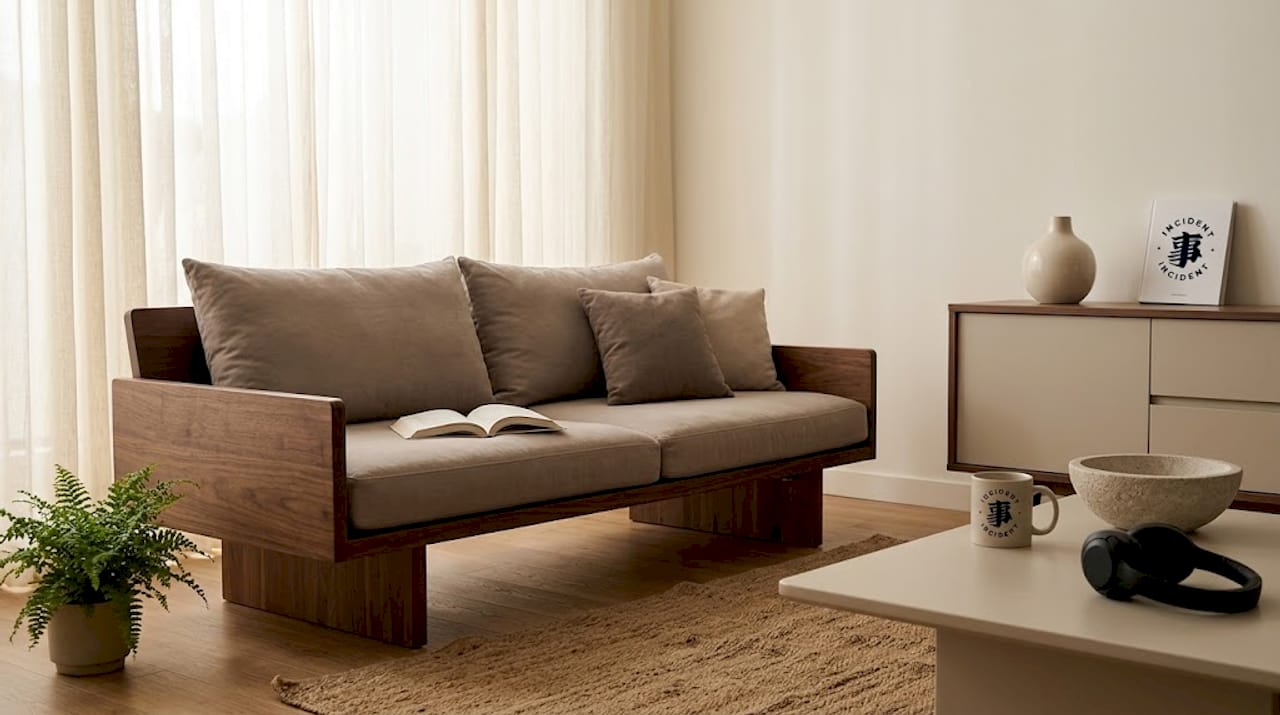
Natural materials carry the tactile dimension. Wood, stone, linen, and ceramics are not just aesthetically pleasing. They age well, feel honest under the hand, and introduce gentle variation without introducing chaos.
The three-object surface rule and negative space
One of the most practical features of Japandi design is the concept borrowed from Japanese spatial philosophy: ma, or meaningful negative space. Empty space in a Japandi room is not a sign that you have not finished decorating. It is an active design choice.
The three-object surface rule is a practical translation of this. Limit any flat surface (a dining table, a sideboard, a kitchen counter) to three objects at most. What remains becomes more visible, more valued, and more intentional. The room breathes.
Lighting that works with mood, not against it
Overhead lighting is avoided in genuinely Japandi spaces. Floor lamps, table lamps, recessed LED strips, and wooden basket lamps placed at low heights create pools of warmth rather than flat, even brightness. The target colour temperature is around 2700K, which sits in the amber-warm range and replicates the quality of candlelight without being dim.
This single change. replacing a central overhead fixture with two or three lower light sources. transforms the emotional quality of a room more than almost any furniture purchase could.
- Identify your room’s primary gathering point (sofa, dining table, reading chair).
- Place one warm lamp within arm’s reach of that point.
- Add a second light source at floor or low-table level across the room to create depth.
- Remove or replace any cool-white overhead bulbs with warmer alternatives or dimmer switches.
- Live with the result for a week before deciding whether more is needed.
Pro Tip: Choose one wood species and one dark accent tone for your entire space before buying a single piece of furniture. Oak paired with deep charcoal, or walnut paired with matte black, creates a foundation that makes every subsequent purchase easier to assess and keeps the space cohesive.
The psychological case for Japandi is not abstract. Japandi-designed spaces reduce mental fatigue and improve focus, particularly in homes that have doubled as workplaces since 2020. Less visual competition means your mind stops processing irrelevant stimuli and can actually rest.
Common Japandi mistakes and how to avoid them
Japandi is deceptively straightforward to admire and genuinely difficult to execute well. Most people who try it and feel disappointed have made one of a predictable set of mistakes. Recognising them in advance saves a great deal of expensive backtracking.
- Mixing wood species. This is the most common error. Oak, ash, walnut, and pine all have different undertones. Mixing wood tones in a single room creates subtle but persistent visual noise that undermines the calm Japandi is supposed to deliver. Choose one species. Commit to it throughout the space.
- Going too sparse. There is a difference between intentional restraint and a room that simply feels unfinished. Japandi spaces have warmth. A single linen cushion, a ceramic vase, a small plant. these are not excess. They are the carefully chosen details that prevent a room from feeling clinical.
- Ignoring texture. When you reduce colour variation, texture carries the room. Smooth stone, rough linen, polished wood, and matte ceramics in the same space create the sensory richness Japandi requires. Limiting yourself to one or two textures, however, keeps it calm rather than busy.
- Choosing purely decorative hardware. Japandi hardware (handles, taps, light fittings) should be almost invisible, matte, and functional. Ornate or shiny hardware pulls the eye and competes with the space.
The insight that Japandi is a discipline of editing rather than a colour scheme is genuinely useful here. Every piece you remove makes the remaining room stronger, not emptier.
| Common mistake | Japandi solution |
|---|---|
| Multiple wood species in one room | Commit to a single wood tone throughout |
| Cluttered surfaces | Apply the three-object rule to every flat surface |
| Cool white overhead lighting | Replace with warm 2700K low-horizon lamps |
| Too many textures | Limit to two or three materials per room |
| Decorative hardware | Choose matte, minimal, functional fittings |
Pro Tip: Try the box method before making any purchases. Clear every surface and shelf completely. Live with the empty room for two weeks. Then reintroduce objects one at a time, assessing each item’s value before it earns its place back. What does not return in the first week probably does not belong in the room at all.
How to integrate Japandi design room by room
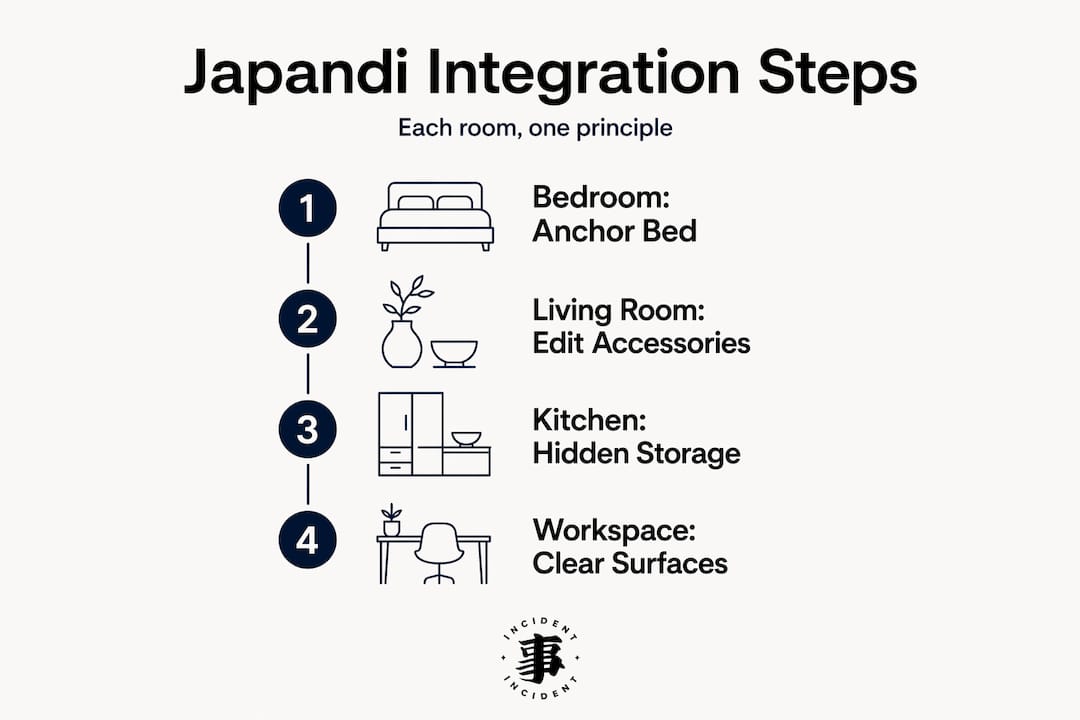
Knowing the principles is different from knowing where to start. Here is how to integrate Japandi design across your home in a way that builds gradually and stays manageable.
Bedroom
The bedroom is the easiest entry point. Start with the bed as your anchor. A low-profile wooden bed frame in a single timber tone, natural linen bedding in warm white or dusty grey, and one small plant or ceramic object on your bedside table. That is a Japandi bedroom. The goal is to make the space feel like the quietest room in your home.
Living room
The living room rewards patience. Begin by removing rather than adding. Take one third of your existing accessories off the shelves and surfaces and place them in storage for a month. If you do not notice their absence, they were visual noise. Add one quality piece: a handcrafted wood basket as a functional centrepiece, or a single ceramic lamp placed low on a side table. Work outward from there.
Kitchen and workspace
Japandi kitchens prioritise hidden storage and clear surfaces above almost everything else. Furniture with concealed storage reduces cleaning time and decision fatigue simultaneously. In a workspace, a single desk with one lamp and minimal surface objects creates the kind of focused calm that a cluttered desk cannot, regardless of how ergonomic the chair is.
The table below offers a quick reference for applying Japandi principles by room:
| Room | Priority action | Key material or element |
|---|---|---|
| Bedroom | Low-profile wooden bed frame | Linen bedding, one plant |
| Living room | Remove one third of accessories | Ceramic lamp, natural textile |
| Kitchen | Conceal storage, clear countertops | One wood tone, matte hardware |
| Workspace | Single lamp, minimal surface clutter | Warm lighting, clean desk |
| Hallway | One functional hook rail, empty floor | Natural fibre mat, no excess |
Japandi also scales to smaller spaces particularly well. The discipline of restraint that can feel challenging in a large room becomes a genuine advantage in a studio flat or compact apartment, where the cognitive ease of a clear space is felt even more directly.
And for those who find the philosophy resonant beyond the home, the principles translate naturally into how you dress. Exploring how to build a Japandi wardrobe follows the same logic: quality over quantity, intentional curation, and pieces that carry genuine purpose.
My perspective on what Japandi really offers
I have spent a long time studying the intersection of Japanese aesthetics and modern living, and I will be direct: Japandi earns its reputation. Not because it looks good in photographs (though it does), but because it genuinely changes how a space feels to inhabit over time.
What I find most compelling is that Japandi does not ask you to sacrifice warmth for order. That is the failure point of most minimalist approaches. Pure minimalism can produce rooms that feel like spaces without lived-in warmth, impressive but not restful. Japandi avoids this through wabi-sabi’s insistence on imperfection and hygge’s insistence on comfort. The result is a home that is both calm and genuinely inhabited.
The discipline is the harder part. The box method sounds simple until you try to live without your favourite objects for two weeks. What I have found, though, is that the process itself is clarifying. You quickly discover that most of what felt necessary was simply familiar. And once you have experienced a pared-back space for several weeks, the idea of reintroducing clutter becomes genuinely unappealing.
My honest recommendation: start with the lighting. It costs little, takes an hour, and produces an immediate, measurable shift in how a room feels. From there, the rest of the philosophy tends to follow naturally, because you have given yourself a tangible reference point for what intentional design actually feels like.
If you want to explore how this philosophy connects to personal style, the guide on Japandi style and quiet luxury is worth reading alongside this one.
— Incident
Japandi design meets Incident’s minimalist streetwear

The same principles that make Japandi design so compelling in a home apply just as naturally to how you dress. At Incident, we have built our collections around exactly this intersection: Japanese craftsmanship, minimal aesthetic, and the kind of quality that improves with wear rather than deteriorating after a season. Clean lines, considered proportions, and premium fabrics that honour the tradition they draw from.
Our Pima cotton collection reflects this philosophy directly. Each piece is designed with the same restraint Japandi demands of a room: nothing excess, nothing decorative for its own sake, and every detail earning its place. If you are building a wardrobe that reflects the calm intentionality you are creating at home, these are the pieces to start with. Explore the full collection at incident.store and find what belongs.
FAQ
What is Japandi design in simple terms?
Japandi design combines Japanese wabi-sabi (the beauty of imperfection and natural materials) with Scandinavian hygge (warmth and functional comfort), creating interiors that are calm, lived-in, and free of visual clutter.
How does Japandi design differ from pure minimalism?
Unlike pure minimalism, Japandi celebrates handmade imperfection, natural textures, and warmth. It avoids the cold, gallery-like quality that strict minimalism can produce, making spaces feel genuinely habitable rather than performatively spare.
What are the main benefits of Japandi style?
The benefits of Japandi style include reduced visual noise, lower cognitive load, easier daily routines, and a home environment that supports focus and rest, particularly relevant since the post-2020 shift to home working increased time spent indoors.
What is the biggest mistake people make with Japandi design?
Mixing wood species is the most common error. Combining oak, walnut, and ash in a single room creates subtle visual tension that undermines the calm Japandi is designed to produce. Choosing one wood tone and committing to it throughout is the single most effective corrective step.
Can Japandi design work in small spaces?
Japandi is particularly well suited to smaller spaces. The discipline of restraint and the use of negative space mean that compact rooms benefit most from the cognitive ease that a clear, intentional layout provides.



Share:
What is utility fashion? A complete style guide
Fashion subcultures explained: origins, meaning, and style