

TL;DR:
- Japanese street symbols represent a layered visual language rooted in cultural heritage, regulation, and youth subcultures. Recognizing their origins and meanings enhances appreciation, ensures respectful use in fashion, and allows wearers to participate deliberately in Japan’s living tradition of visual communication. Understanding these symbols transforms streetwear from mere graphics into culturally meaningful statements.
Walk through Shibuya at dusk and every surface speaks to you. Signs, symbols, stickers, and spray-painted tags compete for your attention, each carrying meaning that goes far beyond simple direction-giving. Japanese street symbols are a living visual language, shaped by centuries of cultural heritage, strict urban regulation, and the relentless creativity of youth subcultures. For anyone who loves Japanese streetwear, understanding what these symbols actually say transforms how you wear them and what they say about you.
Table of Contents
- Setting the scene: What are Japanese street symbols?
- Reading the road: Traffic signs, colours, and meanings
- Cultural layers: Map pictograms and icon origins
- Underground codes: Graffiti, stickers, and fashion reinterpretation
- From road to runway: How symbols shape Japanese streetwear
- A new lens: Why decoding Japanese street symbols matters for style and culture
- Discover Japanese streetwear made for you
- Frequently asked questions
Key Takeaways
| Point | Details |
|---|---|
| Street symbols blend utility and style | Japanese street symbols shape navigation, art, and global fashion motifs. |
| Original meanings matter | Understanding a symbol’s roots helps avoid cultural missteps and adds depth to your aesthetic choices. |
| Fashion interprets, not just copies | Streetwear brands remix these visuals, but the best designs respect and reference their authentic cultural significance. |
| Legal context shapes subculture | Strict graffiti laws fuel sticker and motif trends rather than open mural art. |
Setting the scene: What are Japanese street symbols?
To begin, it’s helpful to clarify exactly what falls under ‘street symbols’ in Japan and why they matter. The term is broader than most people expect. It spans three overlapping categories, each with its own logic and cultural weight.
Japanese street symbols primarily refer to traffic and regulatory road signs, map pictograms with cultural origins, and graffiti and tags in urban streetwear areas like Shibuya and Harajuku. These categories do not exist in isolation. They constantly influence and borrow from one another, creating a uniquely Japanese visual vocabulary that is instantly recognisable yet endlessly layered.
Consider the three main forms:
- Regulatory traffic signs: Circular, triangular, and rectangular forms that govern movement and safety on Japanese roads, many featuring kanji or katakana script.
- Map pictograms: Small icons used on official Japanese maps to denote everything from post offices to Buddhist temples, each with deep historical roots.
- Urban graffiti and sticker art: Low-profile tags, character illustrations, and senjafuda-inspired stickers seen across utility boxes and walls in districts like Harajuku and Shimokitazawa.
“The city does not lie still. Every sign, every sticker, every painted corner is a sentence in a conversation Japan has been having with itself for centuries.”
What makes this visual system so compelling for style-conscious audiences is the symbolic overlap between navigation and identity. In the Harajuku streetwear revolution, street symbols moved from the pavement to the garment, turning functional icons into badges of cultural fluency. Wearing a symbol without knowing its meaning is the equivalent of quoting a poem in a language you do not speak. It might sound beautiful, but something vital is lost.
Reading the road: Traffic signs, colours, and meanings
With this grounding, we can focus on arguably the most familiar example: traffic signs, and why their design is so visually impactful. Japanese traffic signs are governed by a precise colour and shape logic that differs notably from Western conventions.
Regulatory traffic signs include categories like prohibitions, such as the No Entry sign: a red circle with a white horizontal bar, and the Stop sign: a red inverted triangle bearing the kanji 止まれ. Directional signs use blue backgrounds with white arrows or text. Parking and stopping restrictions appear as red circle variations with diagonal bars or specific kanji.
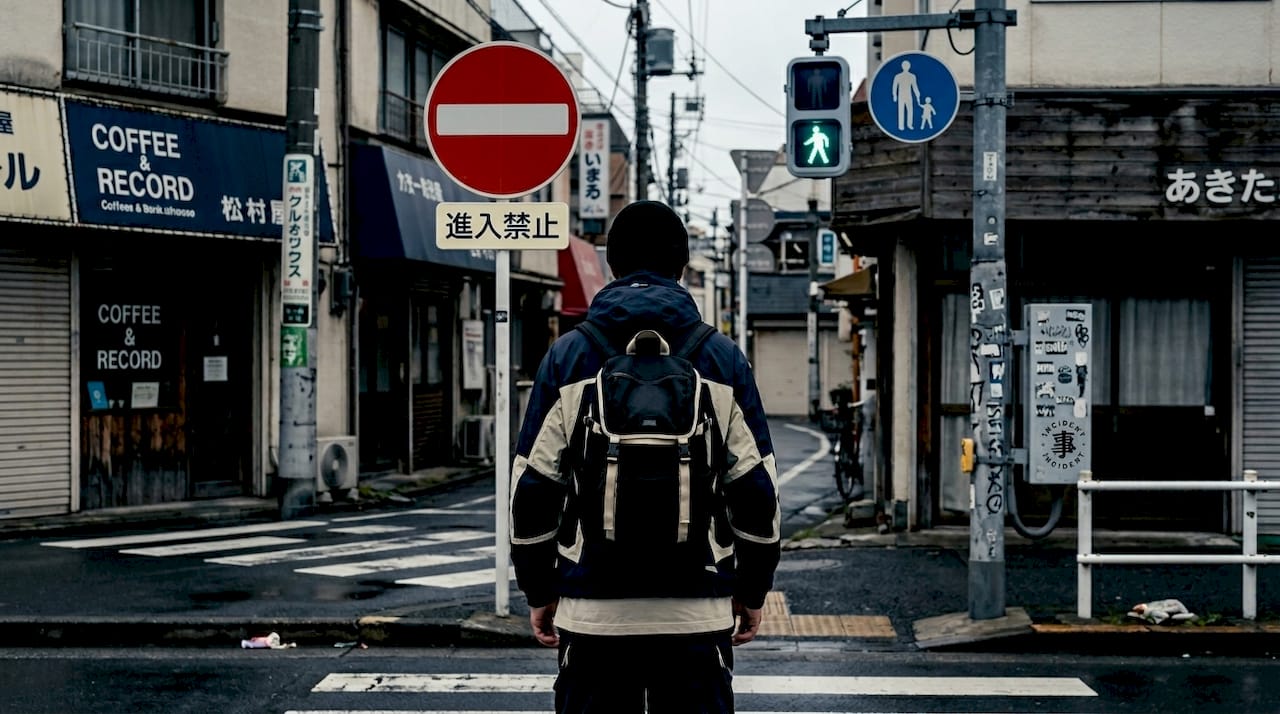
Here is a quick reference for the core colour and shape logic:
| Shape | Colour | Meaning |
|---|---|---|
| Inverted triangle | Red border, white fill | Stop or warning |
| Circle | Red | Prohibition |
| Circle | Blue | Obligation or guidance |
| Rectangle | Blue or green | Direction and information |
| Diamond | Yellow | Warning (some expressways) |
The visual clarity is deliberate. Japan’s road system is dense and fast-moving, so signs must communicate instantly. This is precisely what makes them so attractive to streetwear designers. The boldness of a red prohibition circle, the directional confidence of a blue arrow: these are graphic elements that translate effortlessly onto a heavy cotton tee or an oversized hoodie.
Streetwear labels frequently adapt or subvert these symbols. A no-entry circle becomes a frame around a brand logo. A stop sign’s inverted triangle holds a cryptic kanji phrase. Understanding iconic Japanese patterns helps you see exactly which design choices are deliberate nods and which are accidental misreadings of something culturally specific.
Pro Tip: If you are building a wardrobe around Japanese graphic pieces, learn the colour code first. A red circle motif on a garment carries the weight of prohibition and urgency. A blue-toned design signals guidance and movement. Knowing this adds a layer of intentionality to every outfit you build.
Familiarity with streetwear terminology also helps here. Terms like “graphic drop,” “colourway,” and “capsule” take on richer meaning once you understand the symbolic architecture behind the visuals.
Cultural layers: Map pictograms and icon origins
While road signs are immediately functional, the next layer of Japanese street symbols reveals centuries of culture built into city maps. Japan’s official map pictograms are issued by the Geospatial Information Authority and are unlike anything you will find on a Google Maps pin.
Map symbols feature cultural icons including 〒 for the postal service, derived from Teishin-shō, the old Ministry of Communications; 卍 (manji) for Buddhist temples, pointing left and representing good fortune; crossed batons for police stations; and the sasumata hook symbol marking fire stations. Each icon carries a direct lineage to Japanese institutional or spiritual history.
Here is a closer look at the most culturally significant map pictograms:
| Symbol | Meaning | Cultural origin |
|---|---|---|
| 卍 (manji) | Buddhist temple | Sanskrit symbol of good fortune |
| 〒 | Post office | Teishin-shō Ministry abbreviation |
| ⚔ (crossed batons) | Police station | Historical law enforcement emblem |
| 🏥 (cross) | Hospital | International medical convention |
| Sasumata hook | Fire station | Traditional Japanese restraining tool |
The manji deserves particular attention because it is the most misunderstood symbol in this entire vocabulary. In the West, a similar shape carries devastating historical associations, but the Japanese manji faces left and has been a Buddhist emblem of prosperity for over two thousand years. It appears on Japanese-inspired prints in contemporary fashion, and understanding its actual meaning is the difference between wearing heritage and wearing ignorance.
For collectors interested in the broader ecosystem of Japanese visual culture, the advantages of Japanese map cards for collectors illustrate how deeply these symbolic systems are embedded into everyday Japanese life, even appearing on collectible cartography.
Key points worth remembering about map pictograms:
- They are officially standardised by government bodies, giving them institutional weight.
- Many predate the modern state, connecting to Edo-period or even older traditions.
- Their visual simplicity makes them natural candidates for minimalist streetwear graphics.
- Misidentifying them in a fashion context can cause genuine offence or confusion.
The minimalism of these pictograms is not accidental. Japanese design culture prizes economy of form, the idea that a single well-chosen symbol communicates more than a paragraph of text. That philosophy runs straight from the map legend into the most refined Japanese streetwear collections.
Underground codes: Graffiti, stickers, and fashion reinterpretation
Map symbols connect to heritage, but the streets and alleyways reveal another, more rebellious layer of visual language. One that shapes and is shaped by youth style. Japanese street art occupies a fascinating legal grey zone, and the constraints placed upon it have generated some genuinely inventive forms of expression.
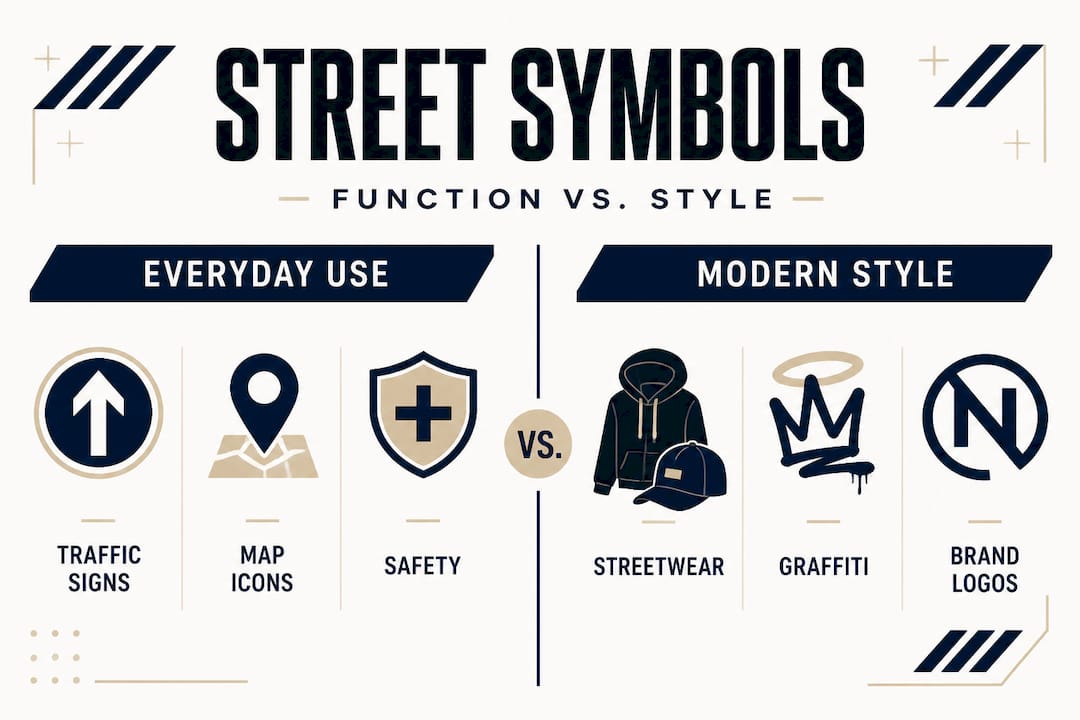
Graffiti in Tokyo, particularly in Shibuya and Harajuku, is often low-profile due to strict laws. Property damage penalties can reach up to five years in prison. As a result, artists turn to stickers, small tags on utility boxes, and character-based art that can be removed or repositioned. Even the Pipo-kun police mascot, a cheerful cartoon figure created by the Tokyo Metropolitan Police Department, has been subverted in street art as a knowing nod to the tension between authority and creative freedom.
This legal pressure has produced a distinctive aesthetic:
- Sticker art: Clean, often character-based images applied to surfaces without permanent damage. These can be peeled off quickly, and they travel far.
- Subtle tags: Small signatures or emblems placed in overlooked corners, visible only to those looking for them.
- Mascot reinterpretation: Official characters like Pipo-kun repurposed with ironic or subversive twists, blurring the line between civic communication and critique.
- Senjafuda revival: A tradition of leaving small printed name-slips at temples, reinterpreted by modern artists as personalised stickers in urban spaces.
Fashion brands watching this scene closely have reinterpreted these motifs through limited drops and capsule collections. The appeal is clear: sticker-inspired graphics carry an authenticity that polished commercial art cannot replicate. They feel earned.
Pro Tip: Pay attention to the texture and placement of graphics on a garment. Pieces inspired by sticker culture often feature slightly irregular edges, faded colouring, or layered effects that mimic the look of a sticker applied to a worn surface. This detail separates genuinely considered design from a quick screen print job.
If you want to understand simple Japanese streetwear styling in everyday outfits, appreciating the sticker and graffiti culture gives you a foundation for reading why certain graphics feel urban and authentic while others feel hollow. And for those tracking streetwear hype in 2026, the underground codes of Tokyo’s streets continue to feed the energy that makes Japanese streetwear globally compelling.
From road to runway: How symbols shape Japanese streetwear
Now that we’ve seen the origins and uses of these symbols, let’s address how they transition from signage to statement pieces in the fashion world. This journey is not simply about lifting a graphic and printing it on a hoodie. The best Japanese streetwear labels treat this process as a form of translation, where meaning, not just form, is carried across.
For fashion-forward youth, kanji and motifs in Harajuku and Urahara streetwear emphasise minimalism through symbolic graphics. Tigers represent power and protection. Sakura evokes transience and beauty. Limited drops prioritise understanding over novelty, and wearing aggressive or inappropriate kanji is a recognised faux pas within knowledgeable streetwear communities.
Here is how the translation from symbol to garment typically works in considered Japanese streetwear:
- Research the source: A designer identifies a symbol, whether a traffic sign shape, a map pictogram, or a graffiti motif, and traces its cultural lineage before placing it on fabric.
- Reduce and refine: Japanese design philosophy favours restraint. A circle or a single kanji character, given space to breathe on a clean garment, carries more weight than a busy collage.
- Choose fabric deliberately: The weight and texture of the cloth affect how a graphic symbol reads. Heavy cotton makes a bold symbol feel grounded. Lightweight linen makes it feel contemplative.
- Contextualise with the collection: A single piece does not stand alone. The symbols used across a collection should build a coherent visual conversation, not contradict each other.
- Communicate origin: The best labels include some context, whether in lookbook notes, garment labels, or community content, explaining what a symbol means and why it was chosen.
“A tiger printed on a tee is not decoration. It is a statement about strength and vigilance, a centuries-old emblem chosen deliberately and worn with intention.”
Limited edition streetwear collections built around specific symbols generate real cultural currency precisely because they reward knowledge. When you understand that a map manji on a jacket references Buddhist temple culture and not anything darker, you wear the piece differently. You carry the context with you.
This is also why anime streetwear occupies such an interesting position in this conversation. Anime is packed with street symbols, traffic signs in action sequences, graffiti backdrops in city scenes, and map icons in plot-relevant settings. Fans who move from anime into broader Japanese fashion often arrive with more symbolic literacy than they realise.
A new lens: Why decoding Japanese street symbols matters for style and culture
Stepping back, it is vital to consider why these symbols’ meanings go beyond cool graphics, and what that means for anyone drawing inspiration from Japan’s streets. The honest truth is that surface-level appreciation can tip into misunderstanding faster than most people expect, and the consequences range from the awkward to the genuinely offensive.
Street symbols blend utility with culture in a way that is distinctly Japanese. Traffic and map signs serve safety and navigation, but they also carry historical motifs. Symbolic kanji and graffiti in streetwear are a form of cultural speech. The edge case everyone should know: the manji is a Buddhist emblem of good fortune with a two-thousand-year history, yet its visual similarity to a Nazi swastika causes real confusion internationally. Context is not optional here. It is essential.
We would argue, from our own experience designing pieces that draw on Japanese visual tradition, that this is precisely where global streetwear often stumbles. The aesthetic is seductive. The minimalism, the clean graphic logic, the sense that every line means something. It is easy to lift a symbol and print it because it looks striking. It is harder, and far more rewarding, to understand what you are holding before you wear it.
The graffiti culture offers another instructive contrast. Japan has a centuries-old tradition of senjafuda, the practice of leaving small printed name-slips at temples and shrines. Modern sticker art in Shibuya draws directly on this lineage, making what looks like rebellion actually a form of participation in a very old cultural ritual. Knowing this changes how you see a sticker-covered utility box, and how you evaluate a streetwear piece inspired by that aesthetic.
Our view is that style and cultural engagement are not separate concerns. When you wear context-rich Japanese prints, you are participating in a living tradition. That participation should be informed, curious, and humble. Japan’s visual language is deeply layered. Wear it wisely, and it rewards you with depth. Wear it carelessly, and it says something about you that you probably did not intend.
The most respected voices in Japanese streetwear, from Harajuku’s Urahara scene to the restrained craft of Osaka-based ateliers, consistently reward those who take the time to understand before they adopt. That is not gatekeeping. It is the difference between a costume and a wardrobe.
Discover Japanese streetwear made for you
If you’re inspired to take this knowledge from theory to your next outfit, the right piece might be only a click away.
At INCIDENT Clothing, we design garments where traditional Japanese symbols meet modern streetwear with genuine intentionality. Every graphic, every motif, and every detail in our collections is chosen with respect for its cultural origin and refined through a Japandi-influenced design philosophy that prizes clean lines over noise.

Whether you’re drawn to the graphic clarity of traffic sign aesthetics or the quiet heritage of map pictograms, you’ll find pieces that honour the story behind every symbol. Our Pima T-shirt collection is a strong starting point: ultra-soft fabric, considered graphics, and the kind of restrained elegance that Japanese design culture values most. Explore the full range at incident.store and find the piece that speaks your language.
Frequently asked questions
Are Japanese street symbols the same as Western signs?
Many are different: Japan’s road and map signs are culturally unique, using specific icons and kanji that have no direct Western equivalent, including the manji temple marker and the inverted triangle stop sign.
What does the 卍 (manji) symbol mean on Japanese maps?
On Japanese maps, the manji marks Buddhist temples and represents good fortune, facing left in a direction that distinguishes it clearly from its historically misappropriated Western counterpart.
Is graffiti illegal in Japan?
Yes; unauthorised graffiti is a serious offence, with property damage penalties reaching up to five years in prison, which is why Tokyo’s street art scene relies heavily on stickers and subtle placements rather than large-scale murals.
Why do Japanese streetwear brands use traffic sign graphics?
These symbols blend urban culture with minimalist graphic design in a way that feels both internationally legible and distinctly Japanese, giving streetwear pieces a visual authority that resonates across cultures.
How can I avoid misinterpreting Japanese symbols in fashion?
Always research the original meaning before wearing a symbol, since some kanji and icons carry spiritual, institutional, or culturally sensitive connotations that are not apparent from the visual form alone.
Recommended
- How to use streetwear elements: Japanese styling made simple – INCIDENT
- What are Japanese-inspired prints? A fashion guide – INCIDENT
- The real impact of Japanese calligraphy in streetwear – INCIDENT
- Harajuku Streetwear: The Japanese Fashion Revolution | Incident Store - INCIDENT
- Ορισμός Street Fashion: The Essential Guide



Share:
How to match Japanese prints for a sharp, refined look
The power of subtle details in Japanese streetwear