

TL;DR:
- Fashion subcultures are built on shared music, ideology, and community, representing organized systems of meaning. In 2026, digital aesthetics spread rapidly via algorithms, often lacking the depth, resistance, and longevity of traditional subcultures. Genuine engagement requires understanding origins, participating authentically, and respecting the cultural heritage behind stylistic expressions.
Fashion subcultures explained properly is something most articles never quite manage. They list aesthetics, name a few movements, and call it done. But if you are genuinely trying to understand why people dress the way they do — and what it means — you need to go deeper than a mood board. Fashion subcultures are not simply clothing choices. They are organised systems of meaning, built around music, politics, community, and resistance. And right now, in 2026, the line between a true subculture and a fleeting digital aesthetic is blurrier than ever. This article cuts through that blur, tracing the history, the mechanics, and the cultural stakes of fashion subcultures from their roots to the algorithm-driven present.
Table of Contents
- Key takeaways
- Fashion subcultures explained: the foundations
- The rise of microtrends and digital aesthetics
- Traditional subcultures vs digital aesthetics: what we gain and lose
- Popular fashion subcultures and aesthetics today
- How to use subcultural knowledge in your own style
- My honest take on subcultures in 2026
- Wear your subculture, not just its surface
- FAQ
Key takeaways
| Point | Details |
|---|---|
| Subcultures run deeper than style | Traditional fashion subcultures are built on shared ideology, music, physical spaces, and genuine community commitment. |
| Digital aesthetics move fast | Microtrends spread through algorithms in days and fade just as quickly, unlike subcultures that evolved over years. |
| Cost of entry matters | Subcultures that demand real sacrifice — time, money, social risk — tend to produce lasting communities and culture. |
| Commodification dilutes meaning | When subcultural signs enter mainstream fashion, they often lose the political and social meaning that made them powerful. |
| Knowing origins enriches style | Understanding where an aesthetic comes from helps you engage with it honestly and avoid surface-level appropriation. |
Fashion subcultures explained: the foundations
To understand fashion subcultures properly, you need to start with what actually defines one. A subculture is not simply a group of people who dress alike. True subcultures demand infrastructure — music, fashion, slang, ideology, and physical spaces — with community as the core. Remove any of those elements and what you have left is an aesthetic, not a subculture.
Think about punk in 1970s Britain. The safety pin, the mohawk, the ripped clothing — these were not random fashion choices. According to Dick Hebdige’s theory, those fashion signifiers carried deliberate political meanings as youth rejected dominant culture through a process he called bricolage: taking everyday objects and recontextualising them as symbols of defiance. A safety pin was not decorative. It was a statement.
The same logic applied to mods, skinheads, goths, and rave culture. Each movement had:
- A sound: from Northern Soul to industrial, from jungle to acid house
- A silhouette: parka coats, Dr Martens, fishnet, tracksuits
- A place: record shops, underground clubs, specific street corners
- A worldview: not just “this looks cool” but “this is who we are and who we are not”
The psychological pull of subcultural belonging is worth taking seriously. Humans are wired for group identity, and fashion served as a critical lens through which younger generations could articulate labour struggles, economic alienation, and social marginalisation without writing a manifesto. You wore it instead.
Pro Tip: If you are exploring a classic subculture for the first time, start with its music, not its clothes. Understanding the sound gives the style its proper weight and prevents you from wearing the costume without the context.
“Style in subculture is… pregnant with significance.” — Dick Hebdige, Subculture: The Meaning of Style
The role of fashion in youth culture has always been tied to this need for collective meaning. When a subculture worked, it offered something that mainstream culture could not: a sense of genuine belonging purchased not with money alone, but with commitment.
The rise of microtrends and digital aesthetics
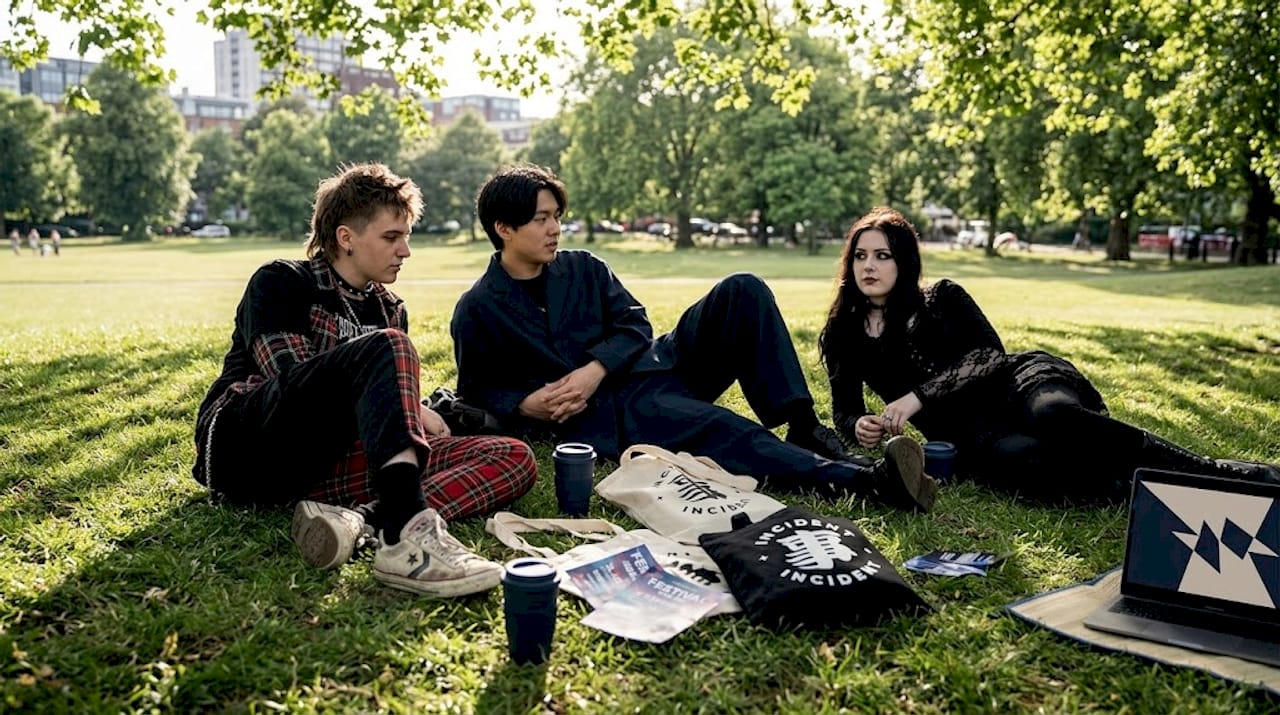
Something shifted in the 2010s and accelerated sharply into the 2020s. The infrastructure that held traditional subcultures together — the venues, the scenes, the slow-burn community building — began giving way to something faster, flatter, and algorithmically driven.
Microtrends appear overnight, spread rapidly through social media algorithms, and fade in weeks, unlike traditional subcultures that evolved over years. Cottagecore, dark academia, coquettecore, goblincore — these aesthetics arrived, peaked, and were replaced before most people had a chance to buy into them fully. They feel like subcultures on the surface because they have visual codes and online communities. But the architecture underneath is fundamentally different.
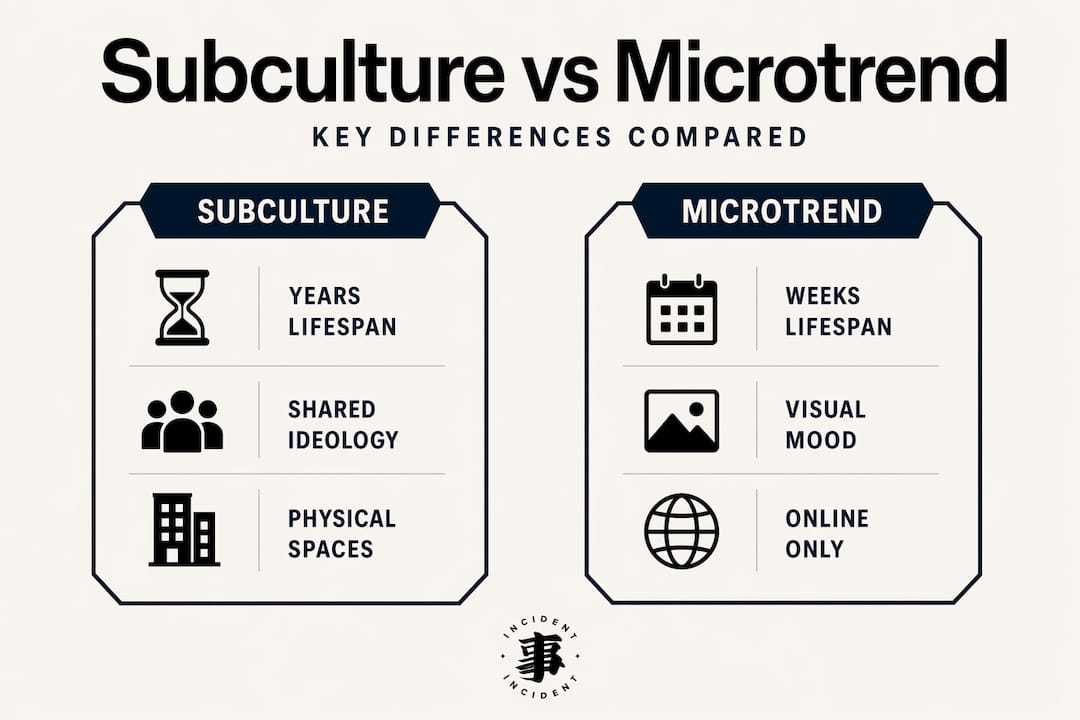
| Feature | Traditional subculture | Digital microtrend |
|---|---|---|
| Lifespan | Years to decades | Weeks to months |
| Community type | Physical, local scenes | Online, dispersed audiences |
| Ideological depth | Strong political or social foundation | Aesthetic or mood-based |
| Entry cost | High (time, money, social risk) | Near zero |
| Origin | Grassroots, working-class communities | Influencers, brands, algorithms |
| Resistance potential | Genuine counter-cultural challenge | Surface-level non-conformity |
How do these trends spread so fast? Digital trend diffusion happens through hierarchical spread from influencers and contagious peer-to-peer sharing. An influencer with two million followers posts a single outfit. The algorithm serves it to thousands who do not follow that account. Those viewers clip, save, and repost. Within a week it has a name, a hashtag, and a shopping list attached.
In 2026, the aesthetics worth paying attention to include:
- Glitch Goth: A post-AI visual language combining cyber-dystopia with distorted digital imagery, responding to digital overwhelm and economic stagnation
- Dark girlhood: Complex, layered femininity that reclaims shadowed emotion in contrast to performative positivity
- Shoujo girl aesthetic: Drawn from Japanese manga visual culture, this trend blends soft romance with structured femininity
None of these are subcultures in the Hebdige sense. They are moods with wardrobes. That is not a dismissal — moods matter, and personal expression matters. But understanding the difference is what separates thoughtful style from trend consumption.
Pro Tip: Before adopting a digital aesthetic wholesale, ask yourself: what does this actually express about who I am? If the answer is “nothing specific,” that is a signal to look deeper at subcultures that might offer more genuine resonance.
Traditional subcultures vs digital aesthetics: what we gain and lose
The shift from physical subcultures to digital aesthetics is not simply a change in delivery mechanism. It restructures the entire relationship between identity, community, and style. To understand what that means in practice, it helps to think about cost.
Where subcultures demand sacrifice, they endure. Being a punk in 1978 was not risk-free. It invited confrontation, job loss, and family tension. Being goth in the 1980s meant navigating genuine social exclusion. That cost was also the glue. When you invest that much in an identity, you defend it, develop it, and build lasting relationships around it.
Digital aesthetics carry near-zero entry cost. You can adopt cottagecore today, dinergoth tomorrow, and Glitch Goth by the weekend. That flexibility is appealing — genuinely so. But it produces a different kind of relationship with style. Modern aesthetics are often individualistic moods performed online without physical community or political foundation. The scene is your feed. The community is your comment section.
Here is the numbered reality of what gets lost in that shift:
- Physical community. Real subcultures were built in rooms with other people. That creates accountability, mentorship, and depth of shared experience.
- Ideological coherence. Traditional subcultures had something to say about power, class, gender, or race. Digital aesthetics rarely sustain that kind of argument.
- Resistance. When an aesthetic has no entry cost and is actively promoted by brands and platforms, it cannot meaningfully challenge the culture it claims to critique.
- Longevity. Subcultures leave behind music, art, literature, and language. Microtrends leave behind abandoned Amazon shopping lists.
What do we gain? Access, for one. The shift from subcultures to digital aesthetics has opened subcultural visual language to a genuinely global audience, which carries real value for connection across geography. There is also creative freedom. When nothing is gatekept, experimentation becomes easier and more democratic.
The danger arrives when that freedom produces isolation dressed up as self-expression. Choosing an aesthetic from a menu every week is not the same as building a style that speaks for you honestly.
Popular fashion subcultures and aesthetics today
Some subcultures have demonstrated remarkable staying power precisely because they maintained that infrastructure of music, community, and ideology. Others are genuinely new formations, shaped by the economic and cultural pressures of 2026.
Enduring subcultures still shaping fashion:
- Goth: Now over four decades old, goth has branched into numerous sub-genres including trad goth, cybergoth, and the newer dinergoth. Its central aesthetic — dark romanticism, black clothing, elaborate accessories — remains a coherent identity across generations.
- Punk: Punk’s visual language of distress, DIY construction, and anti-establishment typography continues to influence high fashion and streetwear origins globally. Designers from Vivienne Westwood’s legacy to contemporary Japanese labels have built entire collections around its vocabulary.
- Hip-hop streetwear: Originating in the South Bronx in the 1970s and 1980s, hip-hop fashion has arguably produced the most commercially influential subculture in history. Oversized silhouettes, logomania, premium sportswear, and now minimalist Japanese-influenced streetwear all carry its DNA.
Emerging formations worth understanding:
- Dinergoth: Embodying “cosy downward mobility”, this aesthetic blends alternative fashion with economic resignation. The dinergoth sits in late-night diners in layered black, accepting precarity with dark humour. It is one of the most honest subcultural responses to 2026’s economic realities.
- Coquettecore: Lace, bows, and hyper-feminine softness as a reclamation of femininity on one’s own terms. More mood than movement, but gaining genuine community depth.
- Glitch Goth: Post-AI visual anxiety translated into fashion. Distorted prints, corrupted graphics, and anti-clean aesthetics that push back against algorithmic perfectionism.
Subcultural elements are frequently borrowed and recontextualised by designers, often losing their political edge in the process. This commodification is most visible in luxury fashion, where punk studs and goth lace appear on garments that cost more than the average monthly rent of the working-class communities that created those aesthetics. Knowing that history changes how you read a garment.
Japanese streetwear occupies a particularly interesting space in this conversation. Rooted in the Harajuku fashion revolution of the 1980s and 1990s, Japanese street style developed its own subcultural infrastructure — distinct neighbourhoods, dedicated magazines, specific brands — while simultaneously absorbing Western influences and transforming them into something wholly original. That cross-cultural exchange continues to produce some of the most considered fashion in the world.
How to use subcultural knowledge in your own style
Understanding fashion subcultures is not an academic exercise. It is one of the most practical things you can do if you care about dressing with intention.
Here is a grounded approach to applying that knowledge:
- Research before you wear. If an aesthetic appeals to you, spend time understanding where it came from. This is especially important with subcultures rooted in specific ethnic or socio-economic communities. Context is not optional.
- Prioritise participation over consumption. Buying the clothes is the easiest part. Engaging with the music, reading the zines, attending events — that is where style becomes identity.
- Question your motivations. Are you drawn to an aesthetic because it genuinely reflects your values and experience, or because it was trending on your feed three days ago? Both are honest starting points, but only one produces lasting style.
- Curate across multiple influences. The most interesting personal styles are not perfect recreations of a single subculture. They are thoughtful conversations between different traditions, time periods, and cultural references.
- Practise mindful consumption. Digital mainstreaming harms subcultures by converting them into fast-fashion costumes. Choosing quality pieces you intend to keep is a form of respect toward the cultures that created those aesthetics.
Pro Tip: Build a small archive of reference material for the subcultures that speak to you. Photographs, album covers, films, and texts. Return to it when you feel your style drifting toward whatever the algorithm is currently serving. That archive is your anchor.
My honest take on subcultures in 2026
I’ve watched the conversation around fashion subcultures shift dramatically over the past several years, and what strikes me most is not the aesthetics themselves — it’s the loneliness underneath them.
When I look at the richness of goth scenes in the 1980s, or the rave communities of the early 1990s, what I see is not just fashion. I see people who built genuine worlds together. The clothes were the surface. The infrastructure — the venues, the music, the magazines, the relationships formed in sweaty rooms at 2am — that was the substance.
What we have now is beautiful in its own way. The visual creativity of Glitch Goth, the tenderness of dark girlhood, the cross-cultural poetry of Japanese streetwear aesthetics reaching someone in Zürich or Seoul who connects with it instantly. That global reach is real and meaningful.
But I think we have to be honest about the trade-off. Speed and access have made aesthetic exploration frictionless, and friction was part of what made subcultures matter. When you had to work for something, you valued it differently.
My advice? Stop chasing aesthetics and start following what you actually love. Find the music first. Then the spaces, even if they are digital ones with genuine depth. The clothes will follow, and they’ll mean something when they do. Japanese streetwear, for what it’s worth, represents one of the clearest examples of a tradition that held on to its craft even as it reached a global audience. That balance between heritage and modernity is something worth studying, whatever your personal aesthetic.
— Incident
Wear your subculture, not just its surface
Fashion subcultures, at their best, represent one of the most honest forms of self-expression humans have developed. That heritage deserves garments built with equal intention.

At Incident, we design premium Japanese-inspired streetwear that carries the weight of genuine craft. Each piece in our Pima collection is made from ultra-soft Pima cotton, shaped by a Japandi-influenced design philosophy that respects both Japanese tradition and contemporary urban style. Clean lines, considered details, and fabrics you can feel the difference in. If you are building a wardrobe with cultural depth rather than trend volume, explore what Incident offers at incident.store. We are always reachable for styling questions and advice.
FAQ
What are fashion subcultures?
Fashion subcultures are social groups defined by shared ideology, music, style, and physical or communal spaces. They use clothing as a form of collective identity and, frequently, cultural resistance.
How are digital aesthetics different from true subcultures?
Digital aesthetics are visually driven moods that spread rapidly through social media but typically lack the ideological depth, community infrastructure, and political foundation of traditional subcultures. The entry cost is near zero, which affects how lasting they are.
What are some examples of popular fashion subcultures in 2026?
Enduring subcultures like goth, punk, and hip-hop streetwear remain influential. Newer formations include dinergoth, Glitch Goth, and dark girlhood, each responding to specific contemporary anxieties around technology, economics, and femininity.
Why does understanding fashion subcultures matter?
Fashion is a critical lens for understanding labour, economy, identity, and societal shifts. Knowing the origins of an aesthetic helps you engage with it thoughtfully and avoid reducing rich cultural histories to costume.
Can you participate in a subculture without appropriating it?
Yes, with genuine research, respect, and participation beyond clothing. Understanding the music, history, and community context of a subculture before adopting its visual codes is the foundation of respectful engagement.
Share:
Why choose Japandi design for a calmer home
What is quality control in fashion: a professional guide