

TL;DR:
- Off-duty style combines relaxed basics with one elevated detail to achieve an effortlessly polished look rooted in streetwear and Japanese minimalism. Core pieces include wide-leg denim, vintage tees, utilitarian outerwear, and neutral accessories, emphasizing quality and proportion. Adding one statement accessory like designer sneakers or a structured bag elevates the overall outfit while maintaining a relaxed, deliberate aesthetic.
Off-duty style is defined as a curated casual aesthetic that pairs relaxed wardrobe staples with one elevated, fashion-forward detail to achieve an effortlessly polished look. Known in the industry as “model off-duty” dressing, this approach sits between true casual wear and smart-casual, occupying a space where comfort and intention coexist. Vogue describes the essence of off-duty style as casual with structure: relaxed basics paired with one standout fashion element to achieve nonchalant cool. The result is an aesthetic that feels uncontrived yet deeply considered, built on wide-leg jeans, vintage tees, utilitarian outerwear, and accessories that carry genuine weight. Whether you are building your first off-duty wardrobe or refining what you already own, understanding the principles behind this look makes every outfit decision sharper and more deliberate.
Which core pieces define off-duty style?
Off-duty style features easy basics including wide-leg jeans, straight-leg trousers, and utilitarian outerwear such as leather jackets, field coats, and trench coats. These are not arbitrary choices. Each piece carries a relaxed silhouette that communicates ease, while its construction and fabric quality signal that the wearer has not simply reached for whatever was closest. The tomboy sensibility at the heart of this aesthetic favours volume and comfort over restriction, making the look feel lived-in rather than laboured over.
The foundational wardrobe for off-duty dressing centres on a small number of high-quality, repeatable pieces:
- Wide-leg or straight-leg denim. The fit is generous without being shapeless. Dark indigo and light-wash grey are the most versatile options.
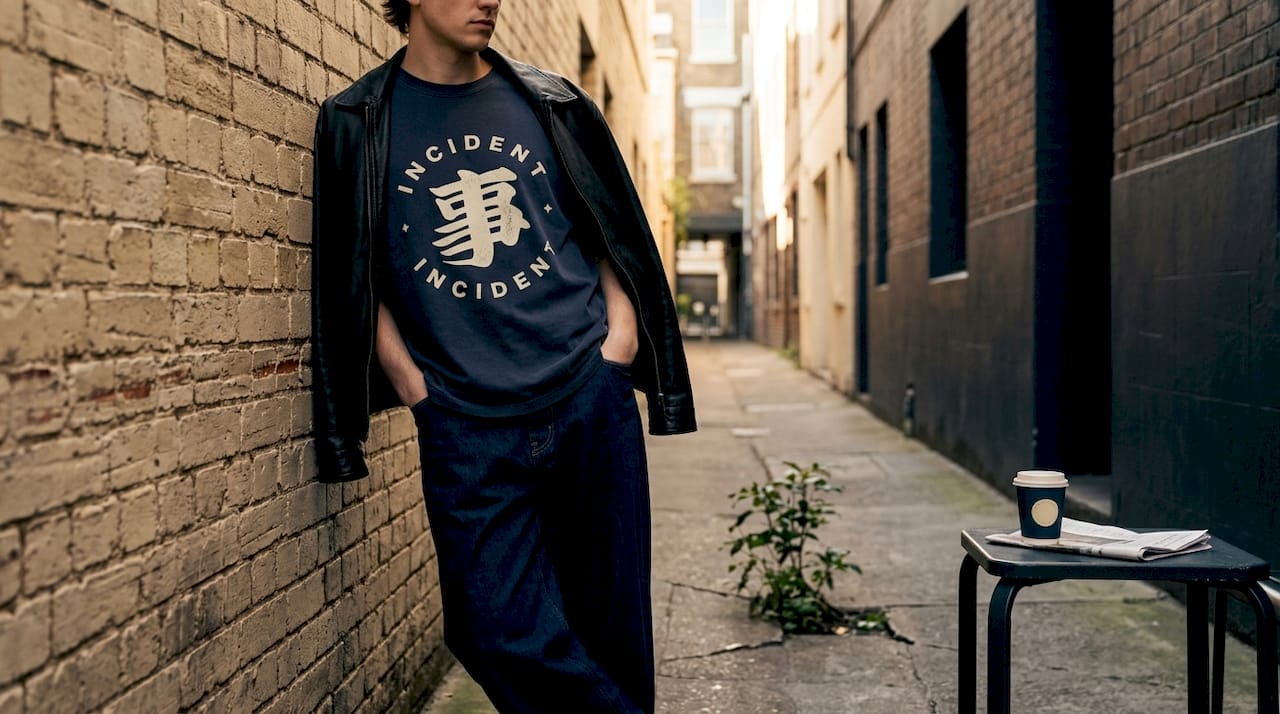
- Vintage or graphic tees. A slightly worn, faded quality adds character. Japanese typography tees and kanji streetwear pieces work particularly well here, adding visual interest without demanding attention.
- Leather jackets and field coats. These are the outerwear workhorses of the look. A well-worn leather jacket reads as personal and authentic; a field coat in olive or camel adds a utilitarian edge.
- Trench coats. The trench is the most polished outerwear option in the off-duty repertoire. Worn open over a simple tee and wide-leg jeans, it transforms the entire outfit.
- Lightly distressed or ribbed knits. These add texture without drama, sitting comfortably between casual and refined.
What makes these pieces work together is their shared commitment to relaxed proportion and understated quality. None of them shout. They create a foundation that allows one elevated element to do the talking, which is precisely the structural logic of the entire aesthetic. Exploring men’s streetwear essentials in the Japanese-inspired tradition reveals how this same principle of considered restraint runs through the best casual wardrobes.
Pro Tip: When building your off-duty foundation, prioritise fabric quality over quantity. Three well-made tees in neutral tones will serve you better than ten mediocre ones, because the look depends on how pieces drape and age rather than how many you own.
How do elevated accessories and footwear complete the off-duty look?
Adding one elevated accessory such as an It bag, designer sunglasses, or hyped sneakers upgrades a look from casual basics to polished off-duty style. This single-element elevation is the most important technical principle in the entire aesthetic. Without it, the look collapses into plain casual dressing. With it, the outfit reads as intentional and fashion-literate.
The accessories that work best in off-duty dressing share a quality of quiet authority:
- Statement sneakers. A pair of New Balance 550s, Nike Air Force 1s, or a premium Japanese streetwear-adjacent trainer in a clean colourway carries enormous visual weight. The sneaker does not need to be loud; it needs to be considered.
- It bags. A structured tote, a mini shoulder bag, or a well-worn leather crossbody in a neutral tone adds polish without effort. The bag signals taste more reliably than almost any other accessory.
- Designer or architectural sunglasses. Oversized frames or a sharp geometric silhouette in tortoiseshell or black add an editorial quality to even the simplest outfit.
- Minimalist jewellery. A single chain, a clean ring stack, or a fine bracelet adds detail without noise. The rule is one or two pieces, worn with confidence.
Footwear deserves particular attention because it anchors the entire silhouette. Slip-on sneakers worn with wide-leg denim create a clean, unbroken line from waist to floor. Chunky boots under a trench coat add weight and intention. The choice of footwear communicates whether the outfit is leaning casual or leaning polished, giving you a reliable dial to adjust the formality of any look.
Pro Tip: If your outfit feels flat, change the shoes before you change anything else. Footwear has a disproportionate effect on how the whole look reads, and swapping trainers for boots or vice versa can shift the entire register of an outfit in seconds.
What are the differences between off-duty style and casual chic?
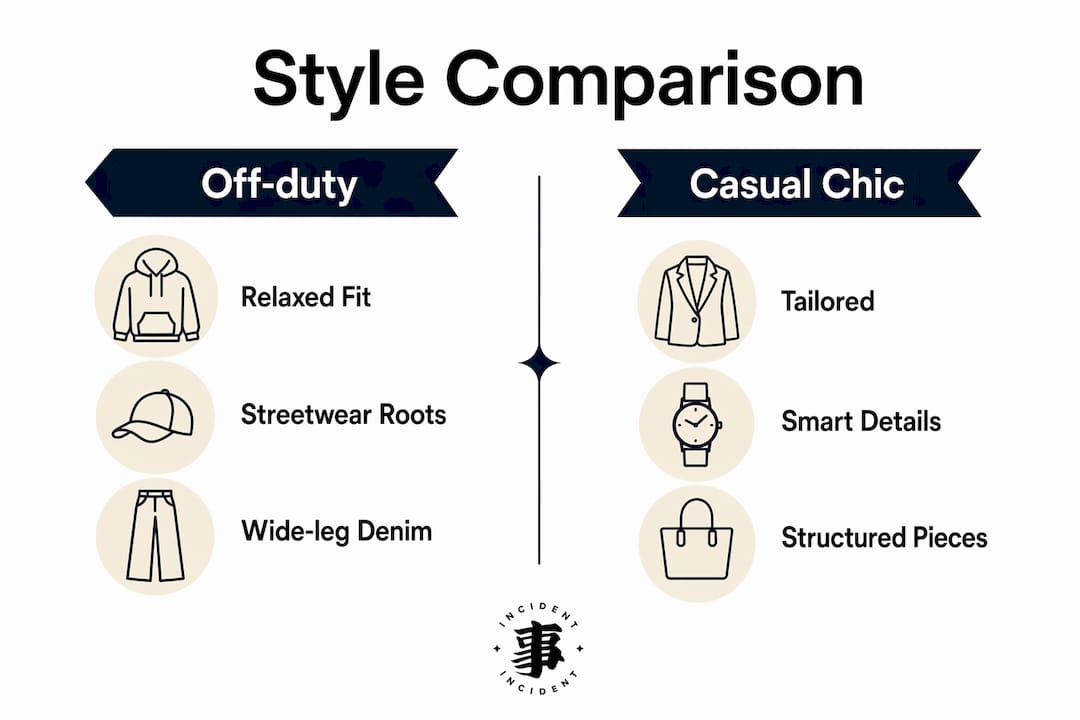
Off-duty style and casual chic are related aesthetics that share a commitment to elevated basics, but they differ meaningfully in attitude, fit, and the role of accessories. Understanding where they diverge helps you dress with greater precision and avoid the common mistake of conflating the two.
Casual cool emphasises quality basics with deliberate details and smart proportions to balance comfort and polish. This description captures casual chic accurately: it is a more refined, slightly more formal register that leans towards tailored fits, clean fabrics, and accessories that whisper rather than speak. Off-duty style, by contrast, embraces volume, a degree of studied dishevelment, and a deliberate nod to streetwear culture. The attitude is different. Casual chic says “I dress well effortlessly.” Off-duty style says “I know exactly what I am doing and I am not trying to impress you.”
| Element | Off-duty style | Casual chic |
|---|---|---|
| Fit | Relaxed, oversized, generous volume | Tailored, streamlined, proportional |
| Outerwear | Leather jackets, field coats, bombers | Blazers, structured coats, trench coats |
| Footwear | Sneakers, chunky boots, slip-ons | Loafers, clean trainers, ankle boots |
| Accessories | Statement sneakers, It bags, bold sunglasses | Minimal jewellery, structured bags, classic watches |
| Colour palette | Neutrals with occasional graphic or tonal contrast | Neutrals and muted tones, rarely graphic |
| Attitude | Deliberate nonchalance, streetwear-informed | Polished ease, classic-fashion-informed |
The overlap between the two aesthetics is most visible in the shared reliance on neutral colour palettes and quality fabrics. Both looks reject fast fashion logic and both reward investment in fewer, better pieces. Where they diverge is in the cultural reference points: off-duty style draws from streetwear, sport, and Japanese urban fashion, while casual chic draws from classic European tailoring and resort dressing. You can borrow from both, but knowing which register you are working in keeps your outfits coherent.
How to build and style an off-duty wardrobe for everyday wear
Off-duty outfits prioritise wearable, real-life looks over dramatic runway fashion, focusing on relaxed silhouettes, elevated basics, and confident minimalism. Building this wardrobe is less about accumulating pieces and more about understanding the compositional logic that makes the look work. Once you grasp the formula, you can apply it to almost anything you own.
The most reliable approach is to work with outfit archetypes: repeatable combinations that you can execute quickly and trust completely.
- The volume-and-structure pairing. Combine one oversized or relaxed-fit piece with one clean, streamlined piece. An oversized trench coat over straight-leg jeans and a fitted tee is the clearest example. The trench provides volume; the jeans and tee provide structure. Vogue’s styling formula of combining one relaxed volume piece with a clean focal item is the single most useful rule in off-duty dressing.
- The distressed-denim-and-leather formula. Lightly distressed jeans paired with a leather jacket and a simple tee is a signature off-duty archetype. Add a statement sneaker and the look is complete. This combination works because the distressed denim provides texture and casualness, the leather jacket provides structure and edge, and the tee keeps the middle ground clean.
- The wide-leg-and-slip-on combination. Wide-leg jeans or trousers with slip-on sneakers and an oversized knit or graphic tee creates a relaxed, editorial silhouette. The key is keeping the top half relatively simple so the volume of the trousers reads as intentional rather than accidental.
- The layered-neutral stack. Build an outfit entirely from neutral tones: black, beige, grey, and white. Neutral tones dominate off-duty style palettes because tonal consistency supports an effortless but intentional aesthetic. Add one textural contrast, such as a ribbed knit over smooth denim, to keep the look from feeling flat.
Colour and fabric choice deserve as much attention as silhouette. The palette for off-duty dressing is deliberately restrained. Black, off-white, stone, camel, and grey are the workhorses. Occasional tonal contrast, such as a charcoal knit over black denim, adds depth without disrupting the overall calm of the look. Fabric textures that suit the aesthetic include heavyweight cotton, washed denim, brushed fleece, and fine-gauge knits. These materials age well, drape naturally, and communicate quality without requiring a label to do the work.
Layering is the technical skill that separates a good off-duty outfit from a great one. The principle is simple: loosen the fit in one category and streamline the details in another. If your outerwear is oversized, keep your trousers clean and straight. If your trousers are wide, keep your top half relatively fitted or tucked. This repeatable composition formula is the structural logic behind every successful off-duty look, and it works regardless of body type because it is about proportion rather than size.
Pro Tip: Photograph your best outfits before you leave the house. Over time, you will build a personal visual reference of combinations that work for your body and your wardrobe, which makes getting dressed faster and more consistent. This is exactly what professional stylists do when building a client’s off-duty wardrobe.
Building a timeless streetwear wardrobe using Japanese minimalist principles applies the same compositional logic: fewer pieces, better quality, and a clear visual language that holds together across seasons.
Key takeaways
Off-duty style succeeds because it applies one consistent structural rule: loosen fit in one category, streamline details in another, and let a single elevated accessory carry the look.
| Point | Details |
|---|---|
| Core wardrobe foundation | Build on wide-leg denim, vintage tees, leather jackets, and trench coats as repeatable staples. |
| The single-element rule | Add one elevated accessory, such as a statement sneaker or structured bag, to lift basics into a polished look. |
| Colour discipline | Restrict your palette to neutrals: black, beige, grey, and white keep the look intentional rather than busy. |
| Volume and structure balance | Pair one oversized piece with one streamlined piece in every outfit to maintain proportion and visual clarity. |
| Off-duty versus casual chic | Off-duty draws from streetwear culture and embraces volume; casual chic leans towards tailoring and classic refinement. |
The effortlessness is the craft: Incident’s perspective
The most common mistake people make with off-duty style is treating it as an absence of effort rather than a specific kind of effort. Her Campus notes that the illusion of effortlessness often involves thoughtful styling and branding strategies rather than purely spontaneous dressing. That observation is not a criticism. It is a clarification. The goal is not to look like you did not try. The goal is to look like trying is beneath you, which requires considerably more skill.
At Incident, we have spent years working with the intersection of Japanese minimalism and streetwear culture, and the lesson we keep returning to is this: restraint is the hardest thing to learn and the most powerful tool you have. Anyone can add more. The discipline is in knowing what to remove. An off-duty outfit with one too many statement pieces does not read as confident. It reads as uncertain.
The other observation worth sharing is that off-duty style is genuinely accessible to anyone willing to invest in a small number of quality pieces and learn the compositional rules. You do not need a stylist or a limitless wardrobe budget. You need three or four pieces that fit well, a neutral palette, and the discipline to stop before the outfit becomes crowded. The Japanese design philosophy we work with at Incident calls this ma: the beauty of negative space, the power of what is left out. Applied to dressing, it is the principle that makes off-duty style feel so compelling. The outfit breathes. And because it breathes, it draws you in.
— Incident
Discover Incident’s pieces for your off-duty wardrobe
Off-duty style lives and dies by the quality of its basics, and that is precisely where Incident’s collections are built to serve you.
Incident’s Pima cotton tees are crafted from ultra-soft Peruvian Pima cotton with a weight and drape that sits perfectly under an oversized trench or worn alone with wide-leg denim. The Japanese graphic tees and kanji typography pieces add the single fashion-forward element that transforms a simple outfit into a considered one, without demanding attention or disrupting the calm of a neutral palette. Each piece is designed with the clean lines and subtle detail that Japandi-influenced dressing demands. Browse the full collection at incident.store and find the foundations your off-duty wardrobe deserves.
FAQ
What is off-duty style in simple terms?
Off-duty style is a curated casual aesthetic built on relaxed basics such as wide-leg jeans, vintage tees, and utilitarian outerwear, elevated by one standout accessory or footwear choice. The result is an outfit that feels effortless but is deliberately composed.
What is the difference between off-duty style and casual chic?
Off-duty style draws from streetwear culture and favours volume, relaxed fits, and statement sneakers, while casual chic leans towards tailored proportions, classic outerwear, and minimal accessories. Both rely on neutral palettes and quality fabrics, but the attitude and cultural references differ.
Which wardrobe pieces are essential for off-duty dressing?
The core pieces are straight or wide-leg denim, a leather jacket or field coat, a trench coat, quality graphic or plain tees, and one pair of statement sneakers. These five categories cover the majority of off-duty outfit formulas.
How do I avoid looking too casual when dressing off-duty?
Add one elevated accessory, such as a structured bag, designer sunglasses, or a premium sneaker, and keep your colour palette neutral. Vogue’s guidance is to combine one relaxed volume piece with one clean, structured focal item to maintain polish without formality.
Can men wear off-duty style effectively?
Off-duty style translates directly to menswear through the same principles: relaxed denim, quality outerwear, graphic tees, and one elevated accessory. Japanese urban fashion and minimalist streetwear brands offer particularly strong foundations for men building this aesthetic, with oversized hoodies, kanji tees, and clean trainers forming the core of the look.

Share:
What is limited edition fashion? A complete guide
How to enhance urban outfits: a 2026 style guide