

TL;DR:
- Fashion is a vital tool for youth identity, social belonging, and self-expression, shaping how young people see themselves and are seen by others. Social media influences trends through social comparison, with young individuals increasingly valuing authenticity over sponsored content. Adopting a deliberate style based on personal values and cultural understanding fosters genuine confidence beyond fleeting trends.
Fashion has always told a story. But for young people, the role of fashion in youth culture goes far beyond choosing what to wear each morning. Clothing is a signal, a shield, a statement. It says who you are, where you belong, and sometimes, who you are still figuring out how to become. For teenagers and young adults navigating identity, social status, and self-expression, what they wear carries genuine weight. This article unpacks that weight honestly, from the psychology behind outfit choices to the digital forces shaping what is considered cool in 2026.
Table of Contents
- Key takeaways
- The role of fashion in youth culture and identity
- Social media, influencers, and trends among youth
- Blending global styles and local identity
- Psychological and social challenges in youth fashion
- Practical ways to engage with fashion meaningfully
- My perspective on fashion and youth identity
- Explore Incident’s Japanese streetwear collections
- FAQ
Key takeaways
| Point | Details |
|---|---|
| Fashion constructs identity | Young people use clothing to test, signal, and develop their sense of self during adolescence. |
| Social media drives trends | Influencers shape youth fashion interest through social comparison, though scepticism towards sponsored content is growing. |
| Japanese streetwear resonates globally | Cross-cultural fusion, particularly Japanese aesthetics, has become a defining force in contemporary youth style. |
| Appearance anxiety is real | Social media addiction links to appearance anxiety in adolescents, particularly among young females. |
| Mindful engagement matters | Choosing styles aligned with personal values protects authenticity and reduces the pressure to constantly conform. |
The role of fashion in youth culture and identity
Most adults dismiss youth fashion as vanity. That is a fundamental misreading of what is actually happening. When a sixteen-year-old spends twenty minutes choosing a hoodie, they are not being trivial. They are making a decision about how the world will read them that day.
Research confirms this instinct. Clothing shapes self-knowledge and social categorisation during adolescence, a period defined by rapid physical and social change. Drawing on frameworks from Foucault and Bourdieu, studies show that young people use daily outfit choices to test identities, learn social rules, and measure their position within peer groups. Clothing, in this sense, operates as a social technology.
The implications run deep. What you wear affects not just how others see you, but how you see yourself. This is why social identity theory matters so much in understanding youth fashion choices. When a group of young skaters all wear the same brand of trainers, or a circle of art students gravitate toward the same oversized silhouettes, they are doing more than following a trend. They are building a shared visual language that reinforces belonging.
School uniforms offer an interesting case study here. Fashion imagery in uniforms positively shapes students’ psychological capital, reinforcing social identity and a sense of community belonging. The regression data is clear: uniform aesthetics contribute meaningfully to hope, resilience, and connection within school settings. Even when individual expression is restricted, the collective visual identity does genuine psychological work.
That said, the tension between conformity and self-expression never disappears. Peer norms exert enormous pressure on how young people dress, and society-wide beauty and appearance standards layer on top of that. The result is a constant negotiation between the person you want to be seen as and the person your social group expects you to be.
- Clothing as social signal: The choice of silhouette, colour, and brand communicates group membership and personal values without a single word.
- Adolescent identity testing: Teenagers cycle through styles rapidly because they are actively experimenting with who they are, not because they are fickle.
- Peer group mirroring: Matching the aesthetic of an admired group is a documented strategy for social integration, not merely imitation.
- Appearance standards as pressure: Societal norms around dress create both aspirational targets and sources of significant anxiety for young people.
Pro Tip: If you find yourself dressing purely to fit in and it feels hollow, that discomfort is useful information. The most confident dressers eventually learn to borrow from what resonates and discard what does not.
Social media, influencers, and trends among youth
The mechanisms behind fashion influence on youth changed decisively when the smartphone became ubiquitous. Influencers are now the primary tastemakers for a generation that never had to wait for a monthly magazine to know what was trending.
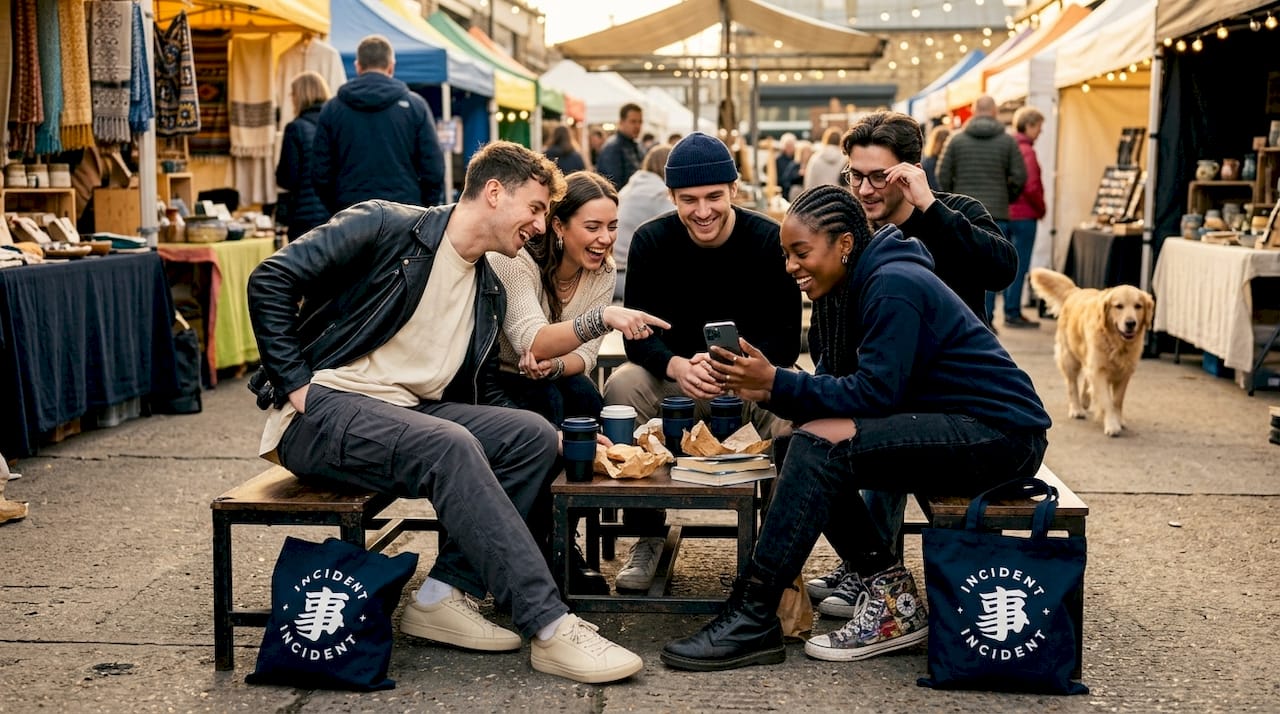
A study of 312 university students found that influencers shape fashion interest through social comparison at a statistically significant level (p < 0.001). When you scroll past someone wearing a particular aesthetic repeatedly, you begin to measure your own style against it. That comparison is not passive. It actively shapes what you want to buy, how you want to dress, and even how you feel about your current wardrobe.
The impact of fashion on teens is not gender-neutral, either. Research from a longitudinal study of 563 students in early 2026 found that female adolescents show higher appearance anxiety linked to social media addiction, with self-rumination acting as a key mediating factor. Young women are more likely to internalise social comparisons made through fashion imagery, which translates into sustained worry about appearance rather than momentary self-consciousness.
Here is how the typical digital fashion cycle works for young people today:
- Trend emergence: A creator on a short-form video platform wears something distinctive. Comments and shares amplify it rapidly.
- Social comparison activation: Viewers measure the look against their own wardrobe and aesthetic identity, often unfavourably at first.
- Interest and research: The algorithm surfaces more content around the trend. Search behaviour increases.
- Purchase or adaptation: The viewer either buys directly, thrifts a version, or adapts elements they already own to approximate the look.
- Content creation: They post their own version, becoming part of the cycle for their own followers.
What makes this particularly complex is that Gen Z increasingly values authentic self-expression over peer validation in digital fashion spaces. They are not simply copying what influencers wear. They are using digital platforms as laboratories to experiment with aesthetics before committing to them in real life.
“Social media offers Gen Z spaces for both authentic identity experimentation and pressures to conform, creating a complex dynamic that young people must consciously negotiate.” Digital empowerment vs offline tension
The other shift worth noting is the growing scepticism among young consumers. Official brand profiles and peer reviews now influence purchase decisions more than sponsored influencer posts for many Gen Z consumers. The obvious product placement, the hashtag-ad disclosure, the unnaturally lit unboxing video, young people have grown remarkably adept at filtering that out. Authenticity is not just a buzzword for this generation. It is a prerequisite for trust.
Blending global styles and local identity
Youth culture has never been more visually cross-cultural, and nowhere is this more apparent than in the global rise of Japanese streetwear. What originated in the back streets of Harajuku has spread to teenagers in Berlin, London, Seoul, and São Paulo who may never have visited Japan but feel a genuine connection to its aesthetic values.
The evolution of streetwear as a global force reflects a broader truth about how youth culture and style interact with globalisation. Young people do not adopt foreign aesthetics wholesale. They fuse them with local references, personal history, and current peer influences to create something new. Japanese streetwear has been particularly fertile ground for this because its core values, minimalism, quality, and quiet self-assurance, translate across cultural contexts without losing meaning.
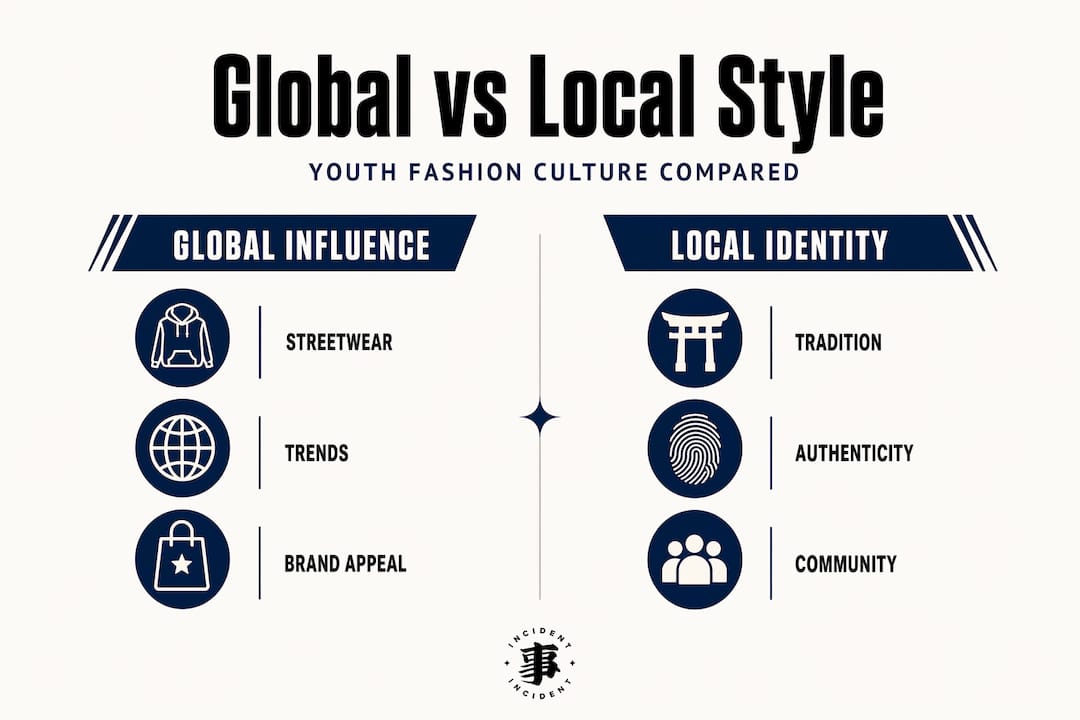
The contrast between different approaches to youth fashion reveals a great deal about what young people are actually looking for:
| Fashion approach | What it communicates | Typical trade-off |
|---|---|---|
| Fast fashion trend-following | Social currency, adaptability, current awareness | Lower quality, higher waste, risk of looking generic |
| Japanese minimalist streetwear | Aesthetic confidence, craftsmanship appreciation, individuality | Higher initial cost, requires style conviction |
| Heritage or vintage dressing | Cultural knowledge, anti-trend identity, sustainability values | Requires curation effort, can feel inaccessible |
| Subculture-specific dress | Deep group belonging, ideological alignment | Potential exclusion from outside groups |
Fast fashion plays a specific and often underestimated social function here. Rapid wardrobe renewal enables young people to maintain and refresh their social identities within fast-moving trend cycles. For teenagers without large budgets, this matters. The ability to update your look affordably is not just convenience. It is a form of social participation.
At the same time, a growing segment of young people are drawn to the opposite. The appeal of Japanese fashion aesthetics for young Europeans lies precisely in its resistance to disposability. Clean lines, premium fabrics, and restrained detail communicate something fast fashion cannot: that the person wearing it has moved beyond trend-chasing and arrived at something more considered.
Pro Tip: Building a style around a coherent aesthetic, whether Japanese minimalism, vintage workwear, or anything with a genuine visual logic, always ages better than chasing whatever appeared in your feed last Tuesday.
Psychological and social challenges in youth fashion
Understanding fashion’s significance for youth requires honest acknowledgment of its harder edges. The same forces that make clothing a powerful tool for identity and belonging can also create real distress.
Appearance anxiety among young people has intensified alongside social media use. The link between social media addiction and appearance anxiety is well-documented, with self-rumination driving the effect, particularly in young women. When your daily experience includes hundreds of curated images of peers and aspirational figures, it becomes extraordinarily difficult to assess your own appearance without measuring it against an endless external standard.
Fashion also maps social class in youth settings with uncomfortable precision. Appearance functions as a social class marker among adolescents, with footwear and clothing brands frequently used to include or exclude peers. The teenager wearing unrecognised budget trainers in a group where a particular brand carries social status knows exactly what that means. That is not a shallow concern. It is a real experience of social exclusion.
The core tensions worth being aware of include:
- Individuality versus acceptance: The desire to express a unique identity often conflicts directly with the need to belong. Most young people manage this through careful negotiation rather than choosing one side entirely.
- Authenticity versus affordability: Dressing in a way that feels genuinely you often requires either significant money or considerable thrift and patience.
- Digital image versus real-world dress: Many young people curate a fashion identity online that they cannot or do not fully replicate in daily life, creating a split self-image.
- Trend speed versus self-knowledge: When trends move at algorithmic pace, there is real pressure to adopt aesthetics before you have had time to understand whether they actually resonate with you.
Managing these pressures is not about opting out of fashion. It is about developing a clearer internal compass. Knowing why you are drawn to a particular style, rather than simply reacting to what appears on your screen, gives you considerably more agency over your own self-expression.
Practical ways to engage with fashion meaningfully
Youth fashion and self-expression work best when they are deliberate rather than reactive. Here are approaches that genuinely help:
-
Identify your aesthetic anchors. Rather than starting with trends, identify three to five consistent elements that appear across everything you genuinely like. Clean silhouettes, monochrome palettes, graphic details, whatever they are, these anchors give you a filter for evaluating new trends without losing yourself in them.
-
Practise conscious consumption. Before purchasing anything, ask whether it fits what you already have, whether you would wear it in a year, and whether you are buying it for yourself or because you saw someone else wearing it. That last question is the most revealing.
-
Explore subculture roots. Every major youth aesthetic has a history worth knowing. Harajuku streetwear did not emerge from nowhere. Understanding where a style comes from deepens your relationship with it and gives you the knowledge to wear it with genuine conviction rather than surface-level imitation.
-
Use clothing to experiment, not to perform. The most interesting dressers treat their wardrobe as an ongoing experiment rather than a performance for social media. Wear something because you want to see how it makes you feel, not just how others will react to it.
-
Balance trend awareness with personal integrity. Following trends is not shallow. Losing yourself entirely to them is. The sweet spot is absorbing what genuinely resonates and leaving the rest behind without apology. Fashion innovation between Japanese streetwear and quiet luxury shows exactly how this balance can look in practice.
My perspective on fashion and youth identity
I have spent years watching how young people interact with fashion, and one thing stands out above everything else: the teenagers and young adults who develop the most compelling personal styles are not the ones with the biggest budgets or the most followers. They are the ones who have done the internal work of figuring out what actually appeals to them versus what they think should appeal to them.
What most articles on this subject miss is the distinction between trend awareness and trend dependence. Being aware of what is happening in fashion culture is genuinely useful. It gives you raw material to work with, references to adopt or subvert, and a shared vocabulary for cultural conversation. Depending on trends for your entire sense of self is where things get precarious.
I find the influence of Japanese streetwear particularly instructive here. The core philosophy of Japandi-influenced design, restraint, quality, and a preference for longevity over novelty, directly challenges the disposable pace of mainstream youth fashion. When a young person discovers that aesthetic and commits to it, something interesting happens. They stop buying things just because they appeared on their feed. They start buying things because they genuinely speak to an internal sense of what good design looks and feels like. That is a shift from external validation to internal confidence, and it shows.
The digital world is not going away, and neither are the pressures it creates. But understanding why you dress the way you do, and what you are communicating through that, gives you something the algorithm cannot take away: genuine style on your own terms.
— Incident
Explore Incident’s Japanese streetwear collections
If what you have read here resonates, Incident exists at exactly that intersection. We design premium Japanese-inspired streetwear from our base in Switzerland, where every piece is built around clean lines, premium fabrics, and a Japandi design philosophy that values craft over noise.
Our collections are made for fashion-forward individuals who want to express something real through what they wear. Whether you are drawn to subtle kanji motifs, oversized silhouettes with architectural precision, or the kind of Pima cotton quality you can genuinely feel, you will find it here. We ship globally, with a particular focus on European customers who are discovering that Japanese aesthetics and contemporary streetwear culture belong together. Explore our full range at incident.store and find the pieces that align with how you actually want to dress.
FAQ
What is the role of fashion in youth culture?
Fashion serves as a primary tool for identity formation, social belonging, and self-expression during adolescence and young adulthood. Research shows that clothing helps young people test identities, signal group membership, and navigate social hierarchies.
How does social media affect youth fashion choices?
Social media influences youth fashion through social comparison mechanisms, with studies showing significant impact (p < 0.001) on fashion interest among young people. However, Gen Z is increasingly sceptical of sponsored content and gravitates towards authentic brand voices and peer reviews.
Why do young people follow fashion trends?
Young people follow trends partly to maintain social belonging and partly to access a shared cultural vocabulary. Fast fashion research confirms that rapid wardrobe renewal helps youth manage social identity within quickly shifting trend cycles.
Does fashion cause appearance anxiety in teenagers?
Yes. A 2026 longitudinal study of 563 students found a clear link between social media addiction and appearance anxiety in early adolescence, with the effect being stronger in young females and mediated by self-rumination.
How can teenagers use fashion for self-expression without losing individuality?
Building a personal style around consistent aesthetic anchors, practising conscious consumption, and learning the cultural roots of the styles you admire all help protect individuality while still engaging meaningfully with fashion culture.
Share:
Street style dos and don'ts for 2026
Urban style evolution guide: from streets to minimalism