

TL;DR:
- Cross-cultural fashion involves genuine dialogue and hybridization of design traditions across cultures.
- It emphasizes reciprocity, reinterpretation, and community engagement to avoid cultural appropriation.
- Respectful blending requires transparency, collaboration, and understanding of cultural significance and context.
Few topics in modern fashion spark as much confusion as cross-cultural blending. Many people assume that wearing another culture’s aesthetics is automatically problematic, while others believe any visual inspiration is fair game. Japanese streetwear sits right at the heart of this debate, offering some of the most vivid examples of both respectful exchange and careless appropriation. This article cuts through the noise, offering you a clear framework for understanding how cross-cultural fashion works, where ethical lines fall, how technology shapes production, and how to make genuinely informed choices about the garments you wear and support.
Table of Contents
- What defines cross-cultural fashion?
- Appropriation versus appreciation: Navigating ethics
- Technology and production: Translating culture into fashion
- Studying cross-cultural fashion: Methods and market adaptation
- A fresh lens: What young streetwear fans get wrong about cross-cultural blends
- Discover authentic blends: Shop Japanese streetwear with global influence
- Frequently asked questions
Key Takeaways
| Point | Details |
|---|---|
| Hybrid looks matter | Cross-cultural fashion produces unique blends by merging techniques, symbols, and aesthetics from different backgrounds. |
| Respect is essential | True appreciation requires context, collaboration, and transparent attribution to avoid accidental appropriation. |
| Technology is a translator | Modern production and innovation allow meaningful translation of cultural symbols into global fashion. |
| Market adaptation is dynamic | Research methods reveal how brands adjust cross-cultural styles for local tastes and customs. |
| Ethical blends are the future | Ethically guided cross-cultural fashion sets trends while maintaining respect for origins. |
What defines cross-cultural fashion?
Before any meaningful conversation about Japanese streetwear and global influence can happen, it helps to define the term itself with precision. Cross-cultural fashion refers to the design, adoption, and circulation of clothing ideas, techniques, symbols, and aesthetics across cultural boundaries, often producing hybrid looks rather than one culture’s style dominating another. This is a crucial distinction. It is not simply about borrowing a motif or printing a pattern onto a garment and calling it global. It is about a genuine dialogue between design traditions, production methods, and communities.
Single-culture style operates within a relatively stable set of references. A traditional Scottish tartan or a Vietnamese áo dài draws from a specific place, period, and community, carrying codes that insiders understand deeply. Cross-cultural fashion, by contrast, exists in the space between those traditions, recombining and reinterpreting elements so that new meaning emerges. Neither the source nor the destination culture remains unchanged.
Japanese streetwear is arguably the world’s most compelling case study in this process. Emerging from districts like Harajuku in the 1980s and 1990s, it absorbed American workwear, European tailoring, and traditional Japanese textile craftsmanship simultaneously, producing silhouettes and garment constructions that belonged to none of those traditions exclusively. The Harajuku streetwear revolution was not a single aesthetic moment but a continuous process of intake and reinvention.
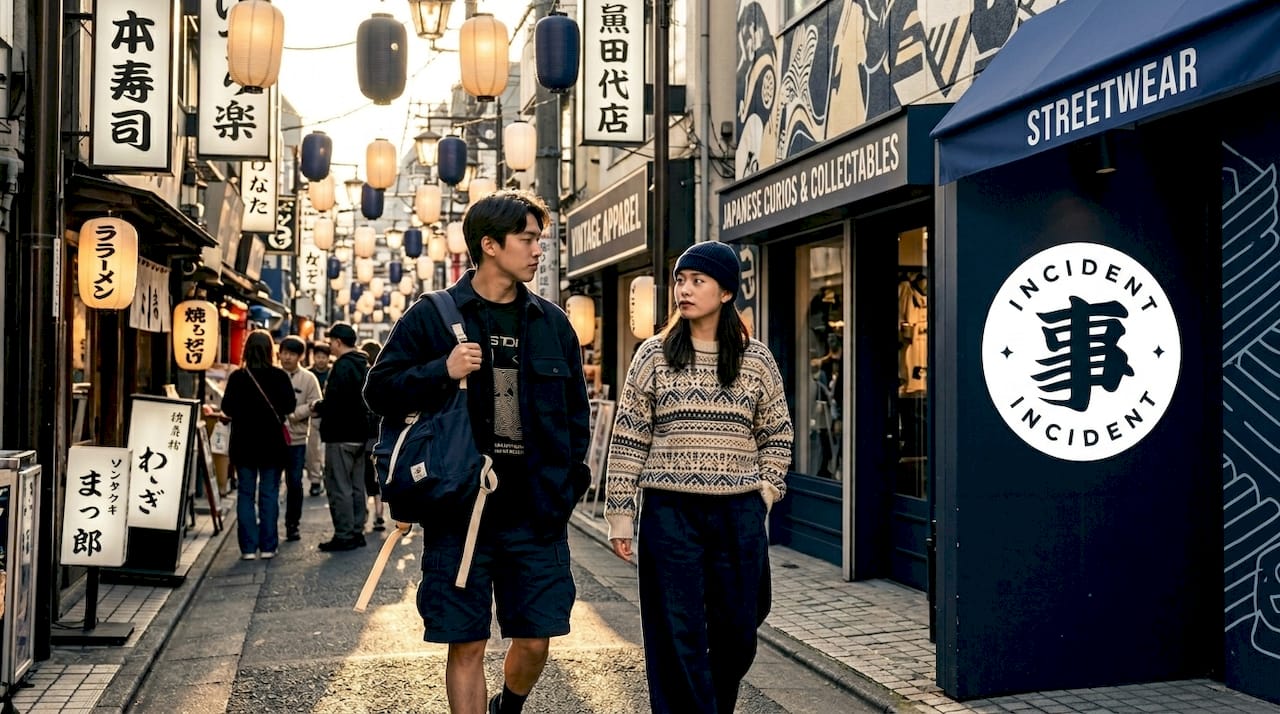
What makes this process particularly interesting is reciprocity. Western brands now draw heavily from Japanese design logic, particularly from the principle of ma (negative space) and the concept of wabi-sabi (imperfect beauty). At the same time, Japanese designers have long studied and reinterpreted Western garment architecture. This two-directional exchange is what separates genuine cross-cultural fashion from shallow imitation.
Key features of cross-cultural fashion blends include:
- Reciprocity: Both cultures contribute and are changed by the exchange
- Reinterpretation: Symbols and forms are reconstructed, not merely copied
- Community awareness: Designers engage with, rather than extract from, source communities
- Hybrid aesthetics: The result looks and functions differently from either source tradition
- Contextual meaning: Cultural codes are studied and respected, not treated as decoration
“The most powerful cross-cultural fashion does not flatten difference. It holds two or more traditions in careful tension, allowing each to remain legible while something genuinely new emerges.”
Minimalism in Japanese streetwear illustrates this beautifully. The clean lines and restrained palettes draw from both Japanese aesthetic philosophy and contemporary European minimalism, yet the result is unmistakably its own thing. It is not European fashion with Japanese colours, nor Japanese fashion in Western cuts. It is a third entity with its own logic and coherence.
Appropriation versus appreciation: Navigating ethics
Understanding what cross-cultural fashion is does not automatically resolve the ethical questions surrounding it. This is where the conversation becomes genuinely complex, and where many streetwear enthusiasts either disengage entirely or adopt overly simplistic positions. Cross-cultural fashion is strongly tied to controversies around cultural appropriation, where the key question is whether cultural elements are taken without respect, context, or attribution, or are instead remixed with reciprocity and recognition.
The distinction matters enormously, both ethically and practically. Consider two scenarios. In the first, a fashion house takes sacred patterns from an Indigenous community, places them on garments sold at luxury prices, credits no one, and pays no royalties. In the second, a Japanese-Swiss streetwear brand studies boro textile tradition (the Japanese practice of mending cloth with patches), works with Japanese fabric specialists, acknowledges the tradition openly, and produces garments that carry the spirit of the original practice into a contemporary urban context. These two examples sit at opposite ends of the ethical spectrum, yet both involve cultural crossing.
Appreciation versus appropriation turns on context, specifically knowledge, collaboration, and transparency. Cross-cultural fashion evaluation often hinges on whether source communities are credited and partnered with, and whether meaning is preserved rather than stripped away for purely commercial gain.
Here is a practical comparison to help you evaluate what you are seeing:
| Factor | Cultural appropriation | Cultural appreciation |
|---|---|---|
| Knowledge | Surface-level or absent | Deep, researched, informed |
| Collaboration | None with source community | Partnership or active engagement |
| Attribution | Omitted or vague | Clear and generous |
| Economic benefit | Flows away from source culture | Shared or returned to community |
| Meaning | Stripped or distorted | Preserved and contextualised |
| Power dynamic | Dominant culture extracts | Exchange between equals or with care |
Recognising an ethical blend in practice is a skill worth developing. Here are five steps to guide your evaluation:
- Research the brand’s creative process. Look for evidence of genuine study and community connection, not just aesthetic inspiration boards.
- Check attribution practices. Does the brand name its influences, cite its references, and acknowledge specific traditions by name?
- Follow the economic flow. Are artisans, textile communities, or cultural custodians benefiting financially from the collaboration?
- Read community responses. Members of source cultures often speak publicly about whether they feel respected or exploited.
- Look beyond visuals. A garment that looks culturally informed but was produced without any meaningful connection to the source tradition is a surface-level exercise.
When navigating streetwear culture, it also helps to have a solid grasp of streetwear terminology, because the language you use shapes how you engage with these conversations. Knowing the difference between garms, colourways, and drip is one thing, but understanding cultural references in design requires a different kind of vocabulary altogether.
Pro Tip: When you are unsure whether a brand is appreciating or appropriating, look at its communications over time rather than a single campaign. Consistent transparency, long-term partnerships, and genuine curiosity about source cultures are far more telling than a single collaboration announcement.
Technology and production: Translating culture into fashion
Most conversations about cross-cultural fashion focus on aesthetics, but the real transformation happens at the level of production. Cross-cultural translation in fashion can be analysed as a process of interpreting and reconstructing cultural symbols within the constraints of tools and production systems. This shifts the focus from surface aesthetics to how technologies and other systems interact with culture and ethics.
This insight is more practical than it might first appear. When a Japanese brand produces garments using traditional tsumugi weaving techniques on contemporary digital looms, the technology mediates the cultural content. The resulting fabric carries visual echoes of a hand-woven tradition but is produced at scale. Whether that mediation is respectful or reductive depends on how intentionally the production process was designed.
Consider the following real-world dimensions of this translation process:
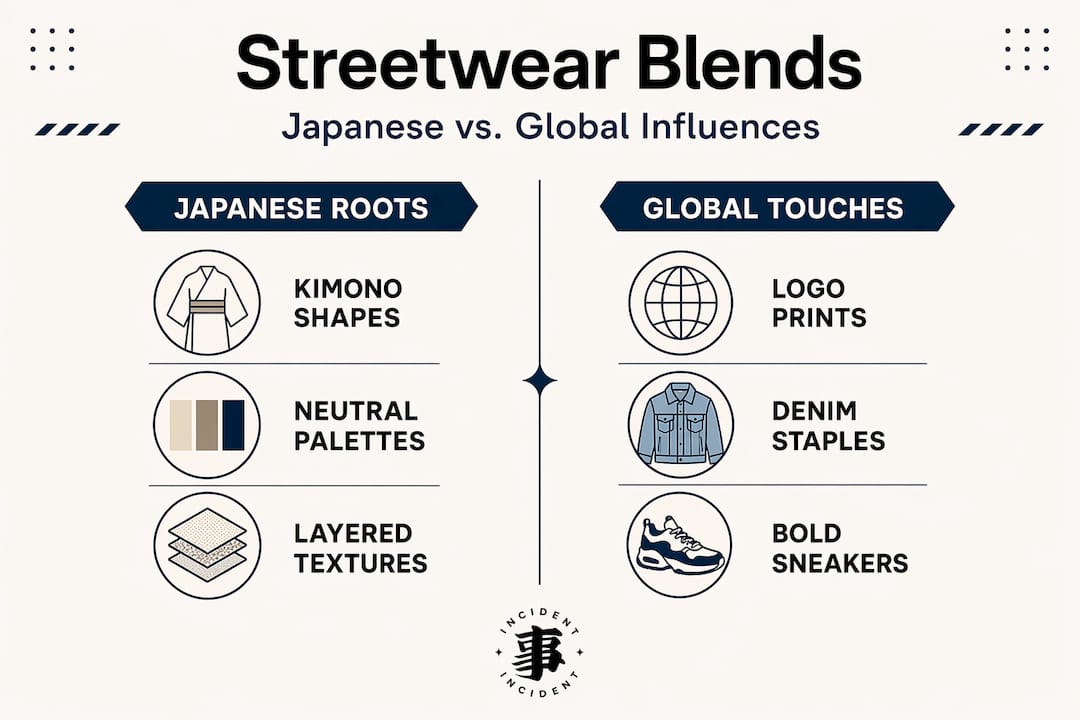
- Material selection: Japanese streetwear frequently uses premium cottons, brushed fleece, and technical fabrics that echo the precision of traditional Japanese textile craft without replicating it literally.
- Construction methods: Features like dropped shoulders, elongated hems, and oversized silhouettes reference traditional Japanese garment geometry while meeting contemporary streetwear expectations.
- Surface treatment: Techniques such as garment dyeing and enzyme washing reference the aged, patinated quality of boro textiles, translating a centuries-old aesthetic into modern production.
- Fit logic: Japanese streetwear often prioritises comfort and ease over body-conscious tailoring, a direct translation of traditional Japanese garment philosophy into urban contexts.
- Colour systems: Muted earth tones, off-whites, and deep indigos mirror both traditional shibori dyeing traditions and contemporary minimalist palettes simultaneously.
| Production element | Traditional Japanese influence | Contemporary streetwear translation |
|---|---|---|
| Fabric weight | Heavy linen, handwoven silk | Heavyweight cotton, brushed fleece |
| Silhouette | Draped, unstructured kimono shapes | Oversized, boxy streetwear cuts |
| Colour palette | Indigo, natural dyes, earthy neutrals | Washed tones, muted pastels, off-whites |
| Surface texture | Handwoven irregularity | Enzyme washing, pigment dyeing |
| Construction | Hand-stitched seams, visible repairs | Clean flatlock seams, premium finishing |
Exploring Japanese styling elements reveals how deeply these production choices shape everyday wearability. A garment is not only a visual object; it is a system of decisions about material, construction, and proportion that carries cultural meaning whether or not the wearer consciously recognises it.
Understanding minimalism and modern street fashion within this production context helps clarify why Japanese-inspired streetwear often feels distinctly different from its Western counterparts. The restraint is not aesthetic indifference; it is a deliberate philosophical position translated into cut, colour, and cloth.
Pro Tip: When you invest in a cross-cultural garment, study the fabric label and construction details. Premium stitching, thoughtful material selection, and considered proportions often signal that the production process involved genuine cultural engagement rather than quick visual extraction.
Studying cross-cultural fashion: Methods and market adaptation
Designers and researchers who work seriously with cross-cultural fashion do not rely on intuition alone. Cross-cultural fashion dynamics often involve methodological questions about how to study them. Qualitative methods such as grounded theory and semi-structured interviews, alongside localisation and glocalisation frameworks, help explain how brands adapt fashion representation for different cultural markets.
Grounded theory, in this context, means building understanding from the ground up through observation and conversation rather than applying a fixed theory from the start. A brand studying how Japanese streetwear resonates in West Africa, for example, would interview local consumers, observe styling practices, note which elements translate and which do not, and build conclusions from that real-world data rather than assuming global uniformity.
Localisation is the process of adapting a product or message for a specific market without losing its core identity. In fashion, this might mean:
- Adjusting sizing standards to reflect the body proportions common in a target market
- Selecting different colourways that resonate culturally or climatically in a region
- Adapting campaign imagery to feature models who reflect local aesthetics and identity
- Offering alternative payment methods that match financial infrastructure in a given country
- Translating not just language but cultural reference in lookbooks and editorial content
Glocalisation, a concept combining globalisation and localisation, describes the process by which a globally distributed brand adapts its approach to feel locally relevant. Japanese streetwear brands expanding into European or North American markets have consistently demonstrated this skill, maintaining the integrity of their aesthetic while adjusting proportions, fabric weights, and retail strategies to suit new contexts.
The rise of Japanese streetwear in 2026 illustrates precisely how this research-driven adaptation works in practice. The brands that endure are those that study their markets carefully and treat cross-cultural exchange as a conversation rather than a broadcast.
It is worth noting that studying cross-cultural fashion also means resisting the temptation to assume a single interpretation of any garment or aesthetic. A Japanese indigo jacket worn in Tokyo, London, and Lagos carries different social meanings in each city. Effective research acknowledges those differences rather than flattening them.
Pro Tip: If you follow a brand that operates across multiple markets, pay attention to how it communicates in each region. Brands that localise genuinely, using different models, different references, and different storytelling approaches, tend to have a more authentic relationship with their diverse audiences than those who simply translate a single campaign into multiple languages.
A fresh lens: What young streetwear fans get wrong about cross-cultural blends
Here is an uncomfortable truth we have observed across years of working at the intersection of Japanese aesthetics and global streetwear: most people think cross-cultural fashion is primarily a visual practice. They believe it is about combining silhouettes, mixing pattern traditions, or pairing a kimono sleeve with a Western trouser cut. It is not. At its core, cross-cultural fashion is a practice of dialogue, and dialogue requires listening.
The streetwear community, for all its energy and creativity, often reduces this to aesthetics. A brand drops a collection with Japanese kanji on the chest and calls it culturally inspired. Another releases indigo-dyed garments with no reference to the shibori tradition that gave indigo dyeing its depth and complexity. These are not blends. They are extractions dressed up as collaboration, and they flatten the richness of the traditions they borrow from.
What genuinely respectful cross-cultural fashion requires is transparency about process, not just outcome. It means showing your workings. It means naming your influences, crediting the communities and artisans who shaped your design thinking, and being honest about the limits of your knowledge. It means building streetwear evolution and global impact into your brand narrative as a living conversation rather than a static mood board.
We also think there is a dangerous misconception that appreciation and appropriation are fixed categories. They are not. A brand can begin with genuine appreciation and drift into appropriation if it stops engaging, stops crediting, and stops listening. Equally, a brand that initially stumbles can course-correct through transparency and genuine community engagement. The category is not determined once and permanently. It is determined by ongoing practice.
What we encourage, from our own experience designing at the intersection of Swiss precision and Japanese aesthetic philosophy, is that cross-cultural fashion works best when it is built on deep respect rather than trend-chasing. When we draw from Japanese design tradition, we do it because we have studied it carefully, because we believe in what it stands for, and because we want to carry its values forward into contemporary garments. That is very different from reaching for Japanese references because they happen to be fashionable this season.
The most meaningful cross-cultural garments are not the loudest or the most visually complex. They are the ones that hold their cultural references with confidence and restraint, allowing the dialogue to exist in the quality of the cloth, the logic of the cut, and the intention behind the design. That is the standard we hold ourselves to, and it is the standard we would encourage you to seek in any brand you choose to support.
Discover authentic blends: Shop Japanese streetwear with global influence
If this exploration of cross-cultural fashion has sparked your curiosity, we invite you to experience what thoughtful blending looks and feels like in practice. At INCIDENT Clothing, every piece we create is rooted in genuine engagement with Japanese aesthetic philosophy and contemporary streetwear culture, not as a passing trend but as a long-term design commitment.

Our Pima collection showcases what happens when premium materials meet considered design. Ultra-soft Pima cotton garments carry the quiet confidence of Japanese minimalism while offering the comfort and versatility that global streetwear demands. Each piece is designed for the kind of wearer who values substance over spectacle, heritage over hype. Visit our online store to explore our full range of Japanese-inspired streetwear, crafted with care and offered globally to those who appreciate the intersection of tradition and contemporary urban style.
Frequently asked questions
How does cross-cultural fashion impact streetwear trends globally?
Cross-cultural fashion enables streetwear to evolve rapidly by blending diverse aesthetics, making global collections far more dynamic and innovative. As hybrid looks emerge from the circulation of ideas across cultural boundaries, no single tradition dominates, keeping the entire field creatively alive.
How can I tell if a fashion brand is appreciating or appropriating culture?
Check for transparency, collaboration with source communities, and attribution, because brands that educate, credit, and partner are more likely to appreciate than appropriate. Appreciation turns on context, specifically knowledge, collaboration, and transparency, all of which are visible in a brand’s long-term communications.
Do technologies change how cross-cultural fashion is produced?
Yes, modern tools and production systems reinterpret cultural symbols, making blends possible while also shifting how meaning is translated for different markets. Cultural symbols are reconstructed within the constraints of specific production technologies, which means the choice of tools is itself an ethical and cultural decision.
Why is Japanese streetwear so influential worldwide?
Japanese streetwear blends traditional motifs with modern urban logic, offering unique designs that appeal to diverse audiences across very different cultural contexts. Its hybrid aesthetic approach sets global trends precisely because it is neither purely Japanese nor purely Western, giving it a universally legible freshness.
What research methods are used to study cross-cultural fashion?
Researchers use structured interviews, grounded theory, and localisation frameworks to analyse how fashion meaning changes across international markets. Qualitative methods and glocalisation frameworks are particularly well-suited to capturing the nuanced ways in which a single garment or aesthetic can carry different meanings in different communities.



Share:
Master Japanese-inspired colour palettes for effortless style
Top 4 haikyuu-merchandise.com Alternatives 2026