

TL;DR:
- Japanese calligraphy, or shodō, integrates into streetwear through various techniques, emphasizing authenticity and cultural depth. Wearing calligraphy signifies more than fashion, reflecting Zen principles, personal values, and a connection to tradition. Authentic pieces prioritize craftsmanship and meaningful symbols, resonating especially with European youth seeking subtle, intentional style.
The real impact of Japanese calligraphy in streetwear
Most people assume streetwear is built on bold logos, oversized graphics, and loud colourways. Yet one of the most quietly powerful forces shaping contemporary fashion right now is something far older and far more intentional. Japanese calligraphy, known as shodō, is woven into the fabric of modern streetwear in ways that go well beyond surface decoration. Shodō integrates into clothing through printed, embroidered, or hand-brushed kanji characters and brushstroke motifs on t-shirts, hoodies, and jackets. For fashion-forward individuals across Europe, this shift carries genuine cultural weight. In this guide, we unpack how calligraphy shapes clothing design, what these motifs actually mean, where the real debates lie, and how you can bring this aesthetic into your wardrobe with confidence and intention.
Table of Contents
- How Japanese calligraphy shapes contemporary clothing
- Philosophy woven into fabric: The deeper meaning of shodō
- Authenticity versus modern trends: Debates and nuances
- How to style and select calligraphy fashion
- What most guides miss: Why meaning matters more than trends
- Find authentic Japanese calligraphy streetwear
- Frequently asked questions
Key Takeaways
| Point | Details |
|---|---|
| Deeper meaning in fashion | Japanese calligraphy transforms clothing into wearable art rich with philosophy and identity. |
| Look for authenticity | Hand-brushed or artist-endorsed pieces provide genuine cultural value over mass-printed designs. |
| Modern and timeless style | Minimalist kanji graphics bring subtle individuality to streetwear, blending East and West. |
| Knowledge empowers selection | Understanding techniques and philosophy guides smarter fashion choices beyond trends. |
How Japanese calligraphy shapes contemporary clothing
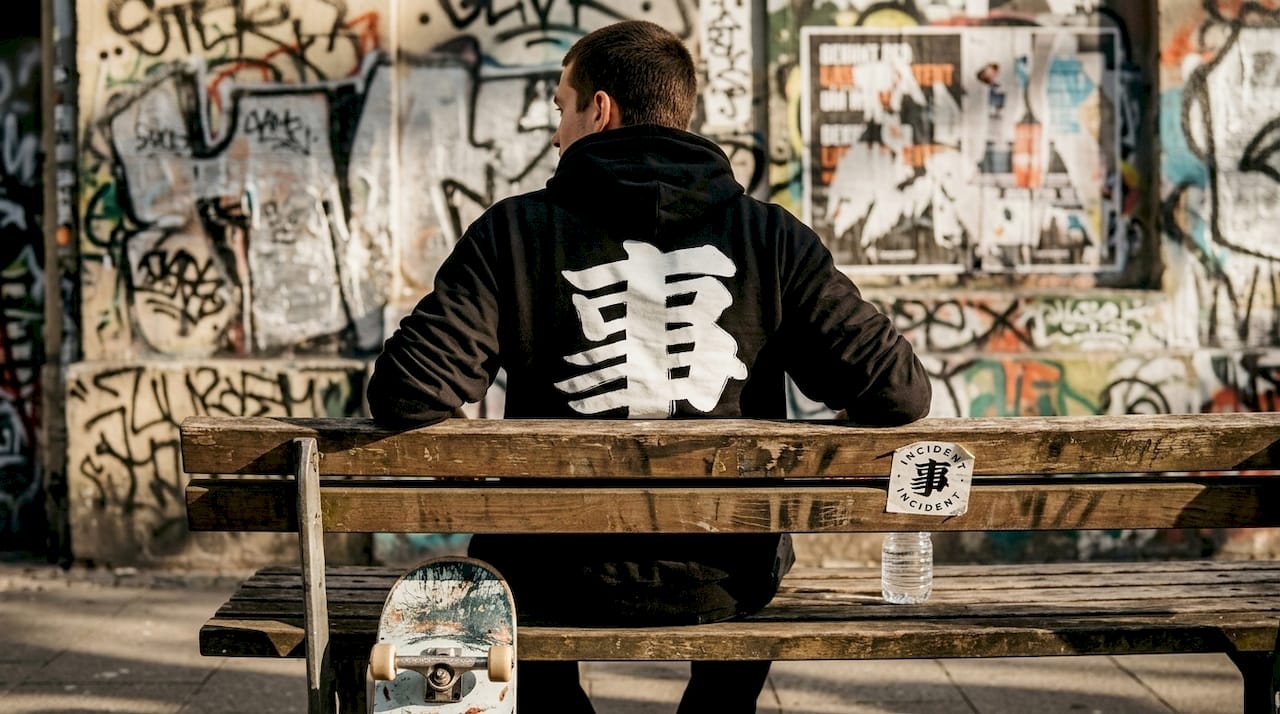
When you spot kanji on a hoodie or a single brushstroke across the back of a jacket, you are seeing the result of a design process that draws from one of Japan’s most respected art forms. The way calligraphy appears on clothing varies enormously depending on the technique, and each method carries its own visual character and level of authenticity.
The main techniques you will encounter
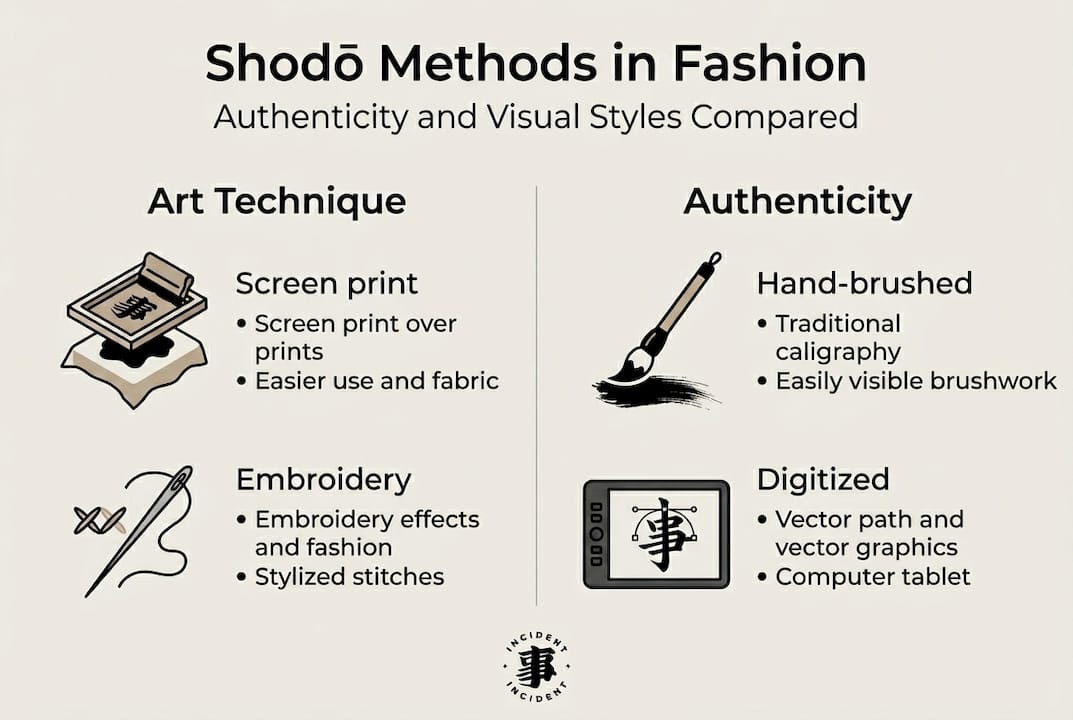
The four most common methods for integrating shodō into garments are screen printing, embroidery, hand-brushing, and devoré fabric processes. Screen printing offers consistency and scale, making it the most commercially viable option for large drops. Embroidery lifts characters off the fabric surface and adds a tactile quality that catches light and shadow differently at every angle. Hand-brushing, where a trained calligrapher works directly onto the fabric or a master artwork later transferred to garments, preserves the living quality of the original stroke. Devoré is a more specialised technique that burns away fibres to reveal a pattern, creating a ghostly, semi-transparent calligraphic form.
Each method results in a completely different relationship between the wearer and the character. A hand-brushed stroke carries irregularity that digital tools simply cannot replicate. That imperfection is, paradoxically, the point.
Popular motifs and what drives their appeal
Japanese calligraphy in streetwear tends to centre on single kanji with strong conceptual meaning, short philosophical phrases, and abstract brushstroke patterns that hint at the written form without being fully legible. Single-character designs are particularly popular because they communicate instantly and carry enormous weight in very little space. A single kanji can mean strength, harmony, or dream, and wearing it feels closer to carrying a talisman than displaying a logo.
Brushstroke patterns that do not form readable characters are also gaining ground in European streetwear circles. These pieces allow wearers to engage with the visual language of shodō without needing to understand Japanese, which raises interesting questions about interpretation that we will explore later.
Brands leading the way
Sustained global interest in Japanese-inspired apparel is evident in the 2025 to 2026 streetwear landscape, with labels like BAPE, New Era, and SHINYAKOZUKA bringing kanji logos and wordplay prints to global audiences. BAPE has long used Japanese script as part of its visual identity, integrating it into capsule pieces that blur the line between streetwear collectible and wearable art. New Era’s kanji-embroidered headwear has found a devoted following across Europe, particularly in markets like France, Germany, and the UK. SHINYAKOZUKA takes a more conceptual approach, using wordplay and typographic experimentation that challenges the boundary between calligraphy and graphic design.
For those exploring Japanese graphic tee styles, the variety of approaches on offer makes it possible to find pieces that feel genuinely aligned with your personal aesthetic, whether you prefer stark minimalism or layered graphic complexity.
Comparison of calligraphy techniques on streetwear
| Technique | Authenticity level | Visual character | Best suited for |
|---|---|---|---|
| Screen printing | Moderate | Clean, consistent | Large production runs |
| Embroidery | High | Textured, dimensional | Premium streetwear pieces |
| Hand-brushing | Very high | Irregular, living quality | Limited editions, collector pieces |
| Devoré | Specialist | Ghostly, semi-transparent | Avant-garde, editorial fashion |
For those who want the most direct connection to the art form, kanji motif hoodies crafted with genuine attention to brushstroke detail offer the closest experience to wearing a piece of living calligraphy.
Philosophy woven into fabric: The deeper meaning of shodō
Once you understand how calligraphy appears on clothing, the next question becomes why it resonates so deeply. The answer lies not in aesthetics alone but in the philosophical tradition that shodō carries within it.
What shodō actually means
Shodō embodies Zen philosophy including presence, impermanence through the concept of ichigo ichie, life energy known as ki, and wabi-sabi beauty in imperfection. These are not abstract concepts layered onto an art form. They are the art form. A skilled calligrapher does not simply write a character. They enter a state of focused presence, allow the ki to flow through the brush, and produce something that cannot be exactly repeated. The resulting stroke holds that moment in time.
This philosophy translates directly to clothing in a way that most Western fashion traditions cannot match. When you wear a piece bearing a hand-brushed kanji, you are wearing a moment. That is a radically different proposition from wearing a screen-printed logo.
The weight of individual kanji
Specific kanji carry enormous symbolic power. Common choices in streetwear include:
- 和 (wa) meaning harmony, a concept central to Japanese social and aesthetic values
- 夢 (yume) meaning dream, expressing aspiration and inner vision
- 工 (kou) meaning craft or construction, speaking directly to the maker’s spirit
- 力 (chikara) meaning strength or power, a popular choice for its direct energy
- 風 (kaze) meaning wind, evoking movement, freedom, and impermanence
When kanji convey these deep meanings, clothing becomes a vehicle for identity expression that goes well beyond branding. You are not displaying what brand you belong to. You are declaring what you value.
Why European youth connect so strongly
“Shodō in streetwear offers authentic cultural depth, allowing subtle expression of Japanese Zen aesthetics amid urban life, prioritising quality over logos unlike Western streetwear.” This captures precisely why the movement resonates so powerfully with fashion-forward individuals aged 18 to 35 across Europe.
Streetwear with shodō influence offers something that logo-heavy Western fashion does not. It rewards the curious. Someone who understands the kanji on your jacket sees something different from someone who simply appreciates the brushstroke as a graphic element. That layered experience, where a piece can communicate on multiple levels simultaneously, is rare and genuinely compelling.
The contrast with conventional Western streetwear branding is sharp. Where much of mainstream streetwear shouts for attention, shodō-influenced fashion speaks quietly. It invites a second look rather than demanding a first. For European youth navigating an oversaturated visual culture, that restraint feels genuinely radical.
Exploring the roots of this movement through Harajuku streetwear philosophy reveals how deeply Japanese street culture has always prized individuality expressed through subtlety rather than spectacle. Understanding the Japanese fashion icons who shaped this sensibility gives further context to why calligraphy feels so at home in contemporary street fashion.
Authenticity versus modern trends: Debates and nuances
Not everyone agrees that calligraphy belongs on a mass-produced hoodie. This is where the conversation becomes genuinely interesting and where critical thinking serves you best as a consumer.
The core tension
True shodō demands irreversible brush strokes reflecting the calligrapher’s mental state at the moment of creation. This is not ornamental. It is a meditative discipline, a way of being. When that same character is digitised, standardised, and reproduced thousands of times on identical garments, something is inevitably lost. The debate is about what exactly is lost and whether that loss matters.
Traditional practitioners argue that removing the irreversibility and uniqueness from the process strips shodō of its essential meaning. The value is not in the character itself but in the act and the moment of its creation. A perfectly reproduced digital version of a master calligrapher’s work is, in this view, a sophisticated copy of something that was fundamentally unrepeatable.
StreetWear innovators and designers take a different position. They argue that bringing calligraphic forms to wider audiences vitalises the tradition rather than diminishing it. When millions of young people in Berlin, Paris, and Amsterdam engage with kanji for the first time through a hoodie, that curiosity can lead them toward genuine cultural learning.
The risk of cultural dilution
Handmade uniqueness per garment contrasts sharply with mass-printed replicas, and the risk of cultural dilution is real when digitised without nuance. This happens most visibly when kanji are selected purely for their visual appeal without any understanding of their meaning, sometimes resulting in garments bearing deeply inappropriate or simply nonsensical characters.
This is not a hypothetical concern. There are well-documented examples of Western fashion brands using kanji that, when read by Japanese speakers, communicate something entirely unintended by the designer. The embarrassment is mutual and avoidable.
What to look for as a discerning buyer
When assessing a piece that uses calligraphic design, consider the following:
- Is there any documentation of who created the original artwork?
- Are the brushstrokes visibly irregular in a way that suggests human origin?
- Does the brand provide any information about the meaning of the characters used?
- Is the technique screen printing or something that requires more craft investment?
- Does the overall design feel considered, or does it feel like calligraphy was applied as an afterthought?
For those exploring the Japanese streetwear market across Europe, researching Japanese streetwear shopping tips can help you identify brands and retailers that take these questions seriously.
Pro Tip: Before purchasing a calligraphy piece, look for brands that openly credit their calligraphers or provide details about the hand-brushing process. Limited edition pieces with documented provenance hold their value longer and carry far more personal meaning than mass-produced alternatives.
How to style and select calligraphy fashion
With a clearer understanding of what makes calligraphy clothing meaningful and how to assess its authenticity, you are ready to think practically about building this aesthetic into your wardrobe.
Choosing pieces with genuine meaning
-
Research the characters before you buy. If a garment features kanji, spend two minutes confirming what those characters mean. Resources online make this straightforward. A piece bearing the kanji for harmony or craft tells a different story than one bearing a character chosen purely because it looked visually strong.
-
Consider the placement and scale. A single small kanji on a chest pocket feels contemplative and understated. A large brushstroke across the back of a jacket makes a bolder statement. Neither is wrong, but the choice should be intentional. Scale and placement are part of the design language.
-
Assess the fabric quality alongside the print. The best calligraphy-inspired pieces are designed as complete objects. The fabric, the cut, and the character work together. If the fabric feels like an afterthought, the piece probably is.
-
Prioritise limited editions and smaller runs. The closer a piece is to a genuinely hand-crafted or hand-supervised origin, the more it rewards long-term wear and appreciation.
-
Consider the cultural sourcing. Brands with genuine connections to Japanese design culture and craft traditions are better positioned to handle this aesthetic responsibly. This matters both ethically and aesthetically.
Styling calligraphy pieces for European wardrobes
Young Europeans adopting Japanese streetwear for singularity without ostentation gravitate toward Harajuku-inspired minimalist designs, and the styling instinct here is sound. Calligraphy pieces work best when given space to breathe. Pair a kanji graphic tee with simple wide-leg trousers and clean sneakers rather than layering it beneath multiple competing graphics.
The Japandi principle, blending Japanese minimalism with Scandinavian functionality, translates beautifully into styling. Neutral palettes, natural materials, and considered silhouettes let the calligraphic element carry its full weight without visual competition. For minimalist graphic tee picks, the principle is always to let the character breathe.
Mixing calligraphy pieces with Western streetwear is also achievable without losing the aesthetic coherence. A relaxed kanji hoodie worn over simple straight-cut denim with white rubber-soled shoes creates a hybrid look that feels culturally fluent rather than costume-like. The key is restraint. One statement piece per outfit is enough.
For a slightly more elevated approach, Japanese oversized tees layered under an open technical jacket create a contemporary silhouette that balances Eastern and Western design references without forcing either.
Pro Tip: When building a calligraphy-informed wardrobe, start with one hero piece that genuinely resonates with you in terms of meaning and technique. Build outfits around it rather than accumulating multiple calligraphy pieces at once. A single well-chosen garment communicates far more than several competing ones.
What most guides miss: Why meaning matters more than trends
Most articles about Japanese calligraphy in streetwear treat it as a trend to observe or a look to achieve. We think that misses the point entirely.
Traditionalists see shodō as spiritual discipline, while streetwear innovators recontextualise it as a dynamic motif bridging past and present, vitalising ancient art in wearable form. Both perspectives are right, and holding them simultaneously is what separates a genuinely engaged wearer from someone who simply bought what looked good on the rack.
The pieces from your wardrobe that you return to across years and decades are never the ones that were on-trend at the time of purchase. They are the ones that meant something. A garment bearing a kanji that reflects something you genuinely value, crafted with visible care and intention, becomes part of your personal narrative in a way that a logo-heavy hype piece simply cannot.
This matters especially for European streetwear culture right now. The appetite for something more considered than seasonal trend-chasing is growing. Shodō-inspired fashion offers a way to engage with aesthetics that have centuries of intellectual and spiritual development behind them. The Japanese fashion icons who shaped global style understood this. They built not just looks but philosophies, and the clothing expressed the philosophy rather than replaced it.
Our honest view is this: if you find yourself drawn to calligraphy in fashion, follow that curiosity beyond the garment. Learn what the characters mean. Read about shodō as a practice. Understand wabi-sabi not as an aesthetic trend but as a way of engaging with imperfection and time. That depth of engagement will transform how you select, wear, and care for these pieces, and it will show.
Authenticity in streetwear is never really about the garment alone. It is about the relationship between the wearer and what they choose to carry.
Find authentic Japanese calligraphy streetwear
If this guide has deepened your appreciation for the artistry and intention behind calligraphy-informed clothing, the next step is finding pieces that live up to that standard.
At INCIDENT, we design with precisely this philosophy in mind. Our garments draw from Japanese craft traditions, prioritising clean lines, considered motifs, and premium fabrics that honour the aesthetic without overcrowding it. Every piece in our range is created to be worn with intention, not just noticed. If you are ready to invest in clothing that rewards attention and carries genuine meaning, explore our Pima T-shirt collection for pieces that embody the quiet confidence of Japanese-inspired streetwear. We are always available if you have questions about our design process or want guidance on finding the right piece for your wardrobe.
Frequently asked questions
What is the difference between Japanese calligraphy and decorative fonts on clothing?
Japanese calligraphy involves hand-brushed design preserving human irregularity and vitality, while decorative fonts are digitally generated and carry none of the energy, intention, or cultural depth of authentic brushwork.
What do the most common kanji mean on streetwear?
The most popular choices convey meanings like harmony (和), dream (夢), or craft (工), each expressing a distinct philosophical or personal value that turns the garment into a form of identity statement.
How can I tell if calligraphy on a shirt is authentic?
Authentic calligraphy shows handmade uniqueness per garment through visible brushstroke variation and irregularity, often accompanied by documentation crediting a specific calligrapher or describing a hand-brushing process.
Why do many European youth prefer minimalist kanji designs over big logos?
Minimalist kanji offer a way to express identity without ostentation, providing cultural depth and singularity that oversized logos cannot match for those who value substance over spectacle.


Share:
Japandi style: minimalism meets comfort and quiet luxury
How premium fabrics shape fashion quality and streetwear